Julia Child ate her first meal in France on November 3rd, 1948, at a restaurant in Rouen called La Couronne, which claims to be the oldest inn in France, operating since 1345. She ordered sole meunière. The fish arrived perfectly browned in butter, its sauce glossy and nutty and lemon-bright, and Julia Child — at that point a 36-year-old former OSS officer who had grown up eating what she described as “pedestrian” American food — experienced what she later called a life-altering moment. She cried. She ordered a second sole meunière. Then she ordered steak au poivre.
This is the dish that helped convert Julia Child to French cooking. Given what French cooking subsequently became in American kitchens — given the entire trajectory of American food culture in the second half of the 20th century — that steak au poivre at La Couronne carries a certain historical weight.
The Paris Bistro and Its Signature Dish
Steak au poivre is a Paris bistro dish in the same way that boeuf bourguignon is a Burgundy farmhouse dish — it is inseparable from its context, from the specific type of restaurant that invented and perfected it, and from the culture that produced both the dish and the restaurant.
The Paris bistro is a particular institution: smaller and less formal than a brasserie, more neighborhood-focused than a restaurant, serving classic French dishes that have not changed since the establishment opened and will not change until it closes. The zinc bar, the paper tablecloths, the handwritten daily specials, the carafe of house red — these are not aesthetic choices. They are the functional requirements of a type of eating place that exists to serve the surrounding neighborhood efficiently and deliciously at a price that makes daily patronage possible.
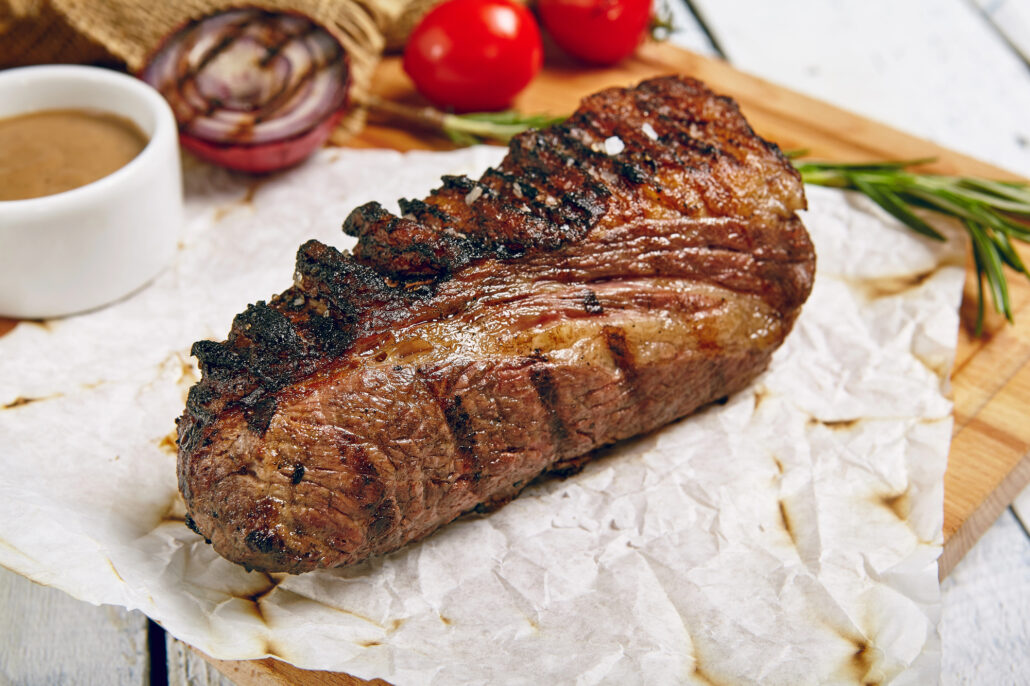
Steak au poivre — steak coated in cracked black pepper, seared hard in butter, finished with cognac and cream — is the perfect bistro dish because it takes about twelve minutes from pan to plate, uses a single skillet, requires no exotic ingredients, and produces a result that is dramatically more impressive than its simplicity suggests. The pepper crust that forms on the exterior of the steak during the sear is at once a spice coating, a textural element, and the foundation of the pan sauce. Nothing about it is accidental.
In Paris the dish appears on virtually every traditional bistro menu. Le Relais de l’Entrecôte on the Rue Saint-Benoît serves nothing but steak frites and steak au poivre and has a line out the door for both lunch and dinner service every day of the week. Café de Flore in Saint-Germain-des-Prés has served steak au poivre to writers and philosophers since the 1880s. The version varies slightly from kitchen to kitchen — some use green peppercorns instead of black, some deglaze with Armagnac rather than cognac, some add Dijon to the cream sauce — but the fundamental technique is consistent across all of them.
Julia Child’s Approach
Julia Child’s version follows the classic Paris bistro method with her characteristic thoroughness — explaining not just what to do but why each step matters and what can go wrong if you deviate. Her emphasis on properly cracking (not grinding) the peppercorns, on the temperature of the pan for the sear, and on the specific technique for flambéing the cognac safely are all worth taking seriously.
The peppercorn crack is important. You want coarsely cracked black pepper — pieces roughly the size of a quarter grain of rice — not finely ground and not whole peppercorns. The coarse crack creates the texture of the crust and releases the pepper’s volatile compounds in a way that fine grinding dissipates and whole peppercorns cannot achieve. The best method is a mortar and pestle or the bottom of a heavy pan on a cutting board. A pepper grinder set to its coarsest setting works in a pinch but produces less consistent results.
The flambé is not showmanship. Adding cognac to a very hot pan and igniting it burns off the alcohol while retaining the cognac’s fruit and oak flavor, producing a pan sauce with more complexity than simply reducing the cognac without flaming. Julia Child flambéed her steak au poivre every time and so should you. Tilt the pan slightly away from you, add the cognac, ignite with a long match or by tilting toward the gas flame. The flames subside in about thirty seconds. This is not dangerous if you do it attentively.
The Recipe
Ingredients (serves 2)
- 2 strip steaks or filets, about 1 inch thick, at room temperature
- 2 tablespoons black peppercorns, coarsely cracked
- 1 teaspoon kosher salt
- 2 tablespoons unsalted butter
- 1 tablespoon vegetable oil
- 3 tablespoons cognac or Armagnac
- ½ cup heavy cream
- 1 teaspoon Dijon mustard (optional)
- Fresh flat-leaf parsley, chopped, to finish
Instructions
Prepare the steaks. At least 30 minutes before cooking, remove the steaks from the refrigerator and let them come to room temperature. Pat completely dry with paper towels — moisture is the enemy of a proper sear. Press the cracked peppercorns firmly into both sides of each steak, pressing with the heel of your hand to embed them in the meat. Season with salt.
Sear the steaks. Heat a heavy skillet — cast iron is ideal — over high heat until smoking. Add the butter and oil together — the oil raises the smoke point of the butter. Add the steaks and do not move them. Sear for 3 to 4 minutes on the first side until a deeply browned crust forms. Flip and sear for 2 to 3 minutes on the second side for medium-rare. Remove the steaks to a warm plate and tent loosely with foil. The steaks will continue to cook slightly as they rest.
Make the pan sauce. Reduce heat to medium. The pan will have dark, fragrant bits on the bottom and rendered pepper — this is your flavor base. Add the cognac carefully. Tilt the pan or use a long match to ignite. The flames will subside in about 30 seconds. Once the flames die, add the heavy cream and Dijon if using, scraping up all the browned bits from the pan. Simmer over medium heat until the sauce has reduced to a consistency that coats the back of a spoon, about 3 to 4 minutes. Taste and adjust seasoning.
Serve immediately. Place each steak on a warm plate. Pour the pan sauce over and around. Finish with chopped parsley. Serve with French fries — pommes frites, thin and twice-fried — or with a simple green salad. In Paris a bistro would serve this with a carafe of Côtes du Rhône. At home any medium-bodied red will do.
Where to Eat Steak au Poivre in Paris
The bistros that do steak au poivre best in Paris are the ones that have been doing it longest. Le Relais de l’Entrecôte near Saint-Germain-des-Prés requires no reservation — the line moves quickly and the formula is simple. Brasserie Lipp on the Boulevard Saint-Germain has served classic bistro food to the literary and political classes of Paris since 1880. Chez Georges near the Palais Royal is one of the last surviving examples of the old Paris bistro in its unmodernized form — formica tables, paper tablecloths, waitresses in black aprons who have been there since before you were born.
The experience of eating steak au poivre in a Paris bistro — the specific pleasure of a dish you know well, made better than you have ever had it, in the city that invented it — is one of the reliable travel pleasures that Paris continues to deliver even as everything around it changes. The bistros that have been making this dish for fifty or a hundred years are doing it correctly. Trust them.
For everything you need to plan a Paris trip and beyond see our complete France itinerary and our Paris food guide. For more classic French recipes see our Croque Monsieur and our Anthony Bourdain Boeuf Bourguignon.

Ingredients
Method
- Preparation:
- Pat steaks dry and allow to come to room temperature while you prepare the peppercorns.
- Place the ground peppercorns in a medium skillet with the 4 tablespoons of oil and heat it over medium-low temperature about five minutes, until you can smell the peppercorns infusing their essential oils into the olive oil. Remove this mixture to a measuring cup or small bowl, add the tablespoon salt and mix well. Wipe the skillet out well with a paper towel.
- Coat both sides of the steaks with the peppercorn mixture. In the skillet, heat the butter and the other tablespoon of olive oil over moderate-high heat until hot, just until it starts smoking, then sear the steaks for 4 minutes (3 – 3½ minutes for thinner steaks) on each side for medium rare. Transfer steaks to serving plates.
- Pour off excess fat from the skillet and add the cream and Cognac. Boil the mixture, scraping up browned bits, until the sauce thickens and coats back of spoon, about 1 minute. Season the sauce with salt and spoon over steaks.
- Serve with pommes frites, a nice salad and crusty bread.