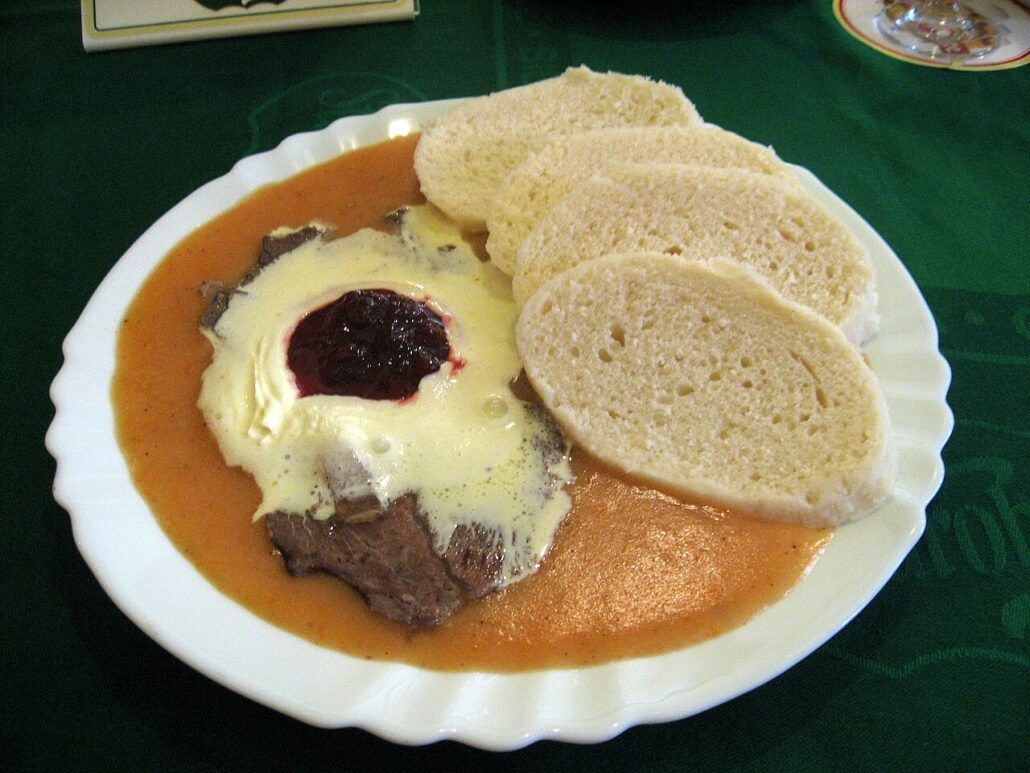
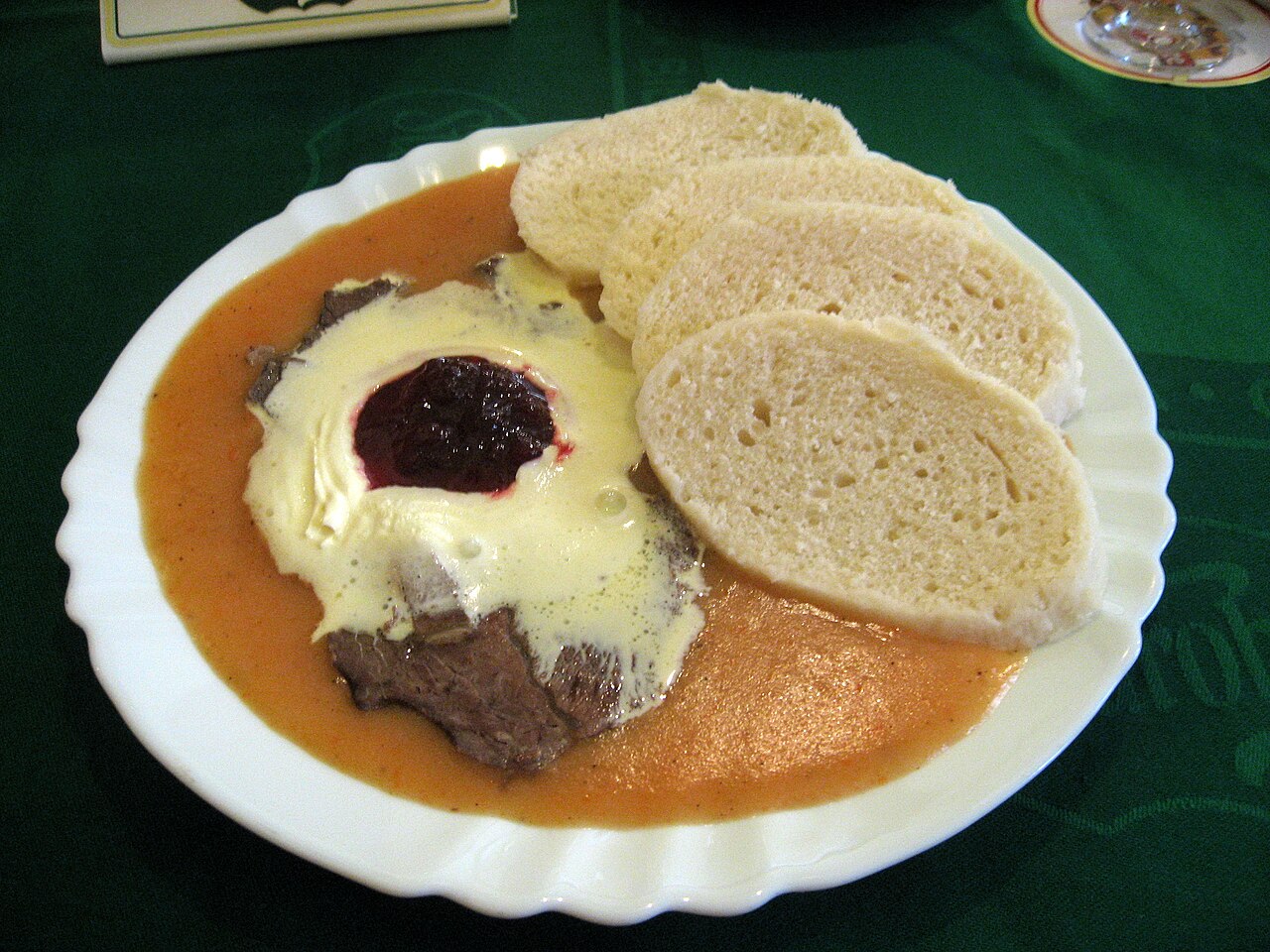
Svíčková na smetaně — beef sirloin in cream sauce — is the dish that Czech people eat when they want to feel at home and the one that visitors to Prague encounter at every traditional Czech restaurant alongside the svíčková’s closest competitor for the title of Czech national dish, the duck with red cabbage and dumplings. Where the duck is more obviously celebratory, svíčková is everyday comfort elevated to the point where it becomes something worth traveling to eat — the combination of slow-braised beef, root vegetable cream sauce, bread dumplings, cranberry compote, and a dollop of whipped cream that makes the dish look strange to anyone who has not encountered it and extraordinary to anyone who has.
The whipped cream on top is not a mistake and it is not optional. It is the specific Czech touch that integrates the slight sweetness of the root vegetable sauce with the acidity of the lemon slice and the cranberry compote in a way that no rational description quite prepares you for. It works. It has been working in Bohemian kitchens for at least two centuries. Trust the whipped cream.
Svíčková and Czech Food Culture
Czech food culture is one of the most underrated in Central Europe — a cuisine of extraordinary comfort and considerable technical interest that receives a fraction of the international attention given to French or Italian cooking while sharing certain qualities with both. The long-braised meat preparations of Czech cooking, the knedlíky (bread dumplings) that absorb the sauces, the preserved and fermented vegetables that balance the richness — these reflect a central European peasant and bourgeois cooking tradition that developed in the same region as Austrian Schnitzel and Hungarian goulash but maintained its own distinct character.
Svíčková is eaten throughout the Czech Republic but it is most associated with Bohemia — the western region of which Prague is the capital — and most perfectly expressed in the restaurants of Prague’s old town and in the homes of Czech families who have been making it the same way for generations. The recipe is one that every Czech cook has from their mother or grandmother and that every Czech cook believes their family version to be the definitive one. The variation between recipes is mostly in the composition of the root vegetables in the sauce — the ratio of carrot to celeriac to parsnip — and in the amount of cream, which ranges from austere to frankly indulgent depending on the cook.
Eating svíčková in Prague at a traditional Czech hospoda — the pub-restaurant format that is the most authentic venue for Czech food — is one of the most satisfying restaurant experiences available in Central Europe. The combination of the dish with a half-litre of Pilsner Urquell at a communal wooden table, surrounded by Czech regulars eating the same thing, is exactly the kind of food travel moment that makes going to specific places to eat specific things worthwhile. U Fleků in the Nové Město neighborhood — a brewpub operating since 1499 — serves svíčková in the setting that best expresses the Czech food and beer culture simultaneously. Lokál, with multiple Prague locations, serves the most consistently excellent svíčková in the city at prices that reflect food costs rather than tourist location.
For more on what to eat beyond svíčková see our Český Krumlov guide and our Olomouc guide for the full Czech Republic food picture.
The Knedlíky: The Essential Accompaniment
Svíčková is served with bread dumplings — houskové knedlíky — without exception. The dumplings are not optional and bread or potato is not an acceptable substitute. The knedlíky’s specific texture — soft, slightly dense, with a crumb that absorbs sauce without dissolving — exists specifically to carry the svíčková cream sauce and to provide the carbohydrate base that makes the dish a complete meal.
Making bread dumplings from scratch requires day-old white bread, flour, eggs, milk, and salt. The dough is formed into cylindrical loaves, simmered in water for 20 minutes, then sliced into rounds. The process is straightforward but unfamiliar to most non-Czech cooks, and the first attempt rarely produces the precisely correct texture of a practiced Czech cook. Pre-made Czech bread dumplings are available frozen at Czech and Polish delicatessens in most cities with Central European communities, and using them for your first svíčková allows you to focus on the sauce without managing an unfamiliar dumpling technique simultaneously.
The Recipe
Ingredients (serves 4 to 6)
For the beef and marinade:
- 1.5 kg (about 3 lbs) beef sirloin or top round, tied in a neat cylinder
- 200g (about 7 oz) smoked bacon, thinly sliced
- 2 medium carrots, roughly diced
- 1 medium celeriac, roughly diced
- 1 medium parsnip, roughly diced
- 2 medium onions, roughly diced
- 3 cloves garlic
- 1 cup dry white wine
- ½ cup white wine vinegar
- 1 cup water
- 2 bay leaves
- 6 whole black peppercorns
- 4 whole allspice berries
- 4 whole juniper berries, lightly crushed
- 1 teaspoon salt
For the sauce:
- 3 tablespoons unsalted butter
- 2 tablespoons all-purpose flour
- 1 cup heavy cream
- Juice of ½ lemon
- 1 tablespoon sugar
- Salt to taste
For serving:
- Bread dumplings (knedlíky), sliced
- Cranberry compote or lingonberry jam
- Lemon slices
- Whipped cream
- Fresh flat-leaf parsley
Instructions
Lard the beef. Using a thin knife or larding needle, insert strips of the smoked bacon throughout the beef — push the knife into the meat and thread bacon through the channel. This technique keeps the beef moist during the long braising and adds smoky flavor throughout. If this step seems too technical, simply wrap the bacon around the outside of the tied beef instead.
Marinate. Combine the vegetables, garlic, wine, vinegar, water, and spices in a large bowl or container. Add the larded beef. Cover and refrigerate for 24 hours, turning once. The acidic marinade tenderizes the beef and begins flavoring the vegetables that will become the sauce.
Brown and braise. Remove the beef from the marinade and pat completely dry — reserve the marinade and vegetables. Heat butter in a Dutch oven over high heat. Brown the beef on all sides until deeply golden — about 4 minutes per side. Remove and set aside. Add the marinated vegetables to the pot and cook over medium heat for 5 minutes. Return the beef. Pour the marinade liquid over — it should come halfway up the beef. Add water if needed. Bring to a simmer, cover tightly, and braise in a 325°F oven for 2 to 2½ hours until the beef is completely tender.
Make the sauce. Remove the beef and keep warm. Strain the braising liquid and vegetables through a fine-mesh sieve, pressing firmly on the vegetables to extract all the liquid and pushing some of the softened vegetable through the sieve to thicken the sauce. You should have approximately 2 cups of rich, deeply colored braising liquid. In a saucepan over medium heat, melt butter, add flour, and whisk for 2 minutes. Add the strained braising liquid and whisk until smooth. Add the cream, lemon juice, and sugar. Simmer for 5 minutes until slightly thickened. Taste and adjust the balance of sweet, sour, and salt — the sauce should be mildly sweet with a background acidity from the lemon and vinegar.
Serve. Slice the beef against the grain into generous portions. Arrange over sliced bread dumplings. Pour the cream sauce generously over both. Add a spoonful of cranberry compote, a lemon slice, and a dollop of lightly whipped cream on top. Scatter fresh parsley. Serve immediately.
For everything you need to plan a Czech Republic trip see our Czech Republic destination guide. For the most beautiful Czech town see our Český Krumlov guide. For more Central European recipes see our Polish Bigos and our German Sauerbraten.
Ingredients
Method
- Lard the beef. Using a thin knife or larding needle, insert strips of the smoked bacon throughout the beef — push the knife into the meat and thread bacon through the channel. This technique keeps the beef moist during the long braising and adds smoky flavor throughout. If this step seems too technical, simply wrap the bacon around the outside of the tied beef instead.
- Marinate. Combine the vegetables, garlic, wine, vinegar, water, and spices in a large bowl or container. Add the larded beef. Cover and refrigerate for 24 hours, turning once. The acidic marinade tenderizes the beef and begins flavoring the vegetables that will become the sauce.
- Brown and braise. Remove the beef from the marinade and pat completely dry — reserve the marinade and vegetables. Heat butter in a Dutch oven over high heat. Brown the beef on all sides until deeply golden — about 4 minutes per side. Remove and set aside. Add the marinated vegetables to the pot and cook over medium heat for 5 minutes. Return the beef. Pour the marinade liquid over — it should come halfway up the beef. Add water if needed. Bring to a simmer, cover tightly, and braise in a 325°F oven for 2 to 2½ hours until the beef is completely tender.
- Make the sauce. Remove the beef and keep warm. Strain the braising liquid and vegetables through a fine-mesh sieve, pressing firmly on the vegetables to extract all the liquid and pushing some of the softened vegetable through the sieve to thicken the sauce. You should have approximately 2 cups of rich, deeply colored braising liquid. In a saucepan over medium heat, melt butter, add flour, and whisk for 2 minutes. Add the strained braising liquid and whisk until smooth. Add the cream, lemon juice, and sugar. Simmer for 5 minutes until slightly thickened. Taste and adjust the balance of sweet, sour, and salt — the sauce should be mildly sweet with a background acidity from the lemon and vinegar.
- Serve. Slice the beef against the grain into generous portions. Arrange over sliced bread dumplings. Pour the cream sauce generously over both. Add a spoonful of cranberry compote, a lemon slice, and a dollop of lightly whipped cream on top. Scatter fresh parsley. Serve immediately.