The food market is the most direct access point to any European food culture — more direct than restaurants, more authentic than food tours, more informative than any guidebook. A market tells you what people in that city actually eat, what ingredients they prize, what the season is producing, and what the relationship between the food and the community looks like when it is not being mediated for tourists. After ten years of traveling Europe with a genuine interest in food, the markets on this list are the ones we return to, think about between trips, and recommend without hesitation to anyone going to the same cities.
Mercado de la Boqueria — Barcelona
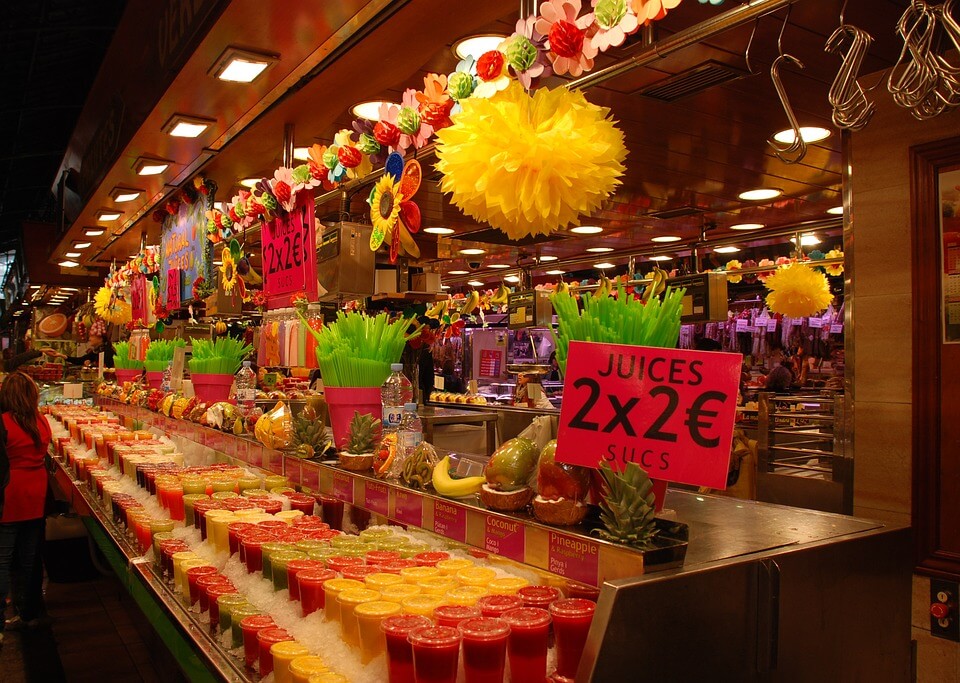
La Boqueria is the most famous food market in Europe and the most controversial. The debate about whether it has become too touristic — too many overpriced smoothie stalls, too many photo opportunities, too few actual Barcelona residents doing their shopping — is legitimate, and the honest answer is that both things are true. La Boqueria has become heavily tourist-oriented near the entrance on Las Ramblas. It is also still a functioning market with excellent produce, outstanding seafood, some of the best charcuterie in Catalonia, and a handful of market bars serving food at counters that represent some of the best casual eating in the city.
The correct approach to La Boqueria is to walk past the front section — the tourist-facing stalls with the cut fruit and the expensive juices — and find the working market in the interior. The fishmongers in the back section sell the catch from the Catalan coast with a precision and variety that no fishmonger outside Spain approaches. The mushroom vendors in autumn are extraordinary — species that do not appear in any other European market, foraged from the Pyrenean forests. Bar Pinotxo, the counter bar on the right side near the entrance, serves food that has been converting visitors to Catalan cooking since 1950.
Mercado Central — Valencia
Valencia’s Central Market is the most beautiful food market in Europe and one of the most functional. The building — an extraordinary Art Nouveau structure of iron, tile, and stained glass completed in 1928 — covers 8,000 square meters and houses nearly a thousand market stalls selling everything that Valencia’s extraordinary agricultural hinterland produces. The city that invented paella sits surrounded by the huerta — the fertile irrigated plain that has been farmed continuously since the Moorish period — and the market reflects the huerta’s abundance.
The oranges of Valencia, the rice of the Albufera, the seafood from the Mediterranean port, the seasonal vegetables that define the Valencian kitchen — all of this is in the Mercado Central on any weekday morning. Go early — by ten the market is at its best and by noon the best produce has been sold. The bar inside the market serves horchata — the cold, milky drink made from tiger nuts that is Valencia’s local specialty — alongside the breakfast options.
Mercado de San Miguel — Madrid
Madrid’s San Miguel is a covered iron market that was converted from a traditional food market into a gourmet food hall in 2009, and it represents the best version of what that transformation can produce when done correctly. The stalls sell exceptional versions of Spanish food specialties — jamón ibérico sliced to order, oysters from Galicia, vermouth from the barrel, pintxos from the Basque tradition, anchovies from Cantabria — in a beautiful 1916 iron-and-glass building in the heart of the old city.
The honest caveat: it is expensive by Spanish standards and definitely oriented toward visitors. But the quality is consistently excellent and the combination of beautiful space, good food, and excellent wine by the glass makes it one of the best places in Madrid to spend a late morning eating and drinking in the Spanish tradition.
Naschmarkt — Vienna
Vienna’s Naschmarkt is the longest open-air market in Austria — 1.5 kilometers of stalls along the Wienzeile — and one of the most cosmopolitan markets in Europe. The market reflects Vienna’s history as the capital of a multi-ethnic empire: Turkish pickle sellers alongside Austrian sausage vendors, Balkan grilled meat stalls next to Viennese pastry shops, Indian spice merchants across from Greek olive importers. The combination produces a market that is simultaneously very Viennese and completely international.
The Saturday flea market at the western end of the Naschmarkt is the best in Vienna — antiques, books, vinyl records, and the occasional genuinely valuable find among the accumulated possessions of a city with 2,000 years of continuous habitation. Arriving at the Naschmarkt at nine on a Saturday morning, eating a Wurst at a standing counter, browsing the flea market, and then sitting at one of the market restaurants for a late breakfast represents a perfect Vienna morning.
Mercado da Ribeira — Lisbon
Lisbon’s Mercado da Ribeira has two distinct lives in one building. The traditional morning market — fresh produce, fish, flowers — operates in the eastern section from early morning until mid-afternoon, selling to the residents of the Cais do Sodré neighborhood as it has for decades. The Time Out Market — a gourmet food hall that opened in the western section in 2014 — has become one of the most visited food destinations in Portugal, concentrating the best dishes from Lisbon’s best restaurants under one roof.
The Time Out Market is explicitly tourist-oriented but genuinely excellent — the quality control is rigorous and the combination of bacalhau from Zé da Mouraria, pastéis de nata from Manteigaria, and wine from Garrafeira Nacional in one large, atmospheric space represents good eating at accessible prices. The traditional market section, operating simultaneously in the same building, provides grounding context — the fish that will become dinner at a Lisbon restaurant starting their market shopping at seven in the morning alongside the visitors who arrive at eleven for the food hall.
Borough Market — London
Borough Market on the South Bank of the Thames — operating on the same site since the 13th century, in its current covered form since the 19th century — is the best food market in Britain and one of the best in Europe. The range is extraordinary: British artisan cheese producers alongside Brindisa’s Spanish charcuterie, Neal’s Yard Dairy alongside Monmouth Coffee, wild game from Scottish estates alongside fresh pasta from Italian suppliers. The market has become a destination for food-focused visitors from across the world and the crowds on Saturday mornings reflect it.
The standing eating options are as important as the shopping. The roast pork rolls from the pork butcher, the girolle mushroom omelette from the egg stall, the hot salt beef bagels from Monty’s Deli — these are genuine London food experiences that represent the market’s role as both a shopping destination and an eating destination simultaneously.
Marché d’Aligre — Paris
While the Marché des Enfants Rouges and the organic markets of the Bastille and Raspail attract food-focused visitors, the Marché d’Aligre in the 12th arrondissement remains the most authentic working market in Paris — the one where actual Paris residents shop rather than where food tourists go to experience authentic Paris. The covered Marché Beauvau at the center sells cheese, charcuterie, and specialty foods. The outdoor market surrounding it sells produce at prices that reflect its local-resident clientele rather than its tourist potential. The flea market on the Place d’Aligre adds an additional layer of character on weekend mornings.
Arriving at the Marché d’Aligre at eight on a Saturday, buying cheese from the Beauvau, taking it to a bench in the Place d’Aligre with a baguette and a glass of wine from the cave next door, and watching Paris do its Saturday shopping — this is the market experience that the more famous Paris markets aspire to but the crowds prevent.
Centrale Mercato — Florence
Florence’s Mercato Centrale — the 19th-century iron market building near San Lorenzo — has a similar structure to Lisbon’s Ribeira: a traditional market on the ground floor and a contemporary food hall on the upper floor. The ground floor is one of the best traditional Italian food markets anywhere — the butchers selling bistecca fiorentina from Chianina cattle, the pasta makers hand-rolling fresh tagliatelle, the truffles in season from the surrounding hills, the Pecorino from the Crete Senesi, the lampredotto stall serving Florence’s traditional tripe sandwich to workers who have been eating here for decades.
The lampredotto — cow’s stomach cooked in broth, served in a crusty roll with green sauce — is Florence’s street food and one that requires a certain willingness to engage with offal before the first bite. After the first bite, most people understand immediately why this has been Florence’s working-class street food for generations.
For destination guides to the cities covered here see our Italy itinerary, our France itinerary, our Portugal itinerary, and our Spain destination guide. For food guides to specific cities see our Florence food guide and our Lisbon food guide. For the best wine regions to visit alongside these markets see our European wine regions guide.