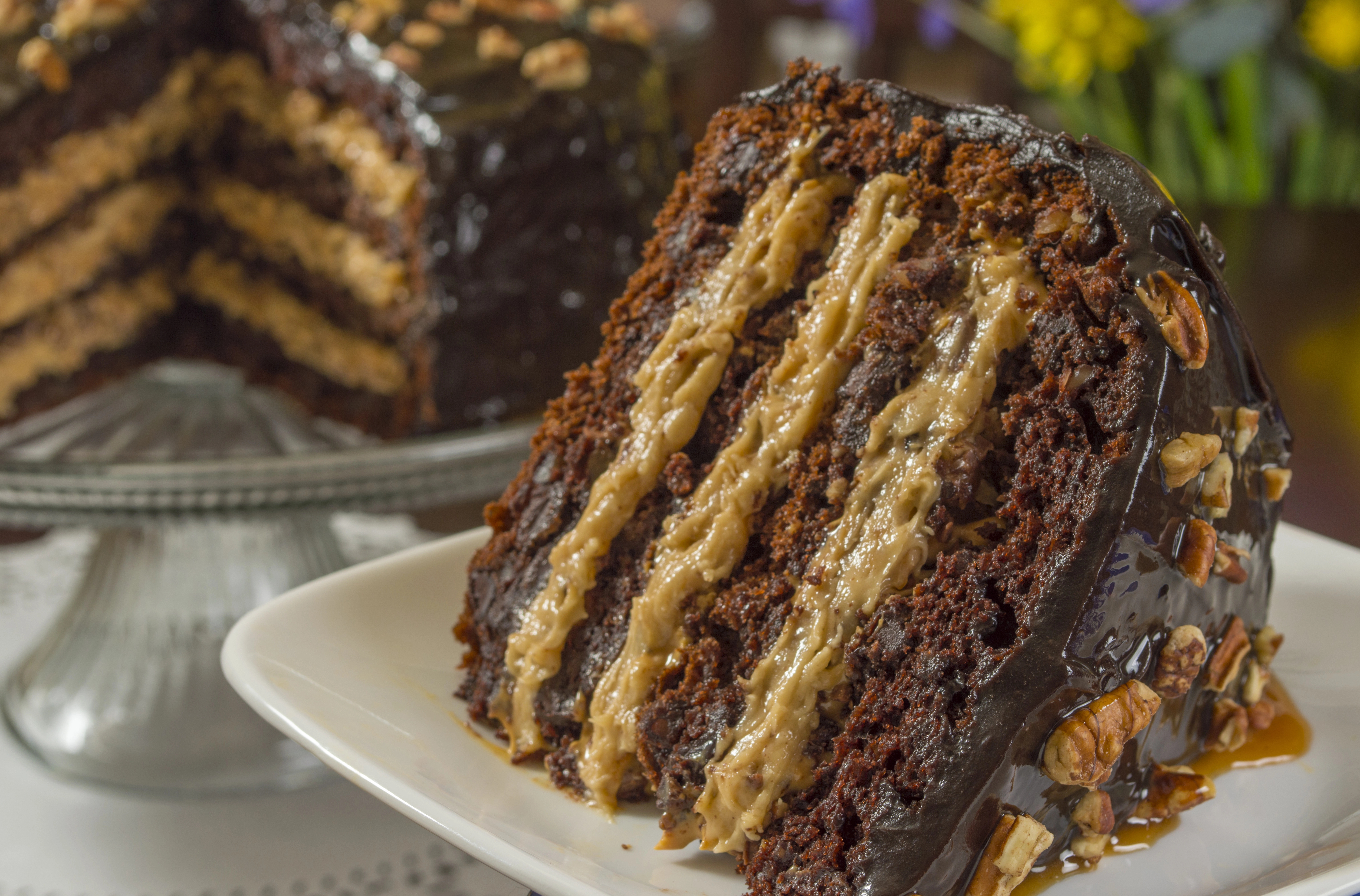
German chocolate cake is one of American baking’s great misattributions — a cake that has nothing to do with Germany, named instead for Sam German, an American baker who developed a sweet baking chocolate for the Baker’s Chocolate Company in 1852. The cake bearing his name appeared in a Dallas newspaper in 1957, went nationally viral when General Foods reprinted the recipe, and has been part of the American baking canon ever since.
Ina Garten’s version elevates the original — better chocolate, better technique, the addition of espresso powder that deepens the chocolate flavor without making the cake taste of coffee — while preserving what makes German chocolate cake worth making in the first place: that extraordinary coconut pecan frosting, toasted and caramel-rich, that no other cake in American baking has.
The Chocolate Cultures of Europe
The cake may not be German but Germany has one of the world’s great chocolate traditions, and the country’s relationship with chocolate is worth understanding for any traveler with serious sweet interests.
Germany is the world’s largest per capita consumer of chocolate and the country’s chocolate industry — centered in the Rhine-Ruhr region, with significant production in Bavaria and Saxony — produces a range of products from mass-market bars to artisan confections that represent some of the finest chocolate work in Europe. The German preference runs toward milk chocolate and praline — the combination of chocolate and roasted hazelnuts or almonds that defines the country’s chocolate identity — rather than the dark, high-cocoa-percentage bars that have become the standard of quality in international chocolate discourse.
The Rausch Schokoladenhaus in Berlin — a five-story chocolate house on the Gendarmenmarkt — is one of the most extraordinary chocolate retail experiences in Europe, selling handmade chocolates alongside chocolate sculptures of the Brandenburg Gate and the Berlin Cathedral, with a café upstairs serving hot chocolate made from single-origin bars. It is worth visiting not because the chocolate is the best in the world — though it is very good — but because it represents the seriousness with which Germany takes what other cultures sometimes treat as a children’s food.
Switzerland — often credited with inventing milk chocolate through the work of Daniel Peter and Henri Nestlé in the 1870s — has an equally serious chocolate culture centered on the tradition of Konditoreien, the pastry shops that serve elaborate chocolate cakes, truffles, and confections as part of the Swiss café culture. A Konditorei in Zurich or Bern on a Saturday afternoon — coffee, a slice of chocolate cake, nowhere particular to be — is one of the reliable small pleasures of Swiss travel.
Belgium’s chocolate tradition is perhaps the most internationally recognized, built on the invention of the praline by Jean Neuhaus in Brussels in 1912 and sustained by a craft chocolate industry that treats its confections with a seriousness more commonly associated with wine and cheese. The chocolate shops of Brussels’s Galeries Royales Saint-Hubert — the covered shopping arcade built in 1847 — are among the best places in the world to understand what chocolate can be when it is treated as a fine food rather than a confection.
Why Espresso Powder in Chocolate Cake
The addition of espresso powder to chocolate cake batter is a technique borrowed from professional pastry kitchens and one of Ina Garten’s most useful recipe interventions. The espresso does not make the cake taste like coffee — used in the quantities called for, it is below the threshold of coffee flavor perception. What it does is amplify the chocolate flavor by suppressing the sweetness slightly and enhancing the bitter, roasted compounds that give chocolate its complexity.
The science is straightforward: coffee and chocolate share many of the same flavor compounds, and the presence of coffee in small quantities enhances the perception of those compounds in the chocolate without contributing its own distinct flavor. This is why espresso appears in good chocolate recipes at amounts that seem too small to matter — they are too small to register as coffee but large enough to make the chocolate taste more like itself.
The Coconut Pecan Frosting
The frosting is the reason German chocolate cake exists. The chocolate layers are excellent — moist, deeply flavored, tender — but they are not what distinguishes this cake from every other chocolate layer cake. The coconut pecan frosting — made by cooking egg yolks, evaporated milk, sugar, and butter together until thick and caramel-golden, then stirring in toasted coconut and toasted pecans — is unlike any other frosting in American baking.
It is not a buttercream. It is not a ganache. It is a cooked custard-based confection that sets to a spreadable consistency somewhere between a preserve and a thick caramel sauce, with the toasted coconut and pecans giving it a texture and flavor that no other cake frosting matches. The toasting of both the coconut and the pecans before they go into the frosting is not optional. Raw coconut and raw pecans produce a frosting that is sweet and textured but lacks the complexity of the toasted version.
The Recipe
Ingredients (serves 12)
For the cake:
- 1¾ cups all-purpose flour
- 2 cups sugar
- ¾ cup good cocoa powder
- 2 teaspoons baking soda
- 1 teaspoon baking powder
- 1 teaspoon kosher salt
- 1 tablespoon instant espresso powder
- 1 cup buttermilk, shaken
- ½ cup vegetable oil
- 2 extra-large eggs, at room temperature
- 1 teaspoon pure vanilla extract
- 1 cup freshly brewed hot coffee
For the coconut pecan frosting:
- 3 egg yolks
- 1 cup evaporated milk
- 1 cup sugar
- ½ cup unsalted butter, cut into pieces
- 1 teaspoon vanilla extract
- 1½ cups sweetened shredded coconut, toasted
- 1 cup pecans, toasted and roughly chopped
- Pinch of salt
Instructions
Make the cake layers. Preheat oven to 350°F. Butter two 9-inch round cake pans, line the bottoms with parchment, and butter the parchment. Sift together flour, sugar, cocoa, baking soda, baking powder, salt, and espresso powder into a large bowl. In a separate bowl whisk together buttermilk, oil, eggs, and vanilla. Slowly add the wet ingredients to the dry ingredients, mixing on medium speed until combined. Add the hot coffee and mix until smooth — the batter will be quite thin. Divide evenly between the prepared pans. Bake for 35 to 40 minutes until a toothpick comes out clean. Cool in pans for 30 minutes, then turn out onto wire racks to cool completely.
Make the frosting. Toast the coconut on a sheet pan at 350°F for 5 to 7 minutes until golden. Toast the pecans in the same oven for 8 minutes. Watch both carefully — they go from toasted to burnt quickly. Combine egg yolks, evaporated milk, sugar, and butter in a medium saucepan over medium heat. Cook, stirring constantly, until the mixture thickens and turns a light golden caramel color, about 12 to 15 minutes. Remove from heat. Stir in vanilla, salt, toasted coconut, and toasted pecans. Cool completely before using — the frosting must be at room temperature or it will slide off the cake layers.
Assemble. Place one cake layer on a serving plate. Spread half the frosting over the top. Place the second layer on top. Spread the remaining frosting over the top of the cake. The sides of this cake are traditionally left unfrosted — the coconut pecan frosting goes on the top only, between the layers, and the chocolate cake sides are left exposed. This is correct and intentional.
The Cake in Context
German chocolate cake is entirely American in origin but the chocolate tradition it draws on — the sweet baking chocolate developed by Sam German, the European-influenced chocolate culture of 19th-century American baking — connects it to the broader story of how European food cultures transformed when they arrived in America. The Germans and Swiss who emigrated to the United States in the 19th century brought their chocolate traditions with them, and the American baking culture that developed from those traditions produced something new: richer, sweeter, more indulgent than the European originals, but recognizably descended from them.
For European chocolate travel see our guide to Germany and our Belgium destination guide. For more Ina Garten recipes see our Ina Garten Beef Tenderloin and our Ina Garten Ratatouille.

Ingredients
Method
- Heat the oven to 350°F, and spray the bottoms and sides of round cake pans with the cooking spray. Olive Oil cooking spray is the best for you, and doesn't alter the flavor of the dish.
- Cut three 8-inch or two 9-inch rounds of cooking parchment paper. Line bottoms of pans with the paper.
- Chop the chocolate very finely.
- In a 1-quart saucepan, heat the chocolate and water over low heat, stirring frequently, until chocolate is completely melted; remove from heat and cool.
- Meanwhile, in a medium bowl, stir the flour, baking soda and salt until mixed; set aside. In another medium bowl, beat 2 cups sugar and 1 cup butter with an electric mixer on medium speed until light and fluffy; set aside.
- On medium speed, beat 1 egg yolk at a time into the sugar mixture until mixed. On low speed, beat in the melted chocolate and 1 teaspoon vanilla. On low speed, beat in 1/2 of the flour mixture just until smooth, then beat in 1/2 of the buttermilk just until smooth. Repeat beating in flour mixture alternately with the buttermilk just until smooth.
- Wash and dry mixer beaters. In a small bowl, beat the eggs whites on high speed until beaten eggs whites form stiff peaks when beaters are lifted. Add egg whites to the batter; to fold in, use a rubber spatula to cut down vertically through the batter, then slide the spatula across the bottom of the bowl and up the side, turning batter over. Rotate the bowl 1/4 turn, and repeat this down-across-up motion. Continue folding until batter and egg whites are blended.
- Pour batter into pans; use a rubber spatula to scrape batter from bowl, spread batter evenly in pans and smooth top of batter. (If batter is not divided evenly, spoon batter from one pan to another.) Refrigerate batter in third pan if not all pans will fit in oven at one time; bake third pan separately.
- Bake 8-inch pans 35 to 40 minutes, 9-inch pans 30 to 35 minutes, or until a toothpick inserted in the center comes out clean.
- Cool cakes in pans 10 minutes. To remove cake from pan, invert onto cooling rack, then invert right side up on second cooling rack. Cool completely, about 1 hour.
- In a 2-quart saucepan, stir the 3 egg yolks, 1 cup sugar, 1/2 cup butter, the evaporated milk and 1 teaspoon vanilla until well mixed. Cook over medium heat about 12 minutes, stirring frequently, until thick and bubbly. Stir in the coconut and pecans. Cool about 30 minutes, beating occasionally with a spoon, until mixture is spreadable.
- Place 1 cake layer, rounded side down, on a cake plate; using a metal spatula, spread 1/3 of the filling over the layer.
- Add second layer, rounded side down; spread with 1/3 of the filling. Add third layer, rounded side up; spread with remaining filling, leaving side of cake unfrosted. Store cake covered in the refrigerator.