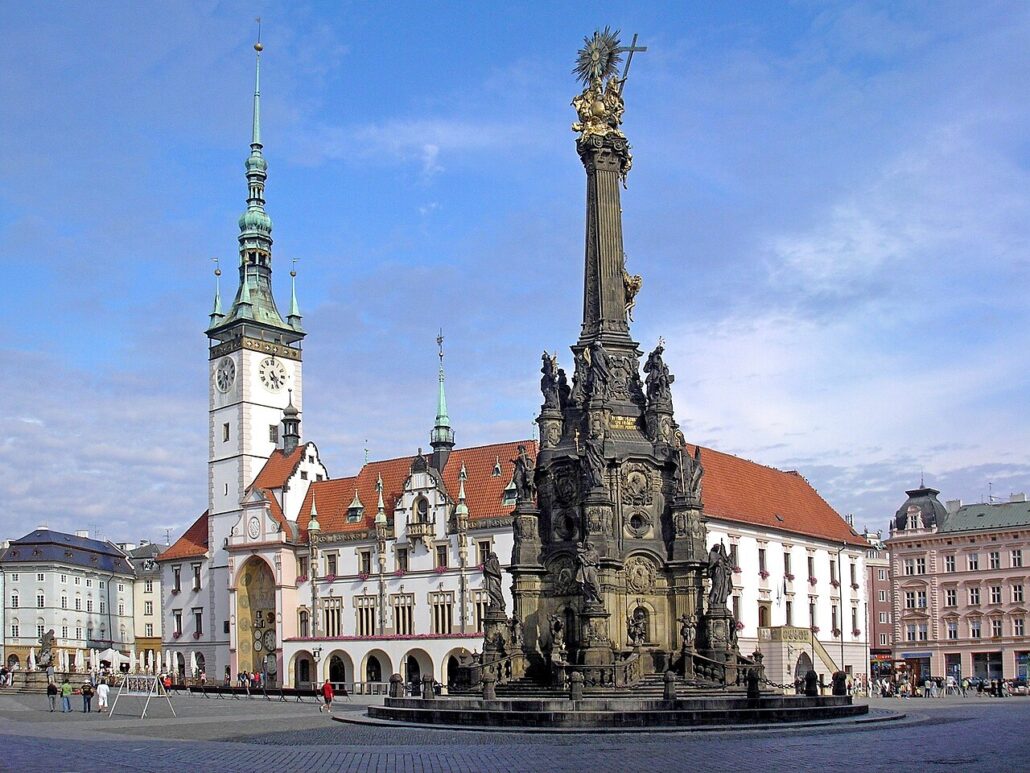
Olomouc is one of Europe’s most underrated cities and the most undervisited significant city in the Czech Republic. The former capital of Moravia — the eastern region of the Czech Republic that produces the country’s best wine and has a distinct cultural identity from Bohemia to the west — Olomouc has a historic center of extraordinary quality: six Baroque fountains, a UNESCO-listed astronomical clock, a Trinity Column that is the largest Baroque sculptural ensemble in Central Europe, and a university that has been operating since 1573 that gives the city a student energy entirely absent from tourist-dominated Czech destinations.
Most visitors to the Czech Republic spend their entire trip in Prague. Those who venture further go to Český Krumlov or Karlovy Vary. Almost nobody goes to Olomouc, which means the city you find there is one that exists for its residents rather than for you — and that is precisely the condition that produces the best travel experiences.
The Historical Context
Olomouc’s historical significance is disproportionate to its current size. The city was the capital of the Margraviate of Moravia for centuries and the seat of one of the most powerful bishoprics in Central Europe — the Archbishop of Olomouc wielded political influence that shaped the history of the Habsburg Empire. The city’s Baroque architecture reflects this ecclesiastical wealth: the Cathedral of St. Wenceslas, rebuilt in Neo-Gothic style in the 19th century on medieval foundations, dominates the skyline from the highest point of the old town. The Archbishop’s Palace, the Jesuit College, and the dozen Baroque churches that punctuate the city center reflect centuries of religious power expressed in stone.
The Thirty Years War — the catastrophic conflict that devastated Central Europe between 1618 and 1648 — left Olomouc occupied by Swedish forces for eight years and reduced from a city of 30,000 to fewer than 2,000 survivors. The city never regained its former size or political significance. Brno replaced it as the capital of Moravia. Prague became the dominant Czech city. Olomouc became what it is today: a university city of 100,000 people with a historic center built for a much larger and more important place, which gives it a specific grandeur-to-scale ratio that produces extraordinary urban walking.
The Astronomical Clock
The Olomouc astronomical clock on the northern facade of the Town Hall is one of only a handful of medieval astronomical clocks still operating in Europe — alongside Prague’s famous Orloj — and the only one with a specifically Communist-era modification that makes it unique. The original 15th-century clock was damaged during the Swedish occupation and rebuilt in the 1950s in a Socialist Realist style that replaced the traditional saints and religious figures with workers, scientists, and athletes. The result is historically fascinating — an astronomical clock that measures cosmic time but whose figures celebrate the socialist vision of human progress. The hourly chiming performance, with its procession of workers and scientists rather than apostles, is one of the more genuinely peculiar experiences in Central European travel.
The Baroque Fountains
Olomouc has six Baroque fountains — more than any other city in the Czech Republic and more than most cities in Europe. Built between 1683 and 1754 as expressions of the city’s wealth and civic pride, they depict figures from classical mythology — Hercules, Neptune, Caesar, Jupiter, Mercury, Arion — in the specific Central European Baroque style that combines Italian influence with local craftsmanship. The fountains are distributed across the main squares and streets of the old town, turning a walk through the historic center into a series of unexpected encounters with mythology rather than a single monument visit.
The Holy Trinity Column
The Holy Trinity Column in the Upper Square — UNESCO-listed since 2000 — is the largest Baroque sculptural ensemble in Central Europe. Built between 1716 and 1754 to commemorate the end of a plague epidemic, the column rises 35 meters and contains a chapel in its base, 18 gilded sculptures of saints across multiple levels, and a gilded crown at the top. The scale and the ambition of the construction — a civic monument that took 38 years to complete and was funded by the entire city including individual donations from ordinary residents — reflects the specific relationship between Olomouc and its religious heritage that distinguishes it from the more secular atmosphere of Prague.
Olomoucké Tvarůžky: The Local Cheese
Olomoucké tvarůžky — Olomouc sour milk cheese — is the most famous food product of the Moravia region and one of the most pungent cheeses in European production. The small, cylindrical yellow cheese has been made in the villages around Olomouc since the 15th century using a specific fermentation process that produces its characteristic strong smell and sharp, complex flavor. It is a protected geographical indication product — only cheese made in the specific villages around Olomouc can carry the name.
Tvarůžky appears throughout Olomouc restaurants in traditional preparations: fried with bread, grilled on a platter, incorporated into sauces for meat dishes. The Tvarůžky Museum in Lošice — a village 20 kilometers from Olomouc where production is concentrated — provides context for travelers with a specific interest in cheese production and regional food heritage. The cheese shop at the museum sells the fresh version that is unavailable outside the region.
The Student City
Palacký University, founded in 1573, makes Olomouc one of the oldest university cities in Central Europe and gives it a demographic energy that most Czech cities lack. The student population of approximately 25,000 — in a city of 100,000 — produces a café culture, bar scene, and independent restaurant culture that is disproportionate to the city’s size and that makes Olomouc genuinely interesting to spend time in rather than simply to look at.
The area around Dolní Náměstí (Lower Square) and the streets leading toward the university campus contain the best concentration of independent cafés and bars — Czech craft beer culture has taken firm hold in Olomouc, and several of the city’s bars and taprooms serve locally produced and regionally sourced Czech craft beers alongside the Pilsner Urquell and Kozel that appear everywhere in the country.
Getting There
Olomouc is 1 hour 20 minutes from Prague by fast train — one of the best-connected secondary cities in the Czech Republic for rail travel. From Brno, the journey takes 1 hour. From Vienna, direct trains reach Olomouc in approximately 3 hours. The train station is a 15-minute walk from the historic center.
Two days in Olomouc — one day for the historic center including the clock, column, and fountains, one day for the surrounding Moravia region including a visit to the Moravian wine villages south of the city — produces a complete and genuinely satisfying experience of a city that rewards visitors who find it on their own.
For everything you need to plan a Czech Republic trip see our Czech Republic destination guide. For the most beautiful Czech town outside Prague see our Český Krumlov guide. For broader Central European travel planning see our Poland city guide.