Transylvania confuses visitors who arrive expecting Dracula and find instead a region of extraordinary medieval towns, Saxon fortified churches, forested mountains, and a food culture that is hearty, spiced, and deeply Central European in character. The vampire mythology — entirely fictional, attached to the region by Bram Stoker who never visited — is the least interesting thing about Transylvania. The goulash is considerably more interesting.
Transylvanian goulash is distinct from Hungarian goulash in the way that most regional variations on a dish are distinct — the spicing is different, the proportion of paprika shifts, sauerkraut and sour cream enter the picture in ways that Hungarian purists would find irregular, and the whole thing is richer and more acidic than the Hungarian version. This is not an inferior adaptation. It is what happens when a Central European dish crosses into a region that has its own culinary logic and gets absorbed into the local tradition.
Transylvania: The Region and Its Food
Transylvania occupies the northwestern interior of modern Romania, enclosed by the Carpathian Mountains on three sides. For most of its history it was governed not by Romania but by Hungary — part of the Kingdom of Hungary from the 11th century until the end of World War I, when the Treaty of Trianon transferred it to Romania. The Hungarian cultural presence in Transylvania remains significant: a substantial ethnic Hungarian minority still lives in the region, Hungarian is widely spoken in cities like Cluj-Napoca and Târgu Mureș, and the food reflects the centuries of Hungarian influence as directly as the architecture reflects the centuries of Saxon German settlement.
Transylvanian goulash is the most visible result of this Hungarian culinary inheritance. The dish arrived with Hungarian settlers and administrators, was adapted by Romanian home cooks who incorporated local ingredients and preferences, and emerged as something that claims both heritages simultaneously. The sauerkraut — fermented cabbage — that defines the Transylvanian version over the Hungarian one is a Romanian and Germanic addition, reflecting the food preservation traditions of a mountainous region where winters are long and fresh vegetables are scarce from November to April.
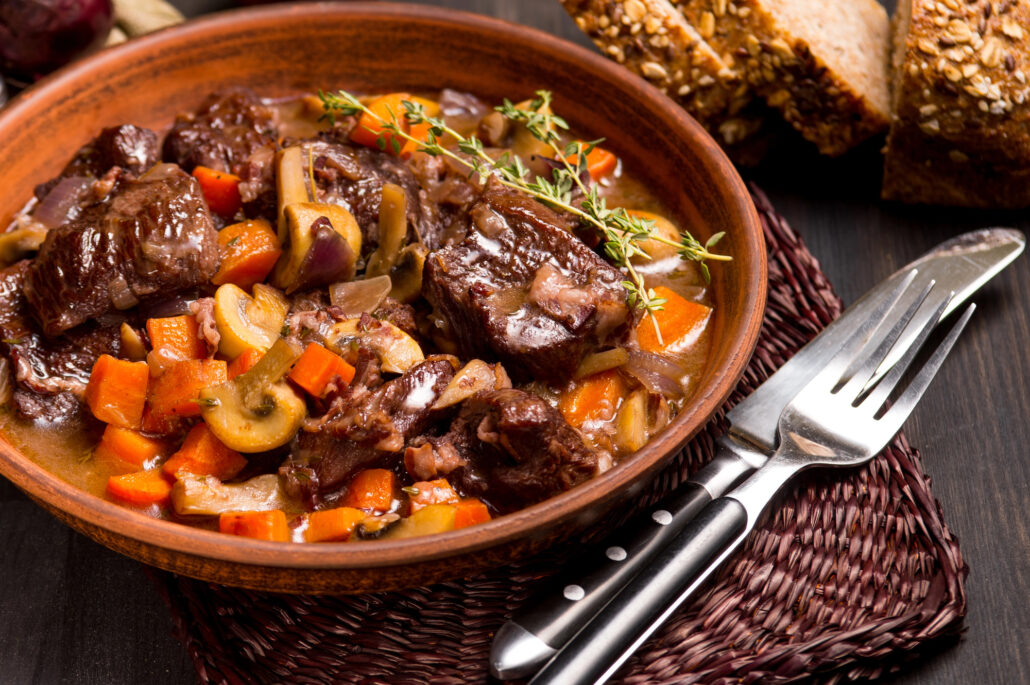
Brasov, the most visited city in Transylvania, has an excellent restaurant scene that does justice to the regional food tradition alongside the inevitable tourist fare. The old town — the historic center around the Black Church, one of the largest Gothic churches in Eastern Europe — has several restaurants serving traditional Transylvanian and Romanian food that are worth seeking out. The goulash served at these places is thick, paprika-red, fragrant with caraway and sour cream, and served with thick slices of bread or Hungarian-style egg noodles called galuska.
Cluj-Napoca — Romania’s second-largest city, often called the unofficial capital of Transylvania — has the strongest Hungarian food culture of any Transylvanian city and the best versions of Hungarian-influenced dishes including goulash. The city’s size and university population have also produced a surprisingly sophisticated restaurant scene that would not feel out of place in any European capital.
The Paprika Question
Paprika is the spice that defines this family of dishes and the quality of the paprika determines more than anything else how good the finished goulash will be. The paprika in the supermarket spice aisle — faded, stale, and lacking in flavor — will produce a goulash that is adequate but not memorable. Good Hungarian sweet paprika — bought from a Hungarian or Eastern European specialty shop, stored in a cool dark place, and used within a year of opening — produces a goulash with a deep, fruity, slightly smoky flavor that cheap paprika cannot approach.
The Transylvanian version uses sweet paprika as the primary spice with a smaller amount of hot paprika for heat. The ratio of sweet to hot is a matter of preference — a 3:1 ratio of sweet to hot produces a goulash that is flavorful without being aggressively spiced. Adjust the hot paprika to your preference but do not reduce the sweet paprika — it is not just a spice here but a structural ingredient that thickens the sauce and provides the characteristic color.
One rule that applies to cooking with paprika that cannot be violated without consequences: never add paprika to a very hot, dry pan. Paprika burns instantly at high heat and burnt paprika is bitter and ruinous. Always add paprika to a pan that has been pulled from the heat or reduced to medium, and stir it into the fat briefly before adding liquid.
The Recipe
Ingredients (serves 6)
- 2 lbs pork shoulder, cut into 1½-inch pieces
- 3 tablespoons lard or vegetable oil
- 2 large onions, finely diced
- 4 cloves garlic, minced
- 3 tablespoons sweet Hungarian paprika
- 1 tablespoon hot Hungarian paprika
- 1 teaspoon caraway seeds
- 1 tablespoon tomato paste
- 1 cup dry white wine
- 2 cups chicken or pork stock
- 1 lb sauerkraut, drained and roughly chopped
- 1 cup sour cream
- Salt and black pepper
- Fresh dill, roughly chopped, to finish
Instructions
Brown the pork. Season the pork pieces generously with salt and pepper. Heat the lard or oil in a large Dutch oven over high heat until shimmering. Brown the pork in batches — do not crowd the pan — until deeply colored on all sides, about 3 to 4 minutes per side. Remove and set aside. The browning produces the fond on the bottom of the pan that will flavor the entire dish.
Cook the onions. Reduce heat to medium. Add the onions to the pot and cook, stirring and scraping up the browned bits, until the onions are completely softened and beginning to caramelize, about 15 minutes. Add the garlic and caraway seeds and cook for 2 more minutes.
Add the paprika. Pull the pot from the heat or reduce to the lowest possible setting. Add both paprikas and the tomato paste. Stir into the onion mixture for about 30 seconds — the paprika will bloom in the residual heat and oil. Immediately add the white wine and return to medium heat, stirring and scraping to incorporate everything.
Braise. Return the browned pork to the pot. Add the stock — the liquid should just cover the meat. Bring to a simmer, then partially cover and cook over low heat for 1 hour, until the pork is beginning to become tender but is not yet falling apart.
Add the sauerkraut. Stir in the drained sauerkraut. Continue cooking, partially covered, for another 30 to 45 minutes until the pork is completely tender and the sauerkraut has softened and integrated with the sauce. The sauce should be thick and rich — if it is too liquid, remove the lid and cook uncovered for the last 15 minutes.
Finish with sour cream. Remove from heat. Let the goulash cool slightly — it should not be at a full boil when you add the sour cream or it will curdle. Stir in the sour cream in two additions, incorporating fully between each addition. Return to very low heat just to warm through. Do not boil. Taste and adjust salt, paprika, and caraway.
Serve with egg noodles, buttered spaetzle, or thick slices of dark bread. Top with fresh dill. A cold Romanian lager or a glass of dry Feteasca Neagra — Romania’s best red wine variety — is the correct accompaniment.
Romania Beyond Transylvania
Transylvania is the most visited part of Romania for good reason but the country rewards exploration beyond its most famous region. Bucharest — the capital, often dismissed unfairly as gritty and overwhelming — has a genuinely excellent restaurant scene and a communist-era architecture that is fascinating in its grandiosity and excess. The Black Sea coast has beach resorts that feel like the 1970s in the best possible way. The Danube Delta is one of Europe’s most significant wildlife areas. Moldova — the northeastern region, not the separate country — has monasteries painted floor to ceiling with Byzantine frescoes that are among the most extraordinary things you can see anywhere in Europe.
Romanian food throughout all of these regions is hearty, honest, and significantly better than its international reputation suggests. The sarmale — stuffed cabbage rolls in fermented grape leaves — are outstanding. The mici — small, skinless grilled sausages eaten with mustard and bread at every roadside stand — are one of the great street foods of Eastern Europe. The polenta, the stews, the pastries influenced by the Ottoman and Austro-Hungarian periods all reflect a country that sits at a food culture crossroads and has absorbed something useful from every direction.
The goulash is the Hungarian contribution to this cross-cultural table and it is among the best things Romania has borrowed.
For everything you need to plan a Romania trip see our Romania destination guide, our guide to Bucharest safety for visitors, and our 2 days in Bucharest itinerary. For more on Transylvania see our Brasov vs Bucharest guide.