Ina Garten calls it Weekend Bolognese for a reason. This is not a quick weeknight sauce — it is a Sunday project, a two-hour commitment, a preparation that fills the kitchen with the smell of slowly cooking meat and wine and milk and produces a ragù that is as far from jarred pasta sauce as a meal can be. The weekend framing is not a warning. It is an invitation to the kind of cooking that is as pleasurable in the making as in the eating.
Her version follows the Bolognese essentials — the soffritto base, the meat browned properly rather than steamed, the wine and milk both present, the long slow cook — while making the preparation accessible to home cooks who did not grow up in Emilia-Romagna. It is one of the best Bolognese recipes in English-language cooking and one that respects the original while acknowledging it is being made in a kitchen in the Hamptons rather than a farmhouse outside Bologna.
Bologna and the Ragù That Bears Its Name
Bologna is the food capital of Italy — a designation acknowledged even in a country where every region considers its own cuisine superior to everyone else’s. The city’s nickname La Grassa — the fat one — was earned through centuries of producing the richest, most indulgent cooking in Italy: mortadella, prosciutto di Parma, tortellini in brodo, tagliatelle al ragù, and the lasagne al forno that uses the ragù as its foundation.
The ragù bolognese is formally registered with the Bologna Chamber of Commerce. In 1982 the Italian Academy of Cuisine deposited the official recipe — beef, pancetta, onion, carrot, celery, tomato paste, white wine, milk — as a protected cultural document. The registered version is deliberately specific about what it does not contain: no garlic, no dried herbs, no red wine, no cream. These are not oversights. They are the specific choices that define the Bolognese tradition against the many variations that have been attached to the name outside Italy.
Eating tagliatelle al ragù in Bologna — at one of the old trattorie in the historic center, made from a recipe that has not changed in thirty years — is one of the great food experiences available in Italy. The fresh egg pasta, hand-rolled to a translucency that dried pasta cannot approach, with the ragù enriched by hours of slow cooking and the final addition of milk that tenderizes the meat and rounds the acidity — this is the dish that produced the Italian Academy’s formal protection and that inspires food travelers to make Bologna a specific destination rather than a stop on a larger Italian circuit.
The city rewards the visit beyond its ragù. The Quadrilatero — the medieval market district surrounding the Piazza Maggiore — has been operating as a food market for centuries and still sells everything that defines Bolognese cooking: the mortadella from the salumerie, the fresh pasta from the sfogline, the Parmigiano-Reggiano from the fromagerie, the Lambrusco and Sangiovese from the wine shops. A morning in the Quadrilatero followed by lunch at Trattoria Anna Maria — one of the best traditional Bolognese restaurants operating in the city — is a food day worth traveling to Italy specifically to have.
The Milk Question
The most surprising element of authentic Bolognese to non-Italian cooks is the milk. Most ragù recipes use wine for acidity and stock for body. Bolognese uses wine and milk — the wine for depth, the milk for tenderness. The milk is added toward the end of the cooking process and allowed to fully absorb into the meat, producing a sauce that is richer and more velvety than wine-only versions and with a texture that reflects the dairy tradition of the Po Valley where the dish originates.
The science behind the milk is straightforward: the casein proteins in milk interact with the meat proteins during cooking, breaking down the tighter protein bonds that develop during browning and producing a more tender, open texture. The lactic acid in the milk also contributes a mild sourness that balances the sweetness of the caramelized soffritto and the richness of the meat fat.
Ina Garten uses whole milk, as the recipe requires. Do not substitute skim or low-fat milk — the fat is part of what the milk contributes and its absence produces a noticeably thinner, less unctuous sauce.
The Recipe
Ingredients (serves 6, enough for 1 lb pasta)
- 2 tablespoons good olive oil
- 4 oz pancetta or thick-cut bacon, diced small
- 1½ cups onion, finely diced (about 1 large onion)
- 1 cup carrot, finely diced (about 2 medium carrots)
- 1 cup celery, finely diced (about 3 stalks)
- 1 lb ground beef (80/20)
- ½ lb ground pork
- 1 lb Italian sausage, casings removed
- 1 cup dry red wine
- 1½ cups whole milk
- 3 cups canned crushed tomatoes
- 2 tablespoons tomato paste
- 1 teaspoon dried oregano
- ½ teaspoon red pepper flakes
- Kosher salt and black pepper
- Freshly grated Parmigiano-Reggiano for serving
Instructions
Render the pancetta. Heat the olive oil in a large Dutch oven over medium heat. Add the pancetta and cook until the fat has rendered and the pieces are lightly golden, about 5 minutes. Do not brown aggressively — the pancetta provides fat and background flavor, not a dominant taste.
Cook the soffritto. Add the onion, carrot, and celery. Cook over medium heat, stirring occasionally, until completely softened and the onion is translucent, about 10 minutes. The soffritto is the flavor foundation — rushing it produces a sauce that is sharp and underdeveloped rather than sweet and rounded.
Brown the meat. Raise the heat to medium-high. Add the beef, pork, and sausage, breaking up the meat thoroughly. Cook, stirring occasionally, until all the pink is gone and the meat is beginning to brown and stick slightly to the bottom of the pan — about 12 to 15 minutes. The browning is essential. Meat that has been merely cooked through rather than browned produces a flat sauce regardless of everything that follows.
Add the wine. Pour in the red wine and raise the heat to high, scraping up any browned bits from the bottom of the pan. Cook, stirring, until the wine has almost completely evaporated — about 5 minutes. The alcohol must cook off completely or it will give the sauce a harsh, sharp edge.
Add remaining ingredients. Reduce heat to medium-low. Add the tomato paste and stir for 2 minutes. Add the crushed tomatoes, milk, oregano, red pepper flakes, 1 teaspoon salt, and ½ teaspoon black pepper. Stir to combine. Bring to a simmer.
Cook slowly. Partially cover and cook over low heat for 1½ to 2 hours, stirring occasionally, until the sauce is thick, rich, and concentrated. The sauce should be barely liquid — not saucy but dense and unctuous. Add small amounts of water if it becomes too dry before the meat is fully tender.
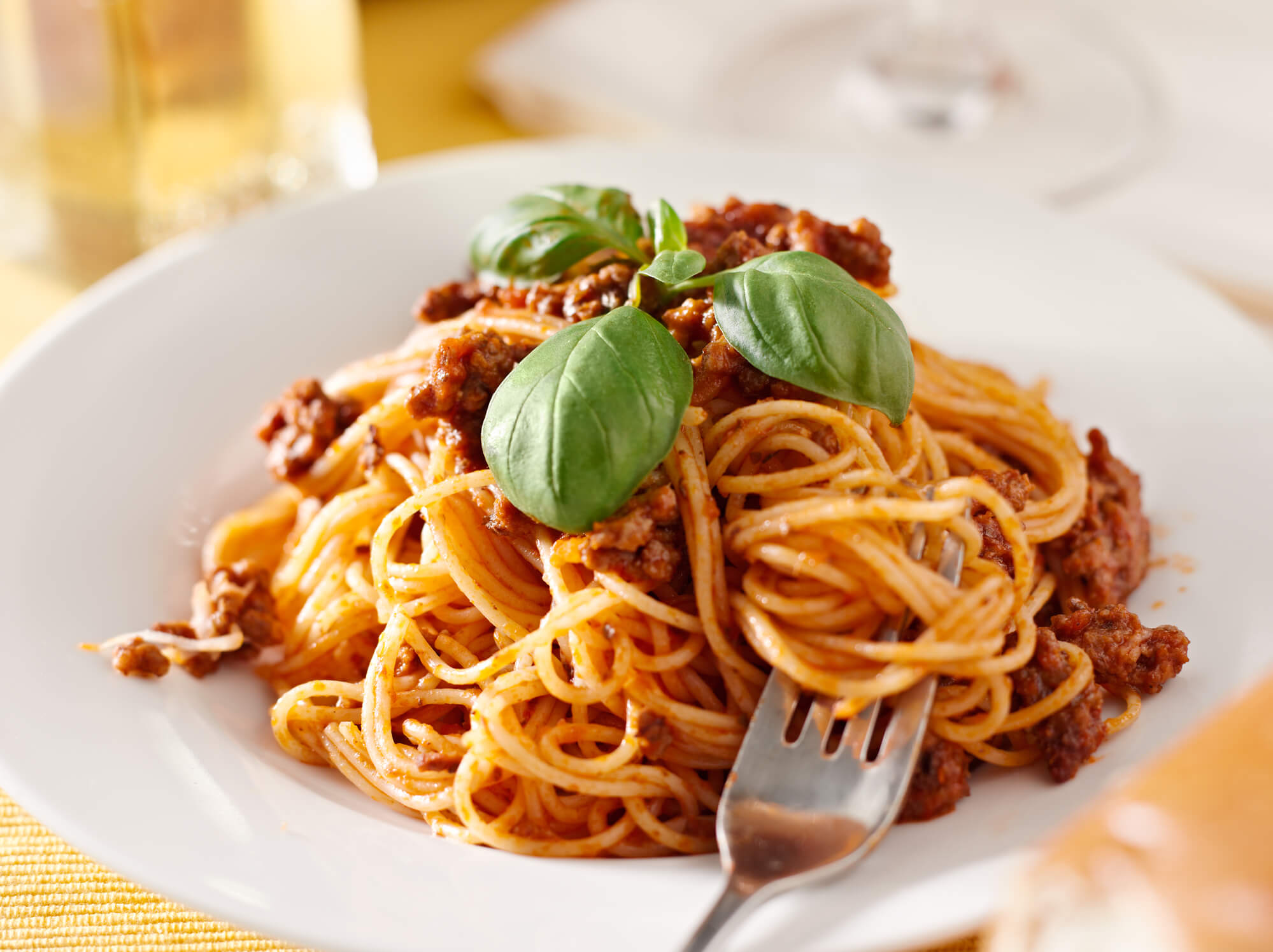
Finish and serve. Taste and adjust seasoning generously — the sauce needs more salt than seems appropriate. Toss with pappardelle, tagliatelle, or rigatoni cooked al dente in well-salted water, adding pasta cooking water to loosen if needed. Serve with a generous amount of freshly grated Parmigiano-Reggiano.
The Pasta Pairing
Bolognese is served on tagliatelle in Bologna — the wide, flat egg pasta that provides enough surface area for the dense ragù to cling to. The Italian Academy’s registered recipe specifies tagliatelle explicitly, with a note that the correct width of the tagliatelle should be 8mm when cooked — 1/12,270th of the height of the Torre degli Asinelli, Bologna’s medieval tower. This specificity is both genuinely useful and a characteristically Italian way of making the point that there is a right way to do things.
Outside Bologna, Bolognese is served on spaghetti in Italian-American restaurants, on rigatoni and penne in Roman restaurants, and on pappardelle in Tuscan ones. All of these work. Tagliatelle works best. The reasoning is purely practical: the flat, rough surface of egg pasta holds a dense meat sauce more effectively than the smooth surface of extruded dried pasta.
Bologna in a Weekend
Bologna is entirely manageable as a weekend destination from anywhere in northern Italy. Two days gives enough time for the Quadrilatero market, the Pinacoteca Nazionale (one of Italy’s best art museums outside Florence and Rome), a walk along the porticoes that line almost every street in the historic center, and enough meals to understand why the city earned its nickname.
For everything you need to plan an Italy trip including Bologna see our complete Italy itinerary. For more Bolognese-style cooking see our Gordon Ramsay Lasagne al Forno and our Homemade Lasagna with Fresh Pasta. For more Barefoot Contessa recipes see our Ina Garten Ratatouille and our Barefoot Contessa Chicken Meatballs.
Ingredients
Method
- Heat the olive oil in a large Dutch oven or heavy pot over medium heat. Add the chopped onion, carrots and celery. Cook for 6-7 minutes, stirring occasionally, until the vegetables are tender but not browned.
- Add the minced garlic and cook for 1 minute more until fragrant.
- Add the ground beef to the pot and increase heat to medium-high. Break up the meat into small pieces using a wooden spoon as it browns. Cook for about 10 minutes until no pink remains.
- Pour in the red wine, stirring to deglaze the browned bits from the bottom of the pot. Cook for 3-4 minutes to reduce the wine slightly.
- Stir in the crushed tomatoes, milk, oregano, 1 teaspoon salt, and a few grinds of black pepper. Bring the sauce to a gentle simmer.
- Turn down heat to maintain a low simmer. Let the sauce bubble gently for 2 1/2 to 3 hours, stirring occasionally. As it simmers, the sauce will thicken and the flavors will develop beautifully.
- After 2 1/2 to 3 hours, stir in the chopped basil and parsley. Taste and add additional salt and pepper if needed.
- Serve over al dente pasta like pappardelle, penne or fettuccine. Also makes a fantastic base for lasagna or enchiladas. Enjoy!