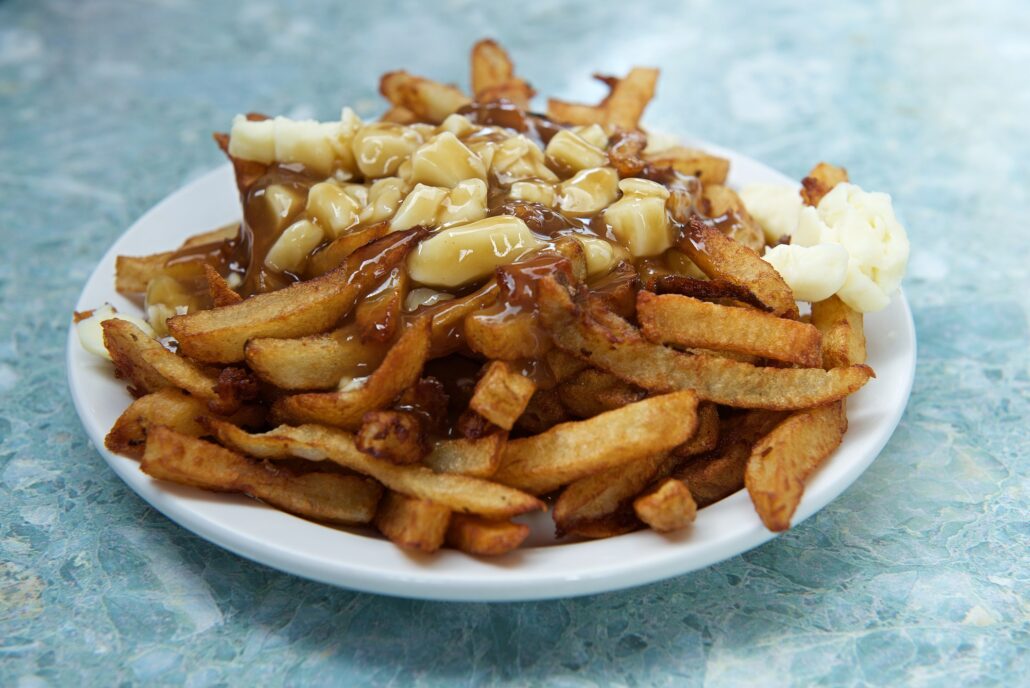
There is a version of poutine that exists at every fast food counter in Canada and a version that exists at a handful of restaurants in Montreal that are doing something genuinely different, and understanding the difference between the two is the key to understanding why poutine matters at all. The fast food version — soggy fries, rubbery cheese curds from a bag, brown gravy from a packet — is adequate comfort food for two in the morning after a hockey game. The Montreal version — thin, twice-fried fries crisp enough to hold their structure under the gravy, fresh cheese curds that squeak against your teeth because they are less than twelve hours old, a dark, rich beef and veal gravy that has been building flavor since this morning — is something worth traveling for.
Poutine is Quebec’s contribution to the world’s great junk food canon and, made properly, one of the most satisfying things you can eat anywhere in Canada.
The Origin Story and the Quebec Identity
Poutine was born in rural Quebec sometime in the late 1950s. The precise origin is contested — at least three different restaurants in the Centre-du-Québec region claim to have invented it — but the general story is consistent: a truck driver or hungry regular at a rural casse-croûte asked the cook to add cheese curds to his fries, then someone added gravy, and the combination was so obviously correct that it spread through Quebec roadside food culture within a decade.
The dish arrived in Montreal in the 1980s and the city did what Montreal does with food — it took a good idea and made it better, then made it sophisticated, then made it an object of culinary pride. Today Montreal has poutine restaurants that serve the dish with foie gras, with smoked meat, with lobster, with pulled pork — variations that have nothing to do with the original casse-croûte version and everything to do with a city that treats food as a form of cultural expression.
Poutine is also, not incidentally, a specifically Québécois dish rather than a generically Canadian one. Anglophone Canadians ate it rarely until the 1990s. The rest of Canada discovered it largely through Tim Hortons and McDonald’s, which began selling their own versions in the early 2000s. Quebec had been eating it for forty years by then. The dish is as much an expression of Quebec’s distinct francophone culture as the French language itself — something that belongs to a specific place and people and has been adopted by the rest of the country somewhat after the fact.
Montreal and the Poutine Pilgrimage
Montreal is one of North America’s great food cities and it is inexcusably overlooked by travelers who go to New York and Toronto and ignore the city that has the best smoked meat on the continent, the best bagels in North America, a French patisserie tradition that would make Paris nod in approval, and poutine that makes every version you have eaten elsewhere seem like a rough draft.
La Banquise on Rue Rachel in the Plateau-Mont-Royal neighborhood is open twenty-four hours a day, seven days a week, and has been serving poutine since 1968. Their menu lists over thirty variations. The classic — fries, curds, gravy — is what you should order the first time. The gravy is dark and complex, built on veal stock and beef bones, and it is the thing that separates La Banquise from every other poutine restaurant in the world.
Poutine Lafleur, a small chain with locations throughout Quebec, serves the roadside casse-croûte version with an authenticity that the Montreal restaurant versions have largely left behind. The fries are thicker, the gravy is lighter, the curds are generous. It is the version closest to what the original truck driver ate in Centre-du-Québec in 1958 and it is excellent for entirely different reasons than La Banquise.
The Cheese Curd Question
Fresh cheese curds are the element that most homemade poutine recipes get wrong. The curds should squeak against your teeth when you bite them — a characteristic of fresh curds that occurs because the protein structure is intact and intact proteins create friction against tooth enamel. Curds that do not squeak are not fresh enough. Curds that have been refrigerated for more than a day begin to lose their squeak as the protein structure changes. In Quebec, poutine restaurants receive fresh curds every morning and serve them within hours of delivery.
Fresh cheese curds are increasingly available at farmers markets, specialty cheese shops, and some grocery stores in North American cities with significant Canadian or dairy-farming communities. They are worth seeking out — the poutine made with fresh curds that still squeak is a different dish from the poutine made with older curds that have gone soft and rubbery.
If you cannot find fresh curds, the closest substitute is mozzarella cut into roughly 1-inch pieces — it will not squeak but it has a similar mild milkiness and it melts in a way that is more accurate than most other cheeses. Do not use shredded mozzarella. The pieces need mass to partially melt under the hot gravy while retaining some of their structure.
The Gravy
The authentic poutine gravy in Quebec is a brown gravy built on chicken or veal stock, thickened with a roux, and deeply seasoned. It is not packet gravy. It is not canned gravy. It is a properly made brown sauce that takes about forty-five minutes from start to finish and is worth every minute.
The gravy needs to be hot — genuinely hot, not warm — when it goes on the fries and curds. The heat from the gravy is what partially melts the curds, softening their exterior while leaving the interior still firm and squeaky. Warm gravy produces inadequately melted curds. Cold gravy produces unmelted curds. The temperature relationship between the gravy and the curds is the textural heart of poutine.
The Recipe
Ingredients (serves 4)
For the gravy:
- 3 tablespoons unsalted butter
- 3 tablespoons all-purpose flour
- 2 cups chicken stock, warm
- 1 cup beef stock, warm
- 1 tablespoon Worcestershire sauce
- 1 teaspoon apple cider vinegar
- Salt and black pepper
For the fries:
- 2 lbs russet potatoes, peeled and cut into ¼-inch sticks
- Vegetable oil for frying
- Kosher salt
For assembly:
- 8 oz fresh cheese curds, at room temperature
Instructions
Make the gravy. Melt the butter in a medium saucepan over medium heat. Add the flour and whisk constantly for 3 to 4 minutes until the roux is golden brown and smells nutty. Add the warm stocks in a slow stream, whisking constantly to prevent lumps. Add the Worcestershire sauce. Bring to a simmer and cook, whisking frequently, until the gravy is thick enough to coat a spoon, about 10 minutes. Add the cider vinegar. Season with salt and pepper. Keep warm over very low heat, whisking occasionally.
Fry the potatoes twice. This is not optional. Single-fry potatoes do not have the structure to support hot gravy without going completely soggy. Rinse the cut potatoes thoroughly in cold water until the water runs clear. Dry completely. Heat oil to 325°F in a heavy pot or deep fryer. Fry the potatoes in batches for 4 minutes — they should be cooked through but completely pale with no color. Remove and drain. Let them rest for at least 15 minutes. Raise the oil temperature to 375°F. Fry the blanched potatoes again in batches until deep golden brown and crisp, about 3 to 4 minutes. Remove, drain, and season immediately with salt. The twice-fried fries should be crisp enough to hold their texture for at least 5 minutes under hot gravy.
Assemble immediately. Divide the hot fries between bowls or plates. Scatter the cheese curds generously over the fries — do not be conservative with the curds. Ladle hot gravy over everything, covering the curds and fries completely. Serve immediately. Poutine waits for no one. The window between perfectly assembled poutine and soggy poutine is about four minutes.
Beyond the Classic
Once you have made the classic version and understood why it works, the variations become obvious. Smoked meat poutine — Montreal smoked beef brisket sliced thin and piled over the curds — is the combination that best represents what Montreal food culture is about. Pulled pork poutine is the version that has spread farthest outside Quebec. Lobster poutine, served at higher-end Montreal restaurants, is extravagant and very good and not something that the inventor of poutine at a rural casse-croûte in 1958 could have predicted.
All of them start with the same foundation: hot fries, fresh curds, hot gravy. Get those three things right and the rest follows.
For everything you need to plan a Montreal trip see our Canada destination guide. For more on Canadian food culture and travel see our Winnipeg Farmers Market guide.