The first time I ordered a croque monsieur in Paris I was sitting at a zinc-topped bar on the Rue de Rivoli, jet-lagged and slightly overwhelmed, and I ordered it mostly because it was the one thing on the chalkboard menu I was confident I could pronounce. What arrived was nothing like the ham and cheese sandwiches I had grown up with. It was hot and golden and architectural — thick bread lacquered in béchamel, Gruyère bubbled dark at the edges, a heft to it that said this was lunch, not a snack. I ate the whole thing in about four minutes and immediately ordered another.
That is the croque monsieur experience. It is the kind of food that seems simple until you eat a great one, and then you understand why the French have been making it since 1910.
What Is a Croque Monsieur?
A croque monsieur is a French hot sandwich made with ham, Gruyère cheese, and béchamel sauce, pan-fried or baked until golden and molten. The name translates roughly to “mister crunch” — a reference to the crisp, toasted exterior that gives way to the soft, cheese-pulling interior. It first appeared on a Paris café menu in 1910 and has been a fixture of French brasserie and café culture ever since.
It is not a grilled cheese. It is not a French dip. It is its own thing entirely — a distinctly French construction that uses béchamel, the classic white sauce, as both a spread inside the sandwich and a topping that gets broiled until spotted and golden. That double application of béchamel is what separates an authentic croque monsieur from every English-language approximation of it.
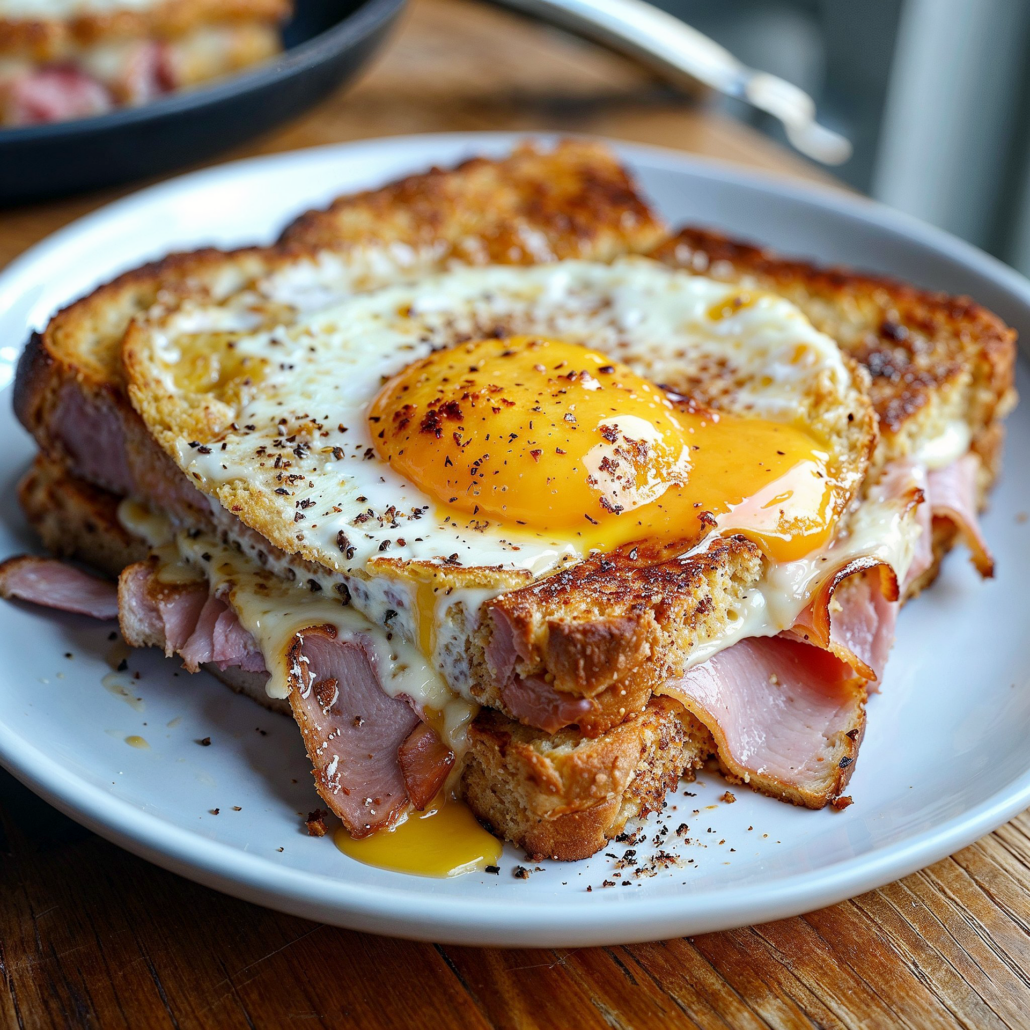
Its close relative the croque madame is identical except for a fried egg placed on top — sunny side up, the yolk running when you cut into it. Order the madame if you want breakfast. Order the monsieur if you want lunch. Order both if you are in Paris and have nowhere to be.
The Paris Café Context
To understand why the croque monsieur matters you need to understand what a Paris café actually is — not the tourist-facing terrasse version with overpriced coffee and waiters who have seen too many Americans, but the neighborhood institution that serves the same regulars every morning, where the patron knows your order and the croque monsieur on the chalkboard has been made the same way for thirty years.
These cafés are a genuinely different institution from anything in North American food culture. They are not restaurants exactly — they serve food but food is not the point. They are not bars exactly — they serve alcohol all day but drinking is not the point either. They are a third place in the truest sense: somewhere between home and work where French people go to exist for a while, to read the newspaper, to have a conversation, to eat a croque monsieur and drink a demi at noon without anyone hurrying them along.
The croque monsieur is the perfect food for this context. It takes about twelve minutes to make properly. It sits well in a hot oven while the café fills up at lunch. It is filling without being heavy. It costs the café very little and sells for a price that represents genuine value in a city where genuine value is increasingly hard to find. It is the platonic ideal of the café lunch — simple, satisfying, and available in approximately four thousand establishments within walking distance of wherever you are standing in Paris at any given moment.
Julia Child ate them obsessively during her early Paris years. She wrote about the croque monsieur in My Life in France with the same reverence she reserved for sole meunière and roast chicken — the kind of simple French cooking that looks effortless until you try to replicate it at home and realize there is technique embedded in every step. Her husband Paul called it the best sandwich in the world. He was not wrong.
The Béchamel Question
The thing that most English-language croque monsieur recipes get wrong is the béchamel. Many skip it entirely and just use cheese. Some use it inside but not on top. Some use it on top but not inside. The authentic version uses it both ways and the difference in the finished sandwich is not subtle.
Béchamel is one of the five French mother sauces — a simple combination of butter, flour, and milk seasoned with salt, white pepper, and nutmeg. It takes about eight minutes to make and it transforms the croque monsieur from a hot sandwich into something that deserves to be eaten slowly with a knife and fork and a glass of white Burgundy.
The inside béchamel keeps the ham and cheese from sliding out and adds a creamy richness that pure cheese cannot deliver. The outside béchamel — applied to the top of the assembled sandwich before broiling — creates the golden, slightly charred, bubbly surface that is the visual signature of a proper croque monsieur. Without it you have a very good ham and cheese sandwich. With it you have the real thing.
Do not skip the nutmeg. It sounds like a small detail and it is a small detail but French béchamel without nutmeg tastes unfinished in a way that is hard to identify but immediately noticeable once you know what you are looking for.
The Bread and Cheese
In Paris a croque monsieur is made on pain de mie — a dense, fine-crumbed white sandwich bread with a thin crust, slightly richer than standard sandwich bread because of the added butter and milk in the dough. It is the French equivalent of brioche’s more practical cousin. Pepperidge Farm Farmhouse White is the closest American equivalent and it works well. What you are looking for is a bread that is sturdy enough to hold the béchamel without going soggy but not so thick or chewy that it overwhelms the filling.
Sourdough does not work for croque monsieur. The tang fights with the béchamel and the open crumb cannot support the sauce. Ciabatta is too airy. A standard supermarket sandwich loaf is too thin and collapses under the weight of everything on top of it. Pain de mie or a good quality white sandwich bread is what the recipe wants.
The cheese is Gruyère — specifically Gruyère, not Swiss, not Emmental, not a generic “Swiss-style” shredded blend. Gruyère has a nuttiness and a melting quality that no substitute fully replicates. It pulls in long strings when you cut into a hot croque monsieur. It browns beautifully under the broiler without separating or going greasy. It is worth seeking out at a good cheese counter rather than accepting a substitute.
The ham is simple — a good quality cooked ham, sliced thin. In France they use jambon de Paris, a mild, lightly cured cooked ham that is not smoky. Black Forest ham works. Honey ham works. What you want to avoid is anything heavily smoked or strongly flavored — the ham is a background element here, providing salt and substance, and it should not compete with the Gruyère and béchamel for attention.
The Recipe
Ingredients (serves 2)
For the béchamel:
- 2 tablespoons unsalted butter
- 2 tablespoons all-purpose flour
- 1 cup whole milk, warmed
- ¼ teaspoon kosher salt
- ⅛ teaspoon white pepper
- Pinch of freshly grated nutmeg
For the sandwiches:
- 4 slices pain de mie or good quality white sandwich bread, about ½ inch thick
- 2 tablespoons unsalted butter, softened
- 4 oz Gruyère, grated (about 1 cup), divided
- 4 oz cooked ham, sliced thin
- 2 teaspoons Dijon mustard
Instructions
Make the béchamel. Melt the butter in a small saucepan over medium heat. Add the flour and whisk constantly for 1 to 2 minutes until the mixture smells slightly nutty and has turned a pale golden color — this is your roux. Add the warm milk in a slow stream, whisking constantly to prevent lumps. Continue whisking over medium heat until the sauce thickens enough to coat the back of a spoon, about 4 to 5 minutes. Season with salt, white pepper, and nutmeg. Remove from heat and set aside. The sauce should be thick but still pourable — thicker than heavy cream, thinner than mayonnaise.
Prepare the bread. Preheat your broiler to high. Butter one side of each slice of bread. Place the bread buttered-side up on a baking sheet and toast under the broiler for 1 to 2 minutes until lightly golden. Watch it carefully — broilers vary and bread goes from golden to burnt faster than seems possible. Remove from the broiler and flip all four slices.
Assemble the sandwiches. Spread a thin layer of Dijon mustard on the untoasted side of two of the bread slices. Spread a generous tablespoon of béchamel over the mustard. Add the ham in an even layer. Top with half the Gruyère. Place the second slice of bread on top, toasted side down, untoasted side up.
Top and broil. Spread a generous tablespoon of béchamel over the top of each assembled sandwich, covering the bread completely to the edges. Distribute the remaining Gruyère evenly over the béchamel on top of each sandwich. Return to the broiler for 3 to 4 minutes until the cheese and béchamel are bubbling and spotted dark brown in places. The edges of the bread should be deeply golden. Remove from the broiler and let rest for 2 minutes before serving — the inside will be molten and needs a moment to settle.
Serve with a simple green salad dressed with Dijon vinaigrette and a glass of something cold and white. In Paris this would be a pichet of house white Burgundy or a demi of lager. Either works.
The Croque Madame Variation
To make a croque madame, complete the croque monsieur recipe exactly as written. While the sandwich is under the broiler, fry an egg in butter over medium heat until the white is set but the yolk is still completely runny. When the sandwich comes out of the broiler, place the fried egg on top. The yolk should run when you cut into it, mixing with the béchamel in a way that is richer and more decadent than either element alone. The croque madame is traditionally a breakfast dish in France but eating it at any hour is entirely acceptable.
Where to Eat a Croque Monsieur in Paris
The best croque monsieur in Paris is almost certainly not at a restaurant that advertises the best croque monsieur in Paris. It is at a neighborhood café that has been making the same version for decades, where it costs around eight euros and comes with a small salad and where nobody will ask you how it is or whether you need anything else because they are busy and they know it is good.
Look for cafés away from the major tourist corridors — the areas around the Marais, Montmartre, the 11th arrondissement, the streets behind the Panthéon in the 5th. Sit at the bar if there is one. Order a croque monsieur and a demi-pression. Read something. Eat slowly. This is what Paris actually is when you get it right — not the Louvre queue or the Eiffel Tower selfie but a Tuesday afternoon at a zinc bar eating a perfect ham and cheese sandwich and feeling, briefly, like you live there.
That feeling is what travel is for. The croque monsieur is one of the most reliable ways to access it.
Making It at Home
The home version will not be identical to the Paris café version — the bread will be slightly different, the ham will be slightly different, the Gruyère may be slightly different depending on what you can find. None of that matters. What makes a croque monsieur a croque monsieur is the béchamel technique and the broiling method, and both of those travel perfectly.
Make the béchamel properly. Use real Gruyère. Do not skip the nutmeg. Broil it until it is genuinely dark and bubbled in places — a pale, blond croque monsieur is an undercooked croque monsieur. And eat it immediately, standing over the stove if necessary, before the béchamel has a chance to lose its heat.
It will taste like Paris. Not exactly like Paris, but close enough to make you want to go back.
For more on French food culture and where to eat in Paris see our Paris food guide and our complete France itinerary.

Ingredients
Method
- Preheat a large skillet or grill pan on the stove over medium heat.
- Make sandwiches by laying down a layer of cheese to taste, then ham to taste on one slice, spread a little Dijon mustard on the other; close up to make the sandwich, then butter both outside surfaces well. Fry in the pre-heated pan until the bread is nicely toasted and golden around the edges on both sides.
- It’s a nice touch to trim off the crusts and cut in half before plating. This is traditionally served with pommes frites and a light salad with vinaigrette on the side, but the sandwich should be lightly covered with a delicious Bechamel Sauce.
- Place on a grill tray or place in the over for 5 minutes, or until bechamel is nice and brown, and bubbling.
- Make your own Bechamel Sauce quickly and easily with our recipe!