The smell of lamb roasting with lemon and oregano is, for anyone who has spent meaningful time in Greece, one of the most immediately transporting food smells in existence. It reaches you before you see the restaurant, drifting from the kitchen of a taverna on a hillside in the Peloponnese or from a table of four at Easter Sunday lunch in a village in Crete or from the rotisserie of a psarotaverna on the waterfront of a Greek island at noon. It is the smell of Greek hospitality, of the Mediterranean’s particular relationship between animal and earth and herb, of a cooking tradition that has been operating in essentially the same way for several thousand years.
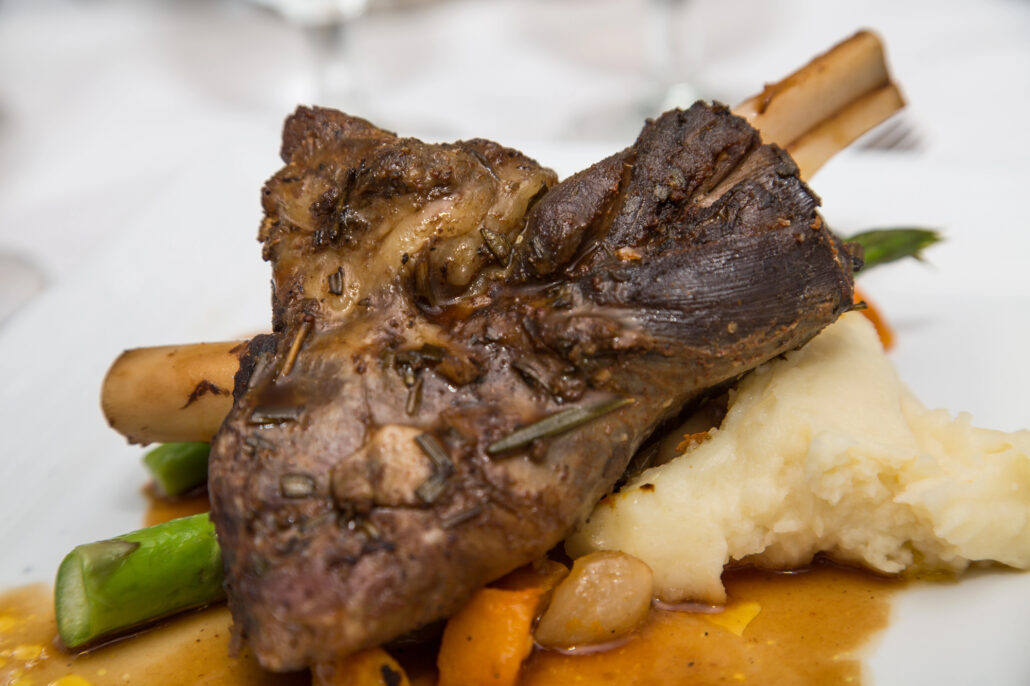
Lamb shanks slow-roasted with garlic, lemon, white wine, and dried oregano is not a complicated dish. It is barely a recipe in the way that most recipes are recipes — there are no techniques to master, no equipment requirements beyond a roasting pan and an oven, no ingredients that require sourcing beyond a good butcher. What it requires is time, and time is something Greek cooking has always been generous with.
Lamb in Greek Culture
Greece is a country that eats lamb with the seriousness and frequency that other cultures reserve for beef. This is partly geography — the mountainous terrain that covers most of mainland Greece and the rocky islands of the Aegean are suited to sheep and goat in ways they are not suited to cattle. It is partly history — Greek shepherding traditions go back to antiquity, and the relationship between Greeks and their sheep has been continuous and intimate for millennia. And it is partly culture — lamb is the correct meat for Easter, for weddings, for celebrations, for Sunday lunch, for the kind of hospitality that says I have prepared something meaningful for you.
The Easter lamb in Greece is as culturally significant as the Christmas turkey in Britain or the Thanksgiving turkey in America, and considerably more delicious. On Holy Saturday night and Easter Sunday, Greek families across the country roast whole lambs on spits over open fires — a practice called spit-roasting or souvla — or slow-cook lamb kleftiko (lamb wrapped in foil with vegetables and herbs, sealed and buried in ash or cooked in a very low oven) or roast lamb shanks in clay pots called stamnato. These are not restaurant preparations. They are home cooking at its most elemental.
We ate roast lamb shanks at a taverna on the outskirts of Nafplio — a beautiful Venetian port town in the Peloponnese that makes an excellent base for exploring the ancient sites of the Argolid. The shanks arrived in a ceramic dish, swimming in reduced pan juices, with a pile of hand-cut fried potatoes and a green salad dressed with nothing but olive oil and dried oregano. The lamb had been in the oven since morning. It fell from the bone before we touched it with a fork. The lemon in the pan juices had cooked down to a concentrated brightness that cut through the lamb’s richness. We ate slowly and ordered more bread and did not speak very much.
Greek Oregano
The dried oregano used in Greek cooking is not the dried oregano in a supermarket spice jar, though that will work in a pinch. Greek oregano — rigani — is a specific variety of Origanum vulgare with a more intense, slightly floral flavor than the Italian or Mexican oregano varieties that most American spice companies sell. It is sold in bundles of dried stems, often still attached to the stalks, and it has a pungency that makes it smell more like what you are looking for when you smell that hillside taverna.
Greek oregano is increasingly available at specialty food stores and online and is worth seeking out for this recipe. The difference in the finished dish is noticeable — the lamb smells authentically Greek in a way that standard dried oregano does not quite achieve. If you cannot find it, a combination of standard dried oregano and a small amount of dried marjoram approximates the flavor reasonably well.
The Recipe
Ingredients (serves 4)
- 4 lamb shanks, about 1 lb each
- 6 cloves garlic, thinly sliced, plus 4 whole cloves
- 2 tablespoons dried Greek oregano (rigani)
- Zest and juice of 2 lemons
- ¼ cup extra virgin olive oil
- 1 cup dry white wine
- 1 cup chicken or lamb stock
- 1 tablespoon tomato paste
- 2 sprigs fresh rosemary
- Salt and black pepper
Instructions
Prepare the lamb. Using a small sharp knife, make 6 to 8 small incisions in each lamb shank, about ½ inch deep. Push a thin slice of garlic into each incision. Season the shanks generously with salt, black pepper, and 1 tablespoon of the oregano, pressing the seasoning into the meat. If time allows, do this the night before and refrigerate uncovered — the overnight seasoning makes a noticeable difference.
Sear. Preheat the oven to 325°F. Heat the olive oil in a large ovenproof Dutch oven or roasting pan over high heat. Sear the lamb shanks on all sides until deeply browned, about 3 to 4 minutes per side. Work in batches if necessary — do not crowd the pan. Remove and set aside.
Build the braising liquid. Reduce heat to medium. Add the whole garlic cloves and cook until golden, about 2 minutes. Add the tomato paste and stir for 1 minute. Pour in the white wine, scraping up the browned bits. Add the stock, lemon juice, lemon zest, remaining oregano, and rosemary sprigs. Bring to a simmer.
Braise. Return the lamb shanks to the pot, nestling them in the liquid. The liquid should come about halfway up the shanks — add more stock or water if needed. Cover tightly and transfer to the oven. Cook for 2½ to 3 hours, turning the shanks once halfway through, until the meat is completely tender and pulling away from the bone. Remove the lid for the final 30 minutes to allow the top of the shanks to caramelize and the sauce to reduce.
Rest and serve. Remove the shanks to a warm plate. If the braising liquid is too thin, reduce it over high heat on the stovetop for 5 minutes until it coats the back of a spoon. Pour over the shanks. Serve with crusty bread, roasted potatoes, or orzo cooked in the pan juices. A Greek salad — tomatoes, cucumber, Kalamata olives, feta — alongside is correct and good.
Eating Lamb in Greece
One of the best things about traveling in Greece is that the quality of the lamb is so consistently excellent that even average tavernas produce memorable lamb dishes. The animals graze on hillsides dense with wild herbs — thyme, oregano, sage — and the meat reflects it. Greek lamb has a flavor that farmed, grain-fed lamb in supermarkets cannot match, and eating it in Greece makes clear why the combination of Greek lamb with Greek oregano and Greek olive oil is greater than the sum of its parts.
If you are traveling in Greece, eat lamb kleftiko in the islands — the slow-cooked, foil-sealed version that emerges from low ovens with a concentrated intensity. Eat lamb on a spit at Easter if you happen to be there for it — the experience of eating freshly spit-roasted lamb with a Greek family on Easter Sunday is one of the great food travel experiences available anywhere. And order the lamb shank whenever you see it on a taverna menu, because the version they have been making for decades in that specific kitchen will be better than anything you can replicate at home, and the combination of very good lamb, very good olive oil, and a cold glass of Assyrtiko on a hillside in the Greek light makes it better still.
For everything you need to plan a Greece trip see our complete Greece itinerary. For more on Greek food and where to eat see our Athens food guide and our Loukaniko Greek sausage recipe. For island travel see our guide to which Greek island to visit.

Ingredients
Method
- Preheat oven to 425° F.
- Trim as much of the outer fat from the shank as you can, set the fat aside, and then rub the shank with the lemon juice. Cut open 4-5 slits in the shank, located a few inches apart. Insert a clove of gresh garlic into each slit you cut.
- Put the prepped shank into a roasting pan, and surround with the onion, which has now been sliced. Season generously with pepper and salt, then finish and rub in olive oil.
- Put the seasoned shank and sliced onion into the oven in a baking pan, and cover for a half-hour. After cooking for a half-hour, remove the cover and continue cooking for one hour, or until lamb reaches an internal temperature of about 130 degrees. and is golden brown on the outside.
- To finish, place the shanks on a high-temp grill about 2 to 3 minutes each side for extra-nice golden crispiness on the outside – just enough to sear in the fats. Allow meat to sit 10 minutes before serving.