Mexico City has one of the great street food cultures in the world — not one of the great street food cultures in Latin America, but one of the great ones anywhere, in the same conversation as Bangkok, Tokyo, and Istanbul. The city of 21 million people feeds itself primarily on the street, from the taco stands that open at midnight and close at dawn, from the market stalls serving pozole and menudo at seven in the morning, from the tlayuda carts and the tamale vendors and the elote sellers who appear in parks and outside metro stations at exactly the times when hungry people are walking past.
Understanding Mexico City street food requires abandoning the idea that street food is a budget compromise. It is not. The best food in Mexico City is frequently on the street, made by people who have been making the same preparation for decades and who have no incentive to change anything because what they make is already perfect.
Tacos al Pastor
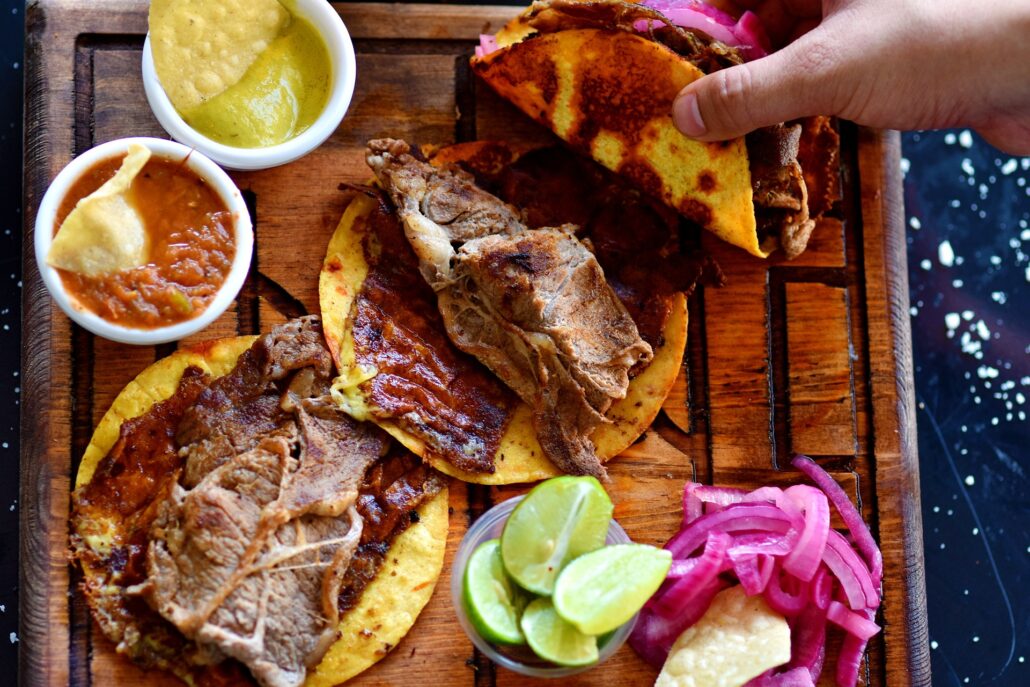
Tacos al pastor are Mexico City’s most iconic street food and the preparation most worth understanding deeply before you eat your first one. The meat — pork marinated in dried chiles and achiote, stacked on a vertical spit called a trompo and cooked slowly as it rotates — was brought to Mexico by Lebanese immigrants in the early 20th century, who adapted their shawarma technique to local ingredients. The result is entirely Mexican in flavor while being entirely Middle Eastern in method — one of the most interesting food culture collisions in culinary history.
The taquero who works the trompo is a craftsman. He shaves the meat from the rotating cone with a long knife, catches it on a small corn tortilla, and tops it with a sliver of pineapple cut from the top of the spit in a single fluid motion that takes years to perfect. The best al pastor in Mexico City is found in the Colonia Roma and Condesa neighborhoods, in the Mercado de Medellín, and in the late-night taco stands of the Centro Histórico that operate until two or three in the morning serving workers finishing their shifts.
El Huequito on Calle Ayuntamiento in the Centro — operating since 1959 — is the most historically significant al pastor destination in the city. El Tizoncito in Condesa claims to have invented the preparation. Both are worth visiting. Both will have a line. The line is the correct response.
Tamales
Mexico City tamales are different from the tamales of Oaxaca or Veracruz — larger, wrapped in corn husks rather than banana leaves, with a masa that is denser and more substantial than the regional variations. They are the breakfast food of the city, sold from enormous steaming pots by vendors who set up outside metro stations at six in the morning and sell out by nine.
The combinations are specific: rajas con queso — strips of poblano chile with cheese. Mole with chicken. Green salsa with pork. Each vendor has their own masa recipe and their own fillings and regular customers who have been buying from the same vendor for years. The correct accompaniment is atole — a thick, warm corn-based drink flavored with chocolate, vanilla, or fruit — served in a styrofoam cup that you carry onto the metro and drink while commuting. This is how Mexico City eats breakfast.
Tortas and Cemitas
The torta — Mexico City’s sandwich — is made on telera or bolillo bread, split and toasted on a plancha, filled with any combination of proteins, beans, avocado, chipotle, and whatever else the torta maker considers essential. The cemita, which comes from Puebla but is well represented in Mexico City, uses a sesame-seeded bun and a specific combination of milanesa (breaded cutlet), avocado, Oaxacan cheese, papalo herb, and chipotle that produces one of the best sandwiches in Mexican cooking.
The Mercado de Jamaica in the south of the city has some of the best torta stands in Mexico City, operating in the back of a flower market that produces a surreal combination of the beautiful and the delicious. The torta de cochinita pibil — slow-roasted achiote pork from the Yucatán tradition, increasingly common in Mexico City — is worth seeking specifically.
Elotes and Esquites
Corn on the cob — elote — served on a stick, slathered with mayonnaise, rolled in cotija cheese, and dusted with chile powder and lime, is one of Mexico’s great street snacks and one that most visitors either love immediately or regard with bewilderment until the first bite converts them. The combination of sweet corn, creamy mayonnaise, salty cheese, acidic lime, and the heat of chile sounds improbable and tastes extraordinary.
Esquites — the same ingredients served off the cob in a cup — are the street food version for people who do not want to eat corn on a stick while walking. Both are sold from carts throughout the city’s parks, markets, and street corners at all hours. Chapultepec Park on a weekend afternoon, surrounded by families eating elotes and flying kites, is one of the most purely pleasurable experiences available in Mexico City.
Tlayudas
Tlayudas originate in Oaxaca but have a strong presence in Mexico City’s Oaxacan community, which is large enough to support dozens of Oaxacan restaurants and street food operations throughout the city. A tlayuda is a large, partially dried tortilla spread with black bean paste, Oaxacan cheese, and your choice of protein — tasajo (dried beef), chorizo, or chapulines (toasted grasshoppers for the adventurous) — folded and cooked on a comal until the cheese melts and the edges crisp.
The Mercado de Medellín in Colonia Roma has a dedicated Oaxacan food section where tlayudas are made to order alongside mezcal poured from unlabeled bottles at eleven in the morning. This is the correct context for both.
Chapulines
Grasshoppers — chapulines — are one of Mexico City’s most discussed street foods and one of the most genuinely worth trying. Toasted with chile, lime, and salt, they have a light, crunchy texture and a flavor that is simultaneously nutty, salty, and slightly sour. They are not an exotic thrill-eating experience — they are a genuine food with a 3,000-year history in Mexican cooking, eaten by the Aztecs and still eaten at markets throughout Oaxaca and Mexico City. They appear in tlayudas, on tacos, as a topping for guacamole, and sold by the bag at market stalls.
The correct approach is to try a few from a market stall rather than ordering a full tlayuda with them before you know whether you like the flavor. Most people who try them find the flavor mild and pleasant. The psychological barrier is the preparation, not the taste.
The Markets
Mexico City’s markets — mercados — are the best places to eat street food because they concentrate the city’s best prepared food vendors in a single covered space. The Mercado de San Juan near the Centro Histórico is the most internationally diverse, selling exotic imported ingredients alongside traditional Mexican produce and prepared food stalls serving everything from Japanese sashimi to Mexican-Lebanese fusion. The Mercado de Medellín in Roma has the best Oaxacan food in the city. The Mercado Jamaica is extraordinary for its combination of flowers and food. La Merced — the largest market in the city — is an overwhelming, all-encompassing experience that requires several hours and a significant appetite.
The Best Neighborhoods for Street Food
Colonia Roma and Condesa are the neighborhoods where Mexico City’s food-focused travelers spend the most time — well-maintained, safe for walking, dense with restaurants, markets, and street food at every price point. The Centro Histórico has the most historically significant street food but requires more navigation awareness. Coyoacán in the south — Frida Kahlo’s neighborhood, with its cobblestone streets and weekend market — has excellent street food in a calmer, more tourist-friendly setting.
For everything you need to plan a Mexico trip see our Yucatán travel guide. For Mexican recipes from our travels see our Traditional Mexican Pozole and our guide to the national dishes of Mexico.