Pozole is the kind of dish that takes you somewhere specific the moment you smell it — the dried chiles toasting in a dry pan, the pork shoulder beginning to yield its fat into the broth, the hominy swelling slowly in the liquid until it blooms open at one end like a small flower. It is the smell of a Mexican market at seven in the morning, of a Oaxacan comedor with plastic chairs and a handwritten menu, of a grandmother’s kitchen in Guerrero state where this soup has been made every Thursday for as long as anyone can remember.
Pozole is one of the oldest dishes in Mexican cuisine — older than Mexico itself. The Aztecs made it for ceremonial occasions, using hominy corn and, according to historical accounts that archaeologists largely accept, human meat. The Spanish conquest ended the ceremonial version abruptly and pork replaced the original protein — a substitution that, whatever its historical circumstances, produced one of the great soups of the world.
The History in the Bowl
Hominy corn — maíz cacahuazintle, treated with calcium hydroxide in a process called nixtamalization — is one of the great culinary inventions of pre-Columbian Mesoamerica. The nixtamalization process transforms dried corn in ways that go far beyond cooking: it increases the bioavailability of the corn’s nutrients, creates the characteristic chewy texture that hominy has and dried corn does not, and develops a flavor that is simultaneously corn-like and something more complex and minerally.
The Aztecs called the dish pozolli, from the Nahuatl word for the foamy broth. When the hominy blooms open during the long simmer — the dried corn kernel splitting at the crown and spreading outward like a flower — the starch it releases creates a slight cloudiness in the broth that the Aztecs associated with the foam on the surface of water. This transformation, the dried kernel becoming something tender and yielding and giving its starch to the broth around it, is the visual marker that pozole is ready.
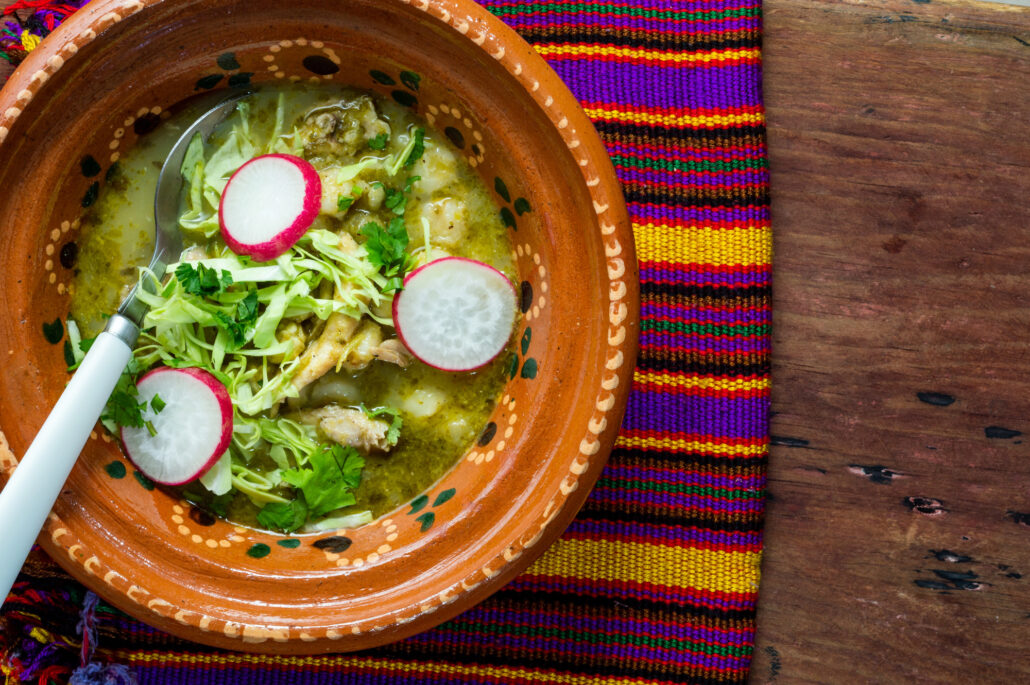
Today pozole exists in three primary versions across Mexico: rojo (red, made with dried chiles), blanco (white, made without chiles), and verde (green, made with tomatillos and green chiles). The red version is most common in Guerrero and Jalisco states. The white version is associated with Guerrero’s coastal communities. The green version is most often found in Mexico City and Morelos. All three use hominy and pork as their foundation. All three are served with a table full of garnishes — shredded cabbage, dried oregano, tostadas, sliced radishes, lime, chile flakes, avocado — that each diner assembles individually, turning a shared bowl of soup into a personal construction.
Oaxaca and the Soup Culture of Southern Mexico
Southern Mexico — Oaxaca, Guerrero, Puebla — has one of the great soup cultures in the world and it is significantly underappreciated by travelers who spend their Mexican time in Mexico City and the Yucatán Peninsula. Oaxaca specifically is a city where eating well requires almost no effort. The mercado 20 de Noviembre has been operating since before the Mexican Revolution and its food stalls serve tlayudas, mole negro, and bowls of pozole rojo to locals and travelers with equal enthusiasm. The city’s fondas — family-run lunch restaurants serving a fixed menu — produce some of the best affordable food in Mexico, and pozole appears on their menus throughout the week.
We ate pozole for the first time in a small comedor near the Oaxacan zócalo at eight in the morning — breakfast, which is the traditional time for pozole in southern Mexico, eaten as a restorative after a night out or simply because the soup is good and it is morning and there is no better reason needed. The bowl arrived with the garnishes arranged on a plate beside it: shredded cabbage, thinly sliced radishes, dried oregano, fresh lime wedges, tostadas. We added everything and ate it slowly and talked about nothing in particular and it was one of the best meals of that trip.
The Recipe
Ingredients (serves 6 to 8)
For the pozole:
- 2 lbs pork shoulder, cut into large chunks
- 1 pork trotter or 2 pork neck bones (optional but adds body to the broth)
- 2 25-oz cans hominy, drained and rinsed (or 1 lb dried hominy, soaked overnight)
- 1 white onion, halved, plus ½ onion finely diced for garnish
- 8 cloves garlic, divided
- 2 bay leaves
- 1 tablespoon kosher salt, plus more to taste
- 10 cups water or light chicken stock
For the red chile base (rojo version):
- 4 dried guajillo chiles, stemmed and seeded
- 2 dried ancho chiles, stemmed and seeded
- 2 dried pasilla chiles, stemmed and seeded
- 4 cloves garlic
- ½ white onion, roughly chopped
- 1 teaspoon dried Mexican oregano
- ½ teaspoon cumin
- 2 tablespoons vegetable oil
For the garnishes:
- ½ head green cabbage, shredded very fine
- 1 bunch radishes, thinly sliced
- Dried Mexican oregano
- Chile flakes or chile de árbol powder
- Tostadas or thick tortilla chips
- Limes, quartered
- 1 white onion, finely diced
- Avocado, sliced (optional)
Instructions
Cook the pork and hominy. Combine the pork shoulder, pork trotter if using, halved onion, 4 garlic cloves, bay leaves, salt, and water or stock in a large pot. Bring to a boil, skimming the foam that rises to the surface during the first 10 minutes. Reduce heat to a gentle simmer. Add the drained hominy. Cook uncovered for 2 to 2½ hours until the pork is completely tender and falling apart and the hominy has bloomed — each kernel opening at the crown like a small flower. This blooming is the visual signal that the hominy is done. Remove the pork and shred it into large pieces, discarding any fat or bone. Remove and discard the trotter, onion halves, garlic, and bay leaves. Return the shredded pork to the pot.
Make the chile base. While the pork cooks, toast the dried chiles in a dry skillet over medium heat for about 30 seconds per side — just until fragrant and slightly puffed. Do not let them burn or the sauce will be bitter. Transfer to a bowl and cover with boiling water. Soak for 20 minutes until completely softened. Drain, reserving the soaking liquid. Combine the rehydrated chiles, remaining 4 garlic cloves, rough-chopped onion, oregano, cumin, and ½ cup of the chile soaking liquid in a blender. Blend until completely smooth. Heat the vegetable oil in a skillet over high heat until shimmering. Pour in the chile purée all at once — it will spit and spatter dramatically. Fry the purée, stirring constantly, for 5 minutes until it darkens slightly and smells fragrant rather than raw.
Combine. Add the fried chile base to the pozole pot and stir to incorporate. Simmer for 30 minutes, allowing the chile flavors to integrate with the broth. Taste and adjust salt generously — pozole broth should be well-seasoned. Add more chile soaking liquid or water if the broth has reduced too much.
Serve. Ladle the pozole into large bowls — the hominy and pork should be generously proportioned relative to the broth. Bring the garnishes to the table on a plate or in small bowls. Each person adds their own: a handful of shredded cabbage, several radish slices, a pinch of dried oregano crushed between the fingers, chile flakes, a squeeze of lime, a tostada for dipping. The garnishes are not optional decoration — they are structural components of the dish, adding texture and freshness to the rich, chile-deep broth.
Pozole in Context
One of the pleasures of pozole as a travel dish is that it tells you where you are. The pozole in Guerrero is different from the pozole in Jalisco is different from the pozole in a Mexico City neighborhood restaurant. The chiles change, the garnishes shift, the proportion of hominy to broth varies, the level of heat adjusts to local preference. Eating pozole in the region that made it — in Oaxaca or in Acapulco or in Guadalajara — is a way of tasting the specific culture of that place, its ingredients and its preferences and its relationship with a dish that has been part of the food culture for three thousand years.
This version is a starting point, not a definitive statement. Adjust the chiles to your preference, add more hominy if you want a thicker bowl, use chicken instead of pork if that is what you have. The soup is forgiving in the way that old dishes are always forgiving — centuries of home cooks have made it with whatever was available and it has remained itself throughout.
For everything you need to plan a Mexico trip see our Yucatán travel guide. For more on Mexican food culture see our national dishes of Mexico and our Mexico City street food guide.

Ingredients
Method
- In a large pot, heat 2 tbsp. of oil over medium heat. Add the pork shoulder pieces and cook until browned on all sides.
- Remove the pork from the pot and set aside.
- In the same pot, add the chopped onion and cook until softened.
- Add the minced garlic and cook for 1 minute.
- Toast the dried ancho chiles in the pot until fragrant.
- Remove the chiles from the pot and blend them with 2 cups of chicken stock in a blender until smooth.
- Add the pureed chiles back to the pot along with the dried oregano, cumin, thyme, flour, and remaining chicken stock.
- Stir in the browned pork and bring the mixture to a boil.
- Reduce heat and let the pozole simmer for 2 hours, stirring occasionally, until the pork is tender.
- Stir in the drained and rinsed hominy and continue cooking for another 15 minutes.
- Season with salt and pepper to taste.
- Serve the pozole in bowls and top with shredded lettuce, sliced radish, diced onion, chopped cilantro, lime wedges, avocado, and crumbled queso fresco.