Athens is one of those cities where the honest answer depends entirely on what kind of traveler you are. If you are here purely for the ancient history — the Acropolis, the Agora, the National Archaeological Museum — three full days is enough to do it properly without rushing. If you want to understand Athens as a living city, with neighborhoods worth exploring, a food scene that has transformed in the past decade, and the kind of slow urban wandering that reveals a place rather than just ticking it off, four to five days is closer to the truth.
What almost everyone gets wrong is arriving with two days allocated. Two days in Athens is not enough. You will spend your first morning jet-lagged, your first afternoon on the Acropolis in peak-hour heat, your second day trying to fit everything else in, and you will leave having seen the monuments but not the city. The monuments are extraordinary. The city is better than most visitors expect. Give it time.
This guide breaks down exactly what you can do in Athens across different trip lengths, what you should prioritize, what you can skip, and how to structure your days so you are not exhausted before noon.
The Short Answer: Three Days Is the Minimum
Three full days in Athens gives you enough time to see the Acropolis and its associated sites properly, visit the two museums that matter most (the Acropolis Museum and the National Archaeological Museum), explore the old neighborhoods below the hill, eat well, and leave feeling like you understood where you were rather than simply passing through it.
Three days is the minimum for a meaningful visit — not the ideal. If your schedule forces a choice between two days and three, always choose three. The difference between a two-day and a three-day Athens visit is not incremental. It is the difference between a stressful monument sprint and an actual experience of the city.
What to Do With Three Days in Athens
Day 1: The Acropolis and Its Context
The Acropolis should be your first full day, and it should start early. Arrive at the main entrance on the south slope by 8am when the gates open. The difference between visiting at 8am and visiting at 11am is not an exaggeration — by mid-morning in summer the rock is hot underfoot, the crowds are thick, and the quality of the experience drops noticeably. In winter the crowds are thinner but the principle of arriving early still applies.
The combined ticket covers the Acropolis itself, the Ancient Agora, the Roman Agora, Hadrian’s Library, Kerameikos, and the Temple of Olympian Zeus. It is valid for five days, which is useful even on a three-day visit because you can spread the associated sites across your stay rather than cramming them all into one exhausting day.
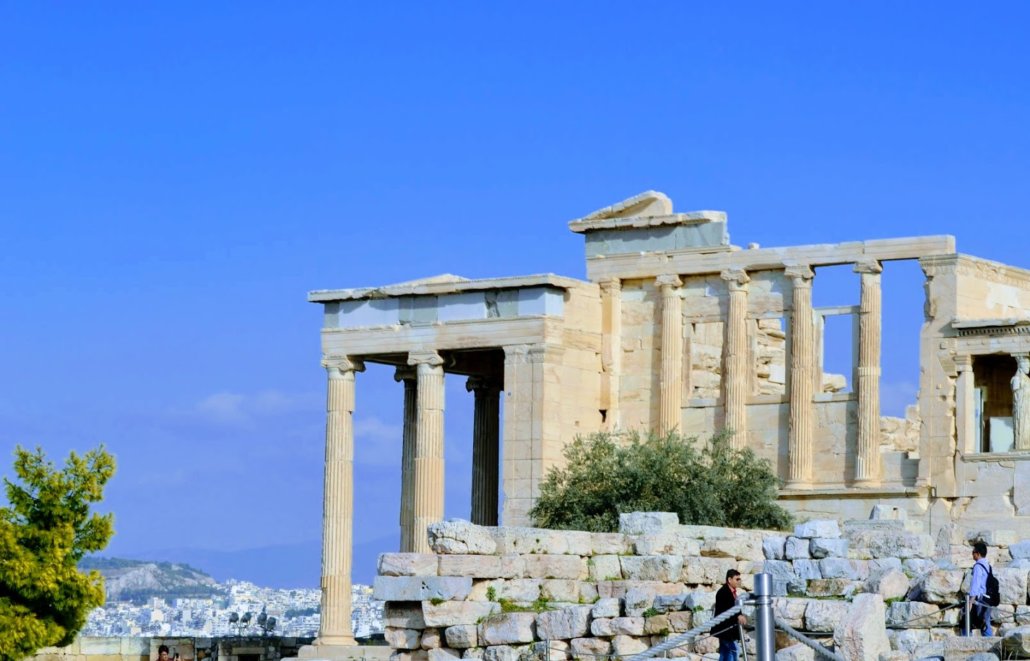
Spend your morning on the rock. The Parthenon is the obvious centerpiece but do not rush past the Erechtheion — the porch of the Caryatids, female figures serving as architectural columns, is one of the most remarkable things in Athens and gets less attention than it deserves. The Propylaea, the monumental gateway to the Acropolis, is equally impressive. Allow 90 minutes on the hill itself.
Come down from the rock and walk directly to the Acropolis Museum, which sits at the base of the south slope. This is not optional. The museum holds the surviving original sculptures from the Parthenon frieze, the original Caryatid figures (replaced on the monument by copies), and a comprehensive collection of pre-classical sculpture that gives everything you just saw on the hill its full context. Allow two hours. The museum café on the upper floor has one of Athens’s best views of the Acropolis — coffee here at midday is one of the city’s better pleasures.
Spend your afternoon in the Plaka, the old town at the foot of the Acropolis. The Plaka is touristy in the way that all ancient historic centers are touristy, but its streets are genuinely old and genuinely beautiful. The neighborhood rewards wandering without a fixed destination. Walk up through Anafiotika, a tiny neighborhood of whitewashed Cycladic-style houses built into the hillside by workers from the island of Anafi in the 19th century — it is the most unexpected and charming corner of central Athens.
For dinner, leave the Plaka and head to Monastiraki or Psiri, both within easy walking distance. These neighborhoods have Athens’s most honest restaurant options — tavernas serving grilled meat, mezze, and house wine rather than the tourist-facing menus that dominate the streets closest to the monuments.
Day 2: Ancient Agora and the National Archaeological Museum
Your second day should split between the ancient civic center of Athens and its greatest museum collection.
Start at the Ancient Agora, which opens at 8am. The Agora was the social, commercial, and political heart of classical Athens — the place where citizens gathered, debated, traded, and conducted the business of democracy. What survives is substantial: the Stoa of Attalos, a reconstructed 2nd-century BC colonnade that now houses the Agora Museum, and the Temple of Hephaestus, the best-preserved Doric temple in Greece, sitting on a low hill above the site. Allow 90 minutes.
From the Agora, walk or take the Metro to the National Archaeological Museum in Exarchia. This is one of the great museums of the world and one that is systematically undervisited relative to its quality — partly because it sits away from the Acropolis area and partly because visitors run out of time. Do not let that happen. The collection spans prehistoric Cycladic figurines through to Byzantine bronzes, but the highlights are the Bronze Age Mycenaean treasures (including Schliemann’s so-called Mask of Agamemnon), the monumental kouroi (archaic marble youths), the ANTIKYTHERA shipwreck bronzes including the extraordinary Youth of Antikythera, and the Minoan frescoes from the island of Thera (Santorini). Allow three hours minimum. If you have only two hours, come back.
Spend your afternoon in Kolonaki, Athens’s upscale residential neighborhood east of the center. The neighborhood has good cafés, the excellent Benaki Museum (which covers Greek art from prehistoric times to the 20th century in a beautiful neoclassical building), and the Lycabettus Hill funicular, which climbs to the highest point in Athens for panoramic views stretching to the sea on clear days.
👉 For dinner recommendations in Athens, see our What to Eat in Athens guide.
Day 3: Neighborhoods, Sunset, and Slower Athens
Your third day is for the Athens that most visitors never see — the residential neighborhoods, the slower pace, and the moments that are harder to plan but easier to find when you are not running from monument to monument.
Start in Monastiraki, where the flea market operates every day but is most lively on Sunday mornings. The surrounding streets have some of Athens’s best independent shops, vintage dealers, and street food. Try a bougatsa (a warm custard or cheese pastry) from one of the bakeries near the square for breakfast.
Walk north to Exarchia, Athens’s most politically charged neighborhood — graffiti-covered, intellectually lively, and home to some of the city’s best neighborhood tavernas and natural wine bars. It is a deliberate contrast to the polished tourist zones near the Acropolis and worth spending a morning in.
In the afternoon, visit any remaining sites from your combined ticket — the Kerameikos archaeological site, which contains the ancient cemetery of Athens and is one of the least-visited but most evocative sites in the city, or Hadrian’s Library and the Roman Agora if you did not get to them on earlier days.
End your third evening at the Lycabettus Hill summit, if you did not go earlier, for sunset. Or climb the hill behind the Acropolis Museum to the Filopappou Hill, which offers a view of the Parthenon from the west — different from the tourist-standard angle and beautiful in the evening light.
What to Do With Four or Five Days in Athens
A fourth day in Athens opens up significantly. With the major monuments covered, you can afford to be more selective and more leisurely.
The Benaki Museum deserves a dedicated morning if you only passed through it on day two. The Islamic Art Museum, housed in a neoclassical building in Kerameikos, is one of the most underrated museums in Greece — a collection of Islamic art and objects that reflects Athens’s complex Ottoman history. The Museum of Cycladic Art is small but exceptional, focused on the enigmatic marble figurines of the Bronze Age Cyclades that influenced Picasso and Brancusi.
A day trip to Cape Sounion, 70 kilometers south of Athens at the tip of the Attica peninsula, is one of the most memorable excursions in Greece. The Temple of Poseidon sits on a clifftop above the Aegean, and the view at sunset is among the finest in the country. Buses run from central Athens in about 90 minutes.
A day trip to Delphi, 180 kilometers northwest of Athens, is more ambitious but rewarding for anyone with a serious interest in ancient history. The sanctuary of Apollo, set on the slopes of Mount Parnassus, was considered the center of the world by the ancient Greeks. The site and its museum make for a full day.
Five days in Athens gives you all of the above plus genuine time to slow down — to sit in a neighborhood café for two hours, to revisit the Acropolis at a different time of day, to follow a recommendation from a local rather than a guidebook. Five days is when Athens stops being a destination you are visiting and starts being a place you are living in, briefly.
Is One Day in Athens Enough?
One day in Athens is not enough, but it is worth doing if a cruise stop or connecting flight gives you no other option. If you have a single day, spend it on the Acropolis in the morning (arrive at opening) and in the Acropolis Museum in the late morning. Have lunch in the Plaka, walk through Monastiraki in the afternoon, and climb to a viewpoint for the evening light. You will see the most important things. You will not understand the city. Come back.
The Best Time to Visit Athens
April, May, and June are the finest months for Athens. The weather is warm and reliable without the brutal heat of high summer, the tourist crowds have not yet reached their July-August peak, and the city is at its most accessible. September and October are nearly as good — slightly cooler, with lower accommodation prices and thinner crowds at the major sites.
July and August are the most popular months and the most difficult. Temperatures regularly reach 35–38°C (95–100°F) and can exceed 40°C (104°F). The Acropolis rock absorbs and radiates heat to a degree that makes afternoon visits genuinely unpleasant and potentially dangerous for vulnerable travelers. If you visit in high summer, the Acropolis must be done at opening time — before 10am — or late afternoon after 5pm when the worst heat has passed.
Winter (December through February) is quiet and inexpensive. The weather is mild by Northern European standards — rarely below 10°C (50°F) — but overcast and occasionally rainy. Most sites are open and less crowded. The light on the Acropolis in winter morning sun is extraordinary, and the absence of crowds makes it easier to spend time with the monuments than in any other season.
Practical Athens Planning Notes
The combined archaeological ticket is your first purchase. It covers the Acropolis, Ancient Agora, Roman Agora, Kerameikos, Hadrian’s Library, and the Temple of Olympian Zeus. Buy it at any of the sites or in advance online. It is valid for five days.
The Athens Metro is clean, reliable, and covers the city well. The main archaeological sites are concentrated in the center and most are walkable from each other. Comfortable shoes matter — Athens is a walking city built on uneven ancient terrain.
Carry cash. Athens operates more on cash than most Western European capitals — many tavernas, market stalls, and smaller shops do not accept cards. ATMs are widely available throughout the center.
Tipping is appreciated but not obligatory. Rounding up the bill is the standard approach — 10% at restaurants is generous rather than expected.
The heat in summer is the most important practical factor for planning your days. Outdoor sightseeing should happen in the morning and early evening. The traditional siesta hours of 2–5pm are the right time for museums, covered markets, and shade.
👉 For where to stay in Athens by neighborhood, see our Where to Stay in Athens guide.
How Athens Fits Into a Broader Greece Itinerary
Most Greece trips combine Athens with at least one island. The most common structure — and the most logical one — is to start with two to three days in Athens before taking a ferry or flight to the islands. Athens handles the ancient history and urban culture; the islands handle the coastline, the light, and the slower pace.
Santorini is the most popular island addition — three nights there is the right allocation for a first visit. For travelers who want more than Santorini’s caldera views, Crete, Paros, or the Peloponnese peninsula (accessible by bus from Athens in under three hours) all offer different and rewarding additions to an Athens-centered itinerary.
👉 For help deciding which Greek island suits your trip, see our Greek Islands Explained: Which One Is Right for You?
The Bottom Line
Three days is the minimum for Athens done properly. Four days is better. Five days is ideal for travelers who want to understand the city rather than just see it.
The Acropolis and the National Archaeological Museum are the non-negotiables. Everything else — the neighborhoods, the day trips, the slower mornings — is what turns an Athens visit from a history lesson into something you will actually remember years later. Give it the time it deserves.