
Munich has a reputation as one of Germany’s more expensive cities — and by German standards, that reputation is earned. Hotel prices are high, restaurant bills add up quickly, and the cost of a Mass (one-liter stein) of beer at Oktoberfest can make even seasoned travelers wince. But beneath the surface of this prosperous Bavarian capital lies one of the finest collections of free and low-cost experiences in Central Europe — world-class parks, extraordinary architecture, historic beer halls you can walk through without spending a cent, and museums that open their doors for next to nothing on Sundays.
Munich is also a city that reveals itself most generously to those who simply walk it. The Altstadt’s medieval streets, the grand neoclassical boulevards of Maxvorstadt, the riverbanks of the Isar, and the vast green expanse of the Englischer Garten are all free, all extraordinary, and together constitute a walking city of the highest order. What few travelers realize before arriving is that Munich’s most memorable experiences — standing in the Englischer Garten watching surfers ride a river wave, eating a pretzel in the Viktualienmarkt beer garden, wandering the grounds of Nymphenburg Palace — cost nothing at all.
Munich has grown from a complex and at times deeply troubled history into a city of genuine serenity and civic pride. The site of the 1923 Beer Hall Putsch, the city that gave the Nazi movement its early political home, and the location of the 1972 Olympic Games tragedy, Munich has confronted its past with a seriousness and honesty that has shaped its present character. Understanding that history — much of which can be accessed for free — makes the city’s current warmth and livability all the more meaningful.
This article is part of our broader Germany travel coverage. For our full Munich guides, see our Munich City Guide, our Munich food guide, and our Munich accommodation guide.
👉 Munich City Guide: Neighborhoods, museums, palaces & everything to do in Munich →
👉 Germany Travel Guide: Cities, regions & everything you need to plan your Germany trip →
1. Free Walking Tour of the City Center
One of the best ways to orient yourself in Munich — and one of the finest free walking tour experiences in Europe — is to join one of the tip-based walking tours that depart daily from Marienplatz. Several independent tour companies operate in Munich, of which Sandeman’s New Europe Tours is the most established and most reliable. Tours convene in front of the Neues Rathaus on Marienplatz — the city’s central square, in continuous use as Munich’s civic heart since 1158 — and run for approximately two and a half to three hours through the Altstadt and surrounding neighborhoods.
The tour guides are genuinely knowledgeable and genuinely passionate about Munich — the combination that makes a walking tour worth doing rather than simply reading a guidebook. The route covers Marienplatz and the Glockenspiel (the mechanical chime clock that performs three times daily from the Neues Rathaus tower), the Viktualienmarkt food market, the Munich Residenz, the Hofbräuhaus, the Odeonsplatz, the Feldherrnhalle, and the sites associated with Munich’s turbulent 20th-century history — including the location of the 1923 Beer Hall Putsch and the early Nazi movement’s political activity in the city.
The Odeonsplatz section of the tour is particularly striking. The square — one of the grandest in Munich, flanked by the yellow Italianate facade of the Theatinerkirche and the Feldherrnhalle (a loggia modeled on Florence’s Loggia dei Lanzi) — was the site of some of the most significant early Nazi events. It was here that Hitler’s 1923 putsch collapsed when police opened fire on the marching column; sixteen Nazi marchers and four policemen were killed. A decade later, after the Nazis came to power, the Feldherrnhalle became a site of compulsory salutes — Munich residents who wanted to avoid saluting would detour through the narrow Viscardigasse alley behind it, which locals still call the “Drückebergergasse” (shirkers’ alley). These layers of history, explained in the context of the actual locations, make the walking tour one of the most valuable two hours available in Munich.
Check ahead for times and availability — tours run daily but frequency varies by season. Arrive a few minutes early to secure a spot; summer tours fill up fast. Tip generously if the guide is good — the entire business model depends on it.
2. The Gardens at Nymphenburg Palace
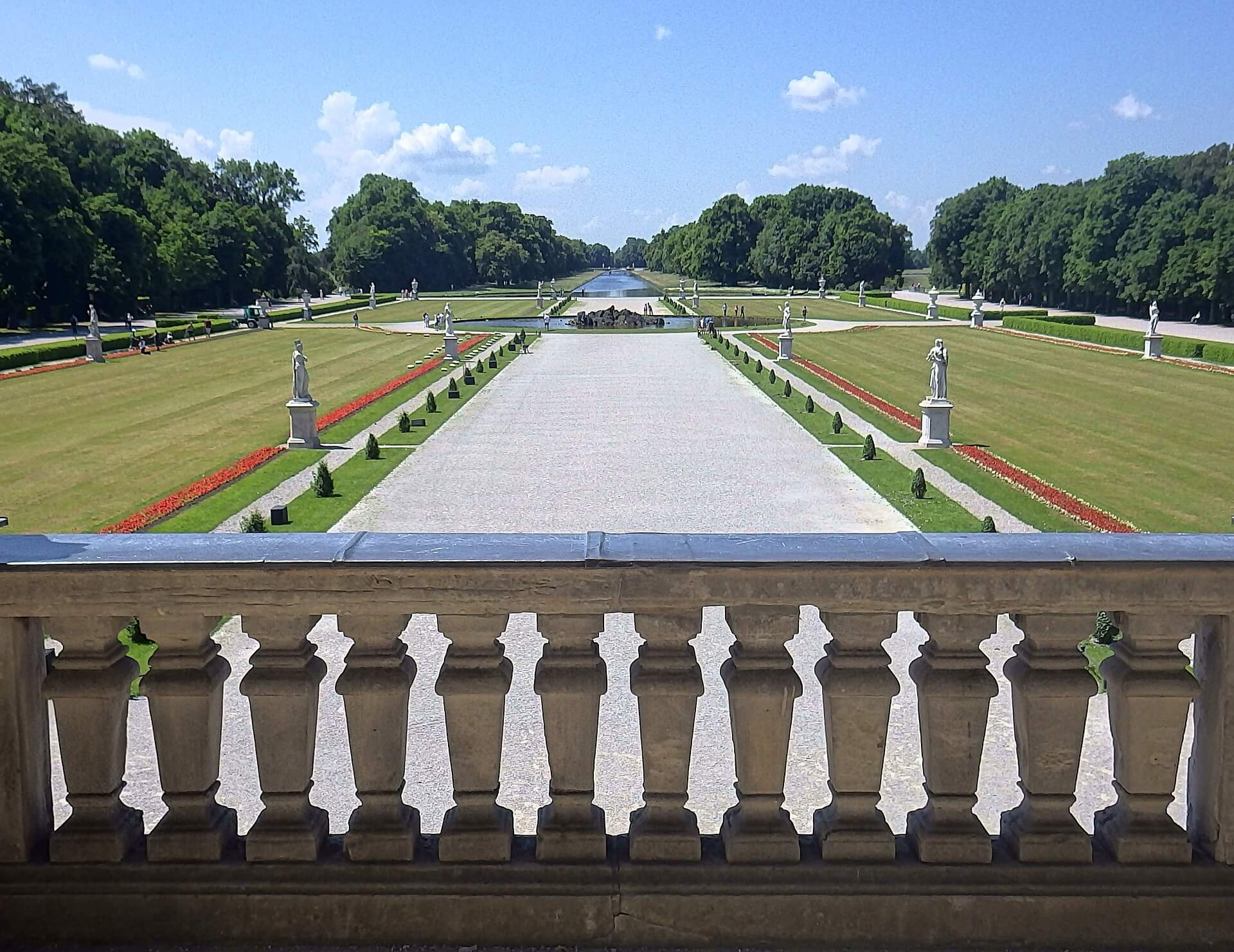
Nymphenburg Palace — the vast Baroque summer residence of the Bavarian royal family, 8km west of the city center — is one of the finest palaces in Europe and one of Munich’s most underrated half-day experiences. The palace interior charges an entrance fee and is absolutely worth paying for (the Gallery of Beauties alone justifies the cost), but the palace gardens — nearly 500 acres of formal Baroque parkland, canals, woodland, and ornamental lakes — are entirely free to enter and explore year-round.
The gardens were laid out in the formal French style in the late 17th century and subsequently expanded and modified through the 18th and 19th centuries. The Grand Cascade — a monumental water feature at the western end of the main canal — is the centerpiece of the formal garden; the long straight canal running from the palace’s central entrance to the cascade is one of the finest garden vistas in Bavaria. The manicured hedgerows, the seasonal flower plantings, and the extraordinary scale of the landscape give the gardens a grandeur that makes a free afternoon here feel genuinely like a privilege.
Within the grounds, several of the smaller pavilions and follies are worth seeking out. The Badenburg — a royal bathing house with an indoor heated pool, one of the earliest in Europe — and the Pagodenburg — a delicate two-story teahouse built in the Chinese style, reflecting the early 18th-century European fascination with Asian decorative arts — are both architectural gems that can be viewed from the outside for free. The Amalienburg, a small Rococo hunting lodge in the south garden designed by François de Cuvilliés (the same architect who designed the Cuvilliés Theatre in the Residenz), is one of the finest small buildings in Munich and visible from the garden paths at no cost.
The gardens are beautiful in every season — the formal parterres in summer, the canal frozen and skated in winter, the tree-lined allées turning golden in October. A morning at the Nymphenburg gardens followed by a picnic from the Viktualienmarkt is one of the finest free days Munich offers.
3. The Englischer Garten
The Englischer Garten is one of the great urban parks in the world — larger than New York’s Central Park and London’s Hyde Park combined, stretching 3.7 kilometers along the Isar River from the city center to the northern suburbs. It was commissioned in 1789 and designed as a public landscape garden for the citizens of Munich — one of the earliest public parks in European history, established at a time when the concept of public green space was genuinely radical. Entry is free, it is open at all hours, and it is used by Munich’s residents with an enthusiasm and regularity that makes it feel less like a tourist attraction and more like an extension of the city’s living room.
The park’s most surprising feature is the Eisbach — a fast-flowing artificial river channel that runs beneath a bridge near the Haus der Kunst museum at the park’s southern entrance. The specific hydraulics of the channel create a standing wave approximately one meter high that has been surfed by Munich residents since the 1970s. Year-round, regardless of temperature, a small group of surfers queues on the bank waiting their turn to ride the wave — typically for 30 to 60 seconds before the current defeats them. It is one of the most surreal urban sights in Europe and one of the most consistently photographed spots in Munich. Watch from the bridge directly above for the best view.
The Chinesischer Turm (Chinese Tower) — a five-story wooden pagoda in the heart of the park, built in 1789 and modeled on the Great Pagoda at Kew Gardens in London — is the center of the park’s largest beer garden, with seating for 7,000 people under the chestnut trees. The beer garden is free to enter; buy a Mass of Augustiner or Hofbräu from the central service counter, find a table, and spend an afternoon doing exactly what Munich residents have been doing here for over two centuries. There is no more authentically Bavarian free experience in the city.
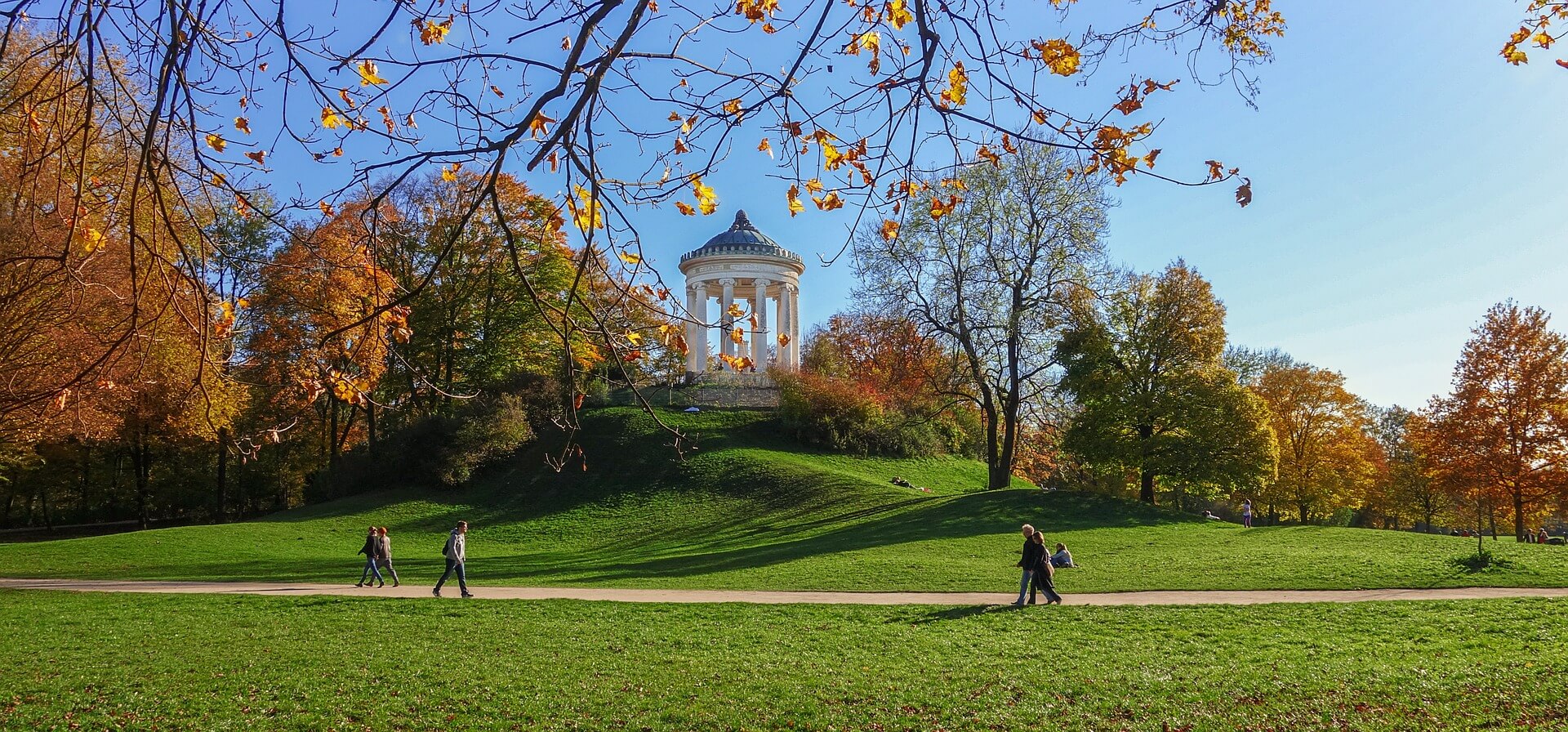
The Japanese Tea House, given to Munich by Japan during the 1972 Summer Olympics, sits on a small island in the park’s lake and hosts traditional Japanese tea ceremonies on certain weekends. The Monopteros — a small Greek-style temple on a hill in the southern section of the park — is the finest viewpoint over the park and the Altstadt skyline. In winter, the park’s lake freezes and locals skate on it; in summer, the meadows fill with sunbathers, picnickers, and the entire social life of a city that moves outdoors at the first opportunity.
4. The Hofbräuhaus
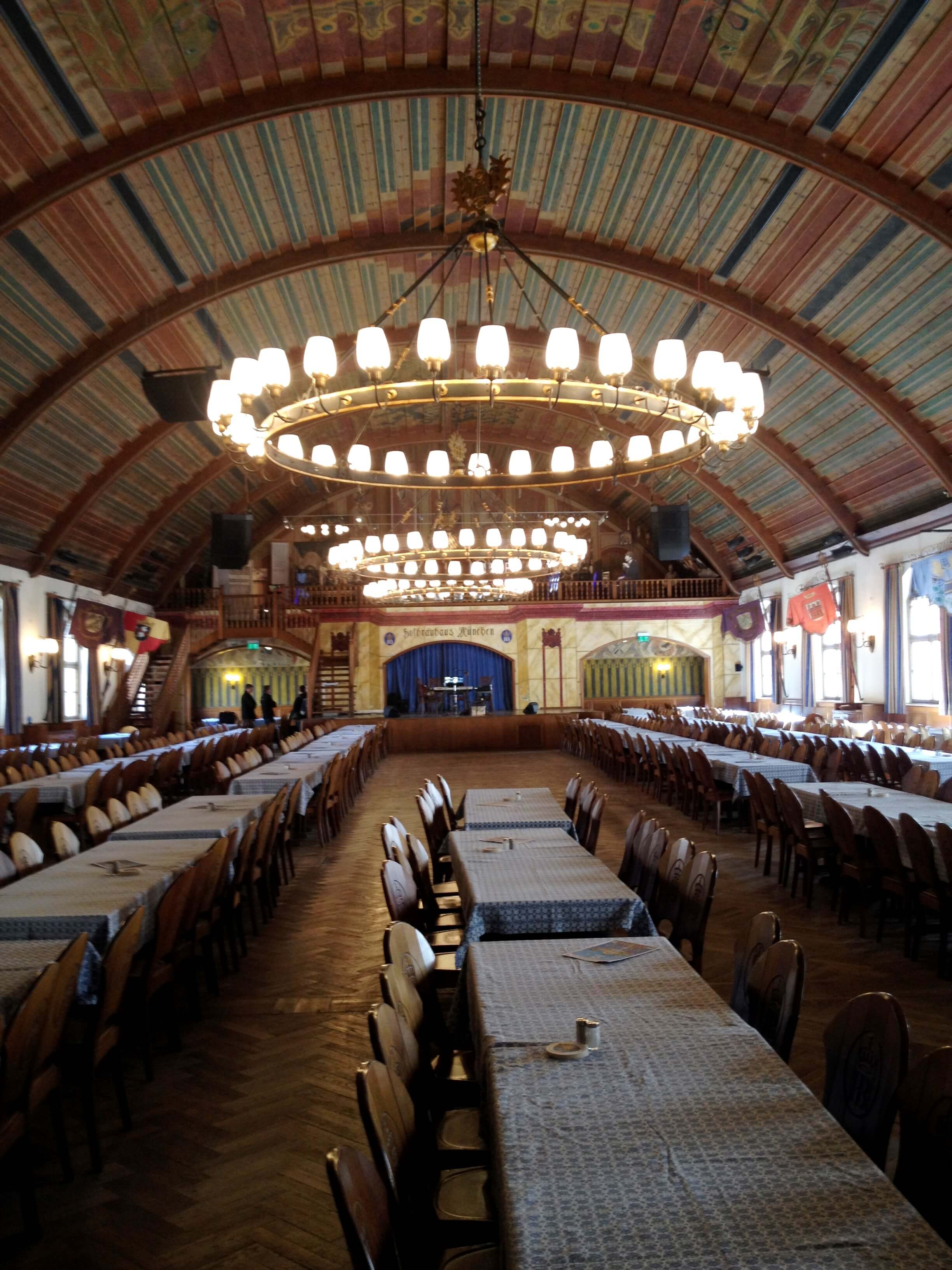
The Hofbräuhaus is Munich’s most famous building after the Marienplatz — a beer hall founded in 1589 as the royal brewery of the Wittelsbachs, heavily damaged in World War II, and meticulously restored to its original splendor. It is one of the most visited tourist destinations in Germany and, simultaneously, one of the most historically authentic beer hall experiences available anywhere in Bavaria. The tension between these two facts resolves itself surprisingly well in practice: the tourist volume is real but the building, the beer, the food, and the live Bavarian music are all entirely genuine.
What many visitors do not realize is that you can walk into the Hofbräuhaus, explore its extraordinary ground floor beer hall and upper dining room, and leave without spending a single euro. The main hall — with its vaulted, elaborately painted ceiling, long communal tables of worn wood, and the brass band platform at one end — is a work of decorative art in its own right and one of the most atmospheric interior spaces in Munich. Walking through it, understanding its history, and observing the particular social choreography of a Munich beer hall are entirely free.
We spent a long afternoon here on our last Munich visit — sat at a communal table in the lower hall, ordered the golden lager and a plate of schnitzel, and listened to the polka band fill the hall with music that bounced magnificently off the vaulted ceiling. The acoustics are extraordinary; the atmosphere is unlike any other room in the city. If you do spend money here, spend it on the Schweinshaxe (roasted pork knuckle) and a Mass of Hofbräu Original — the two things the kitchen has been doing best for over four centuries.
The Hofbräuhaus is also historically significant in ways that extend beyond beer. It was the site of Hitler’s first major public speech in 1920, at which the 25-point programme of the Nazi Party was announced to an audience of approximately 2,000 people. A small plaque acknowledges this history; the building’s postwar restoration and its current life as a place of cheerful communal eating and drinking represent, in some sense, one of Munich’s many acts of reclamation from its darkest period.
👉 What to Eat in Munich: Beer halls, Bavarian classics, the Viktualienmarkt & Munich’s best restaurants →
👉 Where to Stay in Munich: The best Munich neighborhoods and hotels for every budget →
5. Olympiapark — The 1972 Olympic Grounds
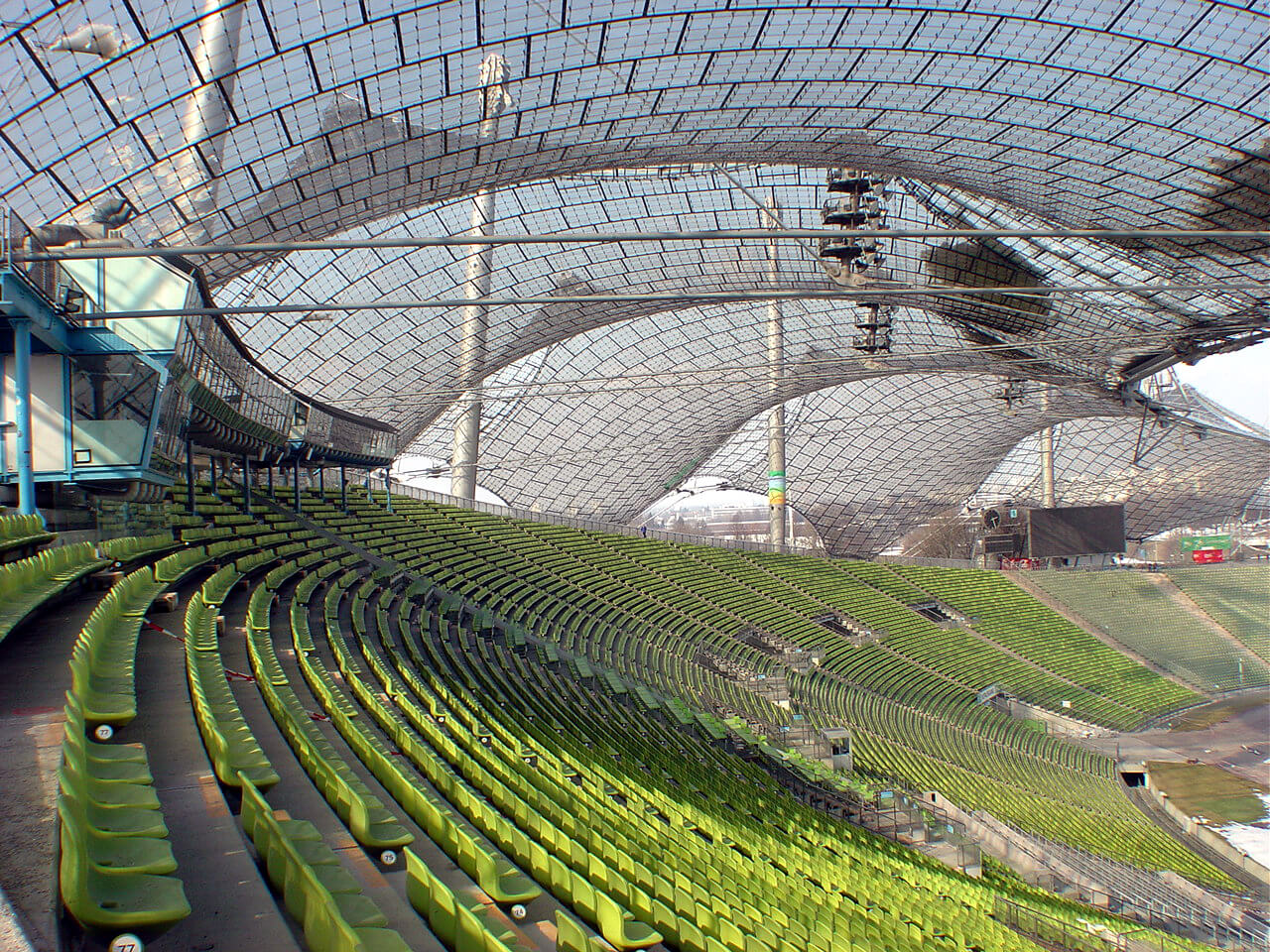
The Olympiapark — built for the 1972 Munich Summer Olympics and still one of the finest examples of late 20th-century urban park design in Europe — is entirely free to enter and explore. The park covers 85 hectares in the northern part of the city, centered on the Olympiastadion (Olympic Stadium), the Olympiahalle indoor arena, the Olympic swimming pool, and the artificial Olympiaberg hill built from the rubble of World War II bomb damage. The tent-like translucent acrylic roof that covers the stadium and adjacent buildings — designed by the architect Frei Otto and considered a landmark of structural engineering — is one of the most distinctive architectural achievements in Germany.
The 1972 Munich Olympics are remembered as much for tragedy as for sport — the massacre of eleven Israeli athletes and coaches by the Palestinian militant group Black September on September 5th, 1972 is one of the most devastating events in Olympic history. A permanent memorial within the park honors the victims; it is a sobering and important stop within the otherwise celebratory context of the Olympic grounds.
The Olympiaberg — the hill created from wartime rubble — is free to climb and offers one of the finest panoramic views in Munich: the Olympic complex below, the city skyline to the south, and on clear days the Alps rising above the southern horizon. It is the best free viewpoint in the city. The park hosts free outdoor concerts on the Olympic grounds during summer months; check the schedule before visiting as the programming varies year to year. The stadium still hosts football matches, concerts, and annual events including Holiday on Ice; the grounds surrounding it are accessible at all times without charge.
6. The Pinakothek Museums on Sunday
The three Pinakothek museums in Maxvorstadt — the Alte Pinakothek (Old Masters), Neue Pinakothek (19th-century European painting), and Pinakothek der Moderne (contemporary art, design, and architecture) — are among the finest art museums in Europe and normally charge standard museum admission. On Sundays, however, all three charge just €1 entry — one of the most extraordinary cultural bargains in any European city.
The Alte Pinakothek alone contains Dürer’s Self-Portrait, Rubens’s massive Massacre of the Innocents, Raphael’s Canigiani Holy Family, and one of the finest collections of early Netherlandish painting outside the Low Countries. The Neue Pinakothek has Caspar David Friedrich’s landscapes, Van Gogh’s Sunflowers (one of the series), and the finest collection of 19th-century German Romantic painting in the world. The Pinakothek der Moderne holds Picasso, Warhol, Beuys, and one of Europe’s finest design collections.
A Sunday visit to all three costs €3 total. Allow a full day and bring comfortable shoes.
7. The Viktualienmarkt Beer Garden
The Viktualienmarkt — Munich’s historic open-air food market in the heart of the Altstadt, operating on the same site since 1807 — has a beer garden at its center that operates year-round and is one of the most democratically accessible beer gardens in the city. Entry is free; the tradition at the Viktualienmarkt beer garden is to buy food from the market stalls surrounding it — cheese, bread, sausage, pretzels — and purchase only your beer from the garden’s central kiosk.
A Mass of seasonal beer from the rotating Munich brewery that supplies the Viktualienmarkt garden costs approximately €8. Sit at one of the long wooden tables under the chestnut trees, eat food from the market, watch the city’s residents do their daily shopping around you, and spend an hour doing what Munich has always done best: drinking good beer in good company in a beautiful public space. It is entirely free beyond the cost of the beer and food, and it is one of the most specifically Bavarian experiences available in the city.
8. Marienplatz and the Glockenspiel
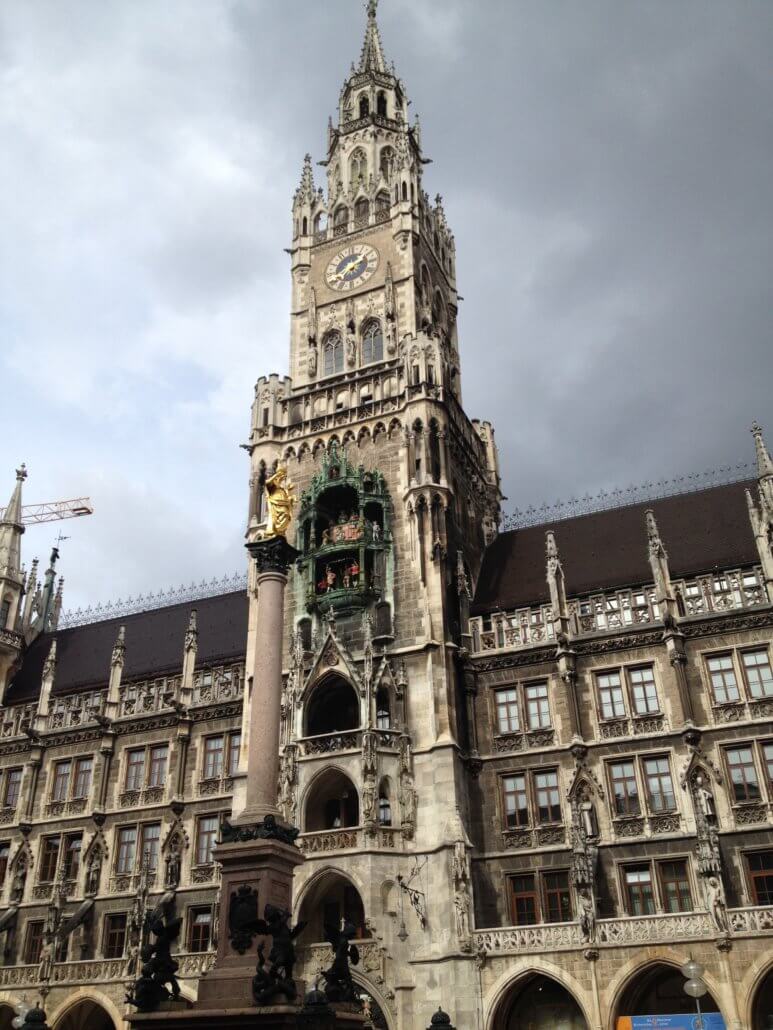
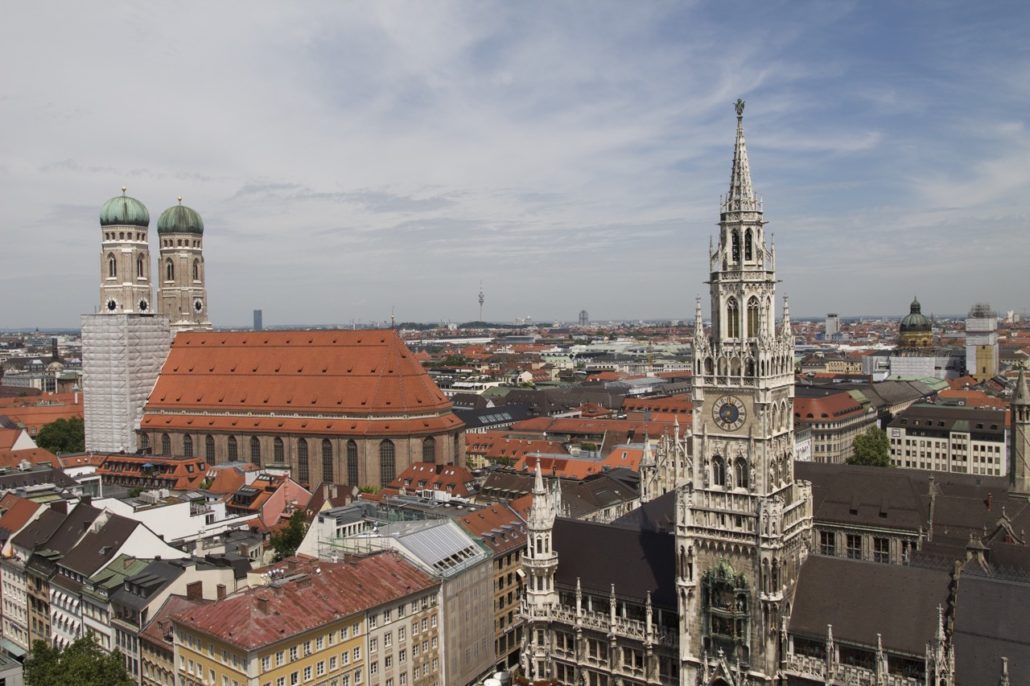
Marienplatz is Munich’s central square and its social heart — in continuous use since 1158, surrounded by the Neues Rathaus (New Town Hall) to the north, the Altes Rathaus (Old Town Hall) to the east, and the animated street life of a city that takes its public spaces seriously. Standing in Marienplatz costs nothing and reveals everything: the Gothic spires of the Frauenkirche rising above the roofline, the golden Mariensäule column at the square’s center, and the Glockenspiel — the 43-bell mechanical chime clock in the Neues Rathaus tower that performs daily at 11am, 12pm, and (in summer) 5pm, with 32 life-size figures reenacting two scenes from Munich’s history.
The Glockenspiel performance is free, takes approximately 15 minutes, and draws a crowd of several hundred people every day of the year. Watch it from the square for the spectacle; understand that the figures tell the story of a 16th-century royal wedding and a dance celebrating the end of a plague epidemic, and the mechanical theater takes on a different weight.
Practical Tips for Budget Travel in Munich
- The MVV day ticket pays for itself quickly — if you plan to use public transport more than twice in a day, the day ticket for the inner zones is better value than individual journey tickets
- Pinakothek museums on Sunday — €1 each; plan a Sunday museum day and see three world-class collections for €3 total
- Viktualienmarkt for lunch — buying from the market stalls and eating in the beer garden is significantly cheaper than sitting in a restaurant and the food quality is higher
- Free walking tour tip — the guides work entirely on tips; €10–15 per person is appropriate for a good two-hour tour. The tour itself is free but tipping well keeps these excellent services running
- Englischer Garten beer garden strategy — bring food from the Viktualienmarkt or a supermarket; the beer garden tradition permits outside food and dramatically reduces the cost of an afternoon in the park
- Nymphenburg gardens are free year-round — the palace interior charges admission but the grounds, canals, and exterior of the pavilions are always free
- Olympiaberg for views — the hill in Olympiapark is the finest free panoramic viewpoint in Munich; visit on a clear day when the Alps are visible to the south
👉 Munich City Guide: The complete guide to Munich’s neighborhoods, museums & experiences →
👉 What to Eat in Munich: Beer halls, Bavarian food & the best Munich restaurants →
👉 Where to Stay in Munich: The best Munich neighborhoods and hotels for every budget →
For our full Germany coverage, see our Germany travel guide.
Wow! This is pretty fascinating! So much about Munich. I will love to visit Munich someday but language barrier could be a major hitch to me, do they speak English also? I will appreciate any useful information about their official language.. Thanks!
Actually, yes. It’s funny because Tracy and I do speak some German (her more-so than me), but most of the time we would start speaking in German they reply in flawless English. In fact, I don’t think we ran across anyone that couldn’t communicate in English.
The Olympic Park is obviously a place to see by everyone landing on the soil of Munich. Its beauty is still standing even after years. The usual summer events will surely blow you off your mind. I love Munich beauty like ever before.
Agree – it’s such an underrated city, we believe 🙂