Florentine cuisine is arguably the most important in Italy — not the flashiest, not the most globally recognized, but the most historically significant. The cooking traditions of Renaissance Florence influenced the development of French haute cuisine, established the template for the formal Italian meal, and produced a body of recipes that have survived largely intact for five centuries. Eating well in Florence means understanding what makes its food distinct, which dishes are worth seeking out, and which neighborhoods and markets connect you most directly to how the city actually eats.
Unlike Rome, whose cuisine is built around a handful of pasta preparations and an offal tradition, Florentine food ranges from some of the most refined dishes in Italian cooking to some of its most deliberately rough-edged street food. The same city that gave the world bistecca alla Fiorentina — a steak of almost ceremonial simplicity — also gave it lampredotto, a tripe sandwich eaten standing up at a market cart. Both are essential. Both are Florentine.
👉 Planning the full Florence visit? See our Florence city guide for neighborhood coverage and logistics, and our how many days in Florence guide to build your itinerary.
The Dishes That Define Florentine Cuisine
Bistecca alla Fiorentina
A T-bone or Porterhouse steak from Chianina cattle — the massive white breed raised in the Val di Chiana south of Florence — grilled over hardwood charcoal and served rare, salted only after cooking, with a thread of Tuscan olive oil. Nothing else. This is the defining dish of Florentine cuisine and one of the great steaks in the world.
The rules are specific: the cut must include both the tenderloin and the strip, connected by the T-bone, at least 4 centimeters thick and typically 800 grams to 1.2 kilograms for a single serving. It is cooked al sangue — rare, still pink at the center — and served warm rather than hot. Ordering it well done is considered a serious breach of protocol and many restaurants will decline the request. Chianina beef has a distinctive flavor — mild, clean, slightly sweet — that is quite different from commodity beef and only works when the cooking is treated with this kind of restraint.
Bistecca alla Fiorentina is sold by weight (typically per 100 grams) and the price reflects both the quality of the beef and the restaurant. Budget €40–70 for a standard steak at a reputable Florentine steakhouse. The price is justified; this is a serious piece of beef from a breed with a documented history going back to ancient Rome.
The best places to eat it: Buca Mario (Florence’s oldest restaurant, operating since 1886), Trattoria Sostanza, and the steakhouses of the Oltrarno neighborhood. For guidance on Florence’s best bistecca, the Gambero Rosso restaurant guide is a reliable resource.
Ribollita
A thick Tuscan bread soup — built from cannellini beans, cavolo nero (black kale), savoy cabbage, carrots, celery, onion, tomato, and stale Tuscan bread. The name means “reboiled” — traditionally the soup was made one day and reheated the next, improving in flavor as the bread broke down further and the flavors deepened. It is substantial, earthy, and specifically Tuscan in a way that makes it worth ordering even in summer.
Ribollita is a cucina povera dish — farmhouse food that became a Florentine restaurant staple. It is also one of the dishes most frequently done badly at tourist-facing restaurants, where it can arrive as a thin vegetable soup rather than the dense, spoonable preparation it should be. A proper ribollita should hold a spoon upright.
Pappa al Pomodoro
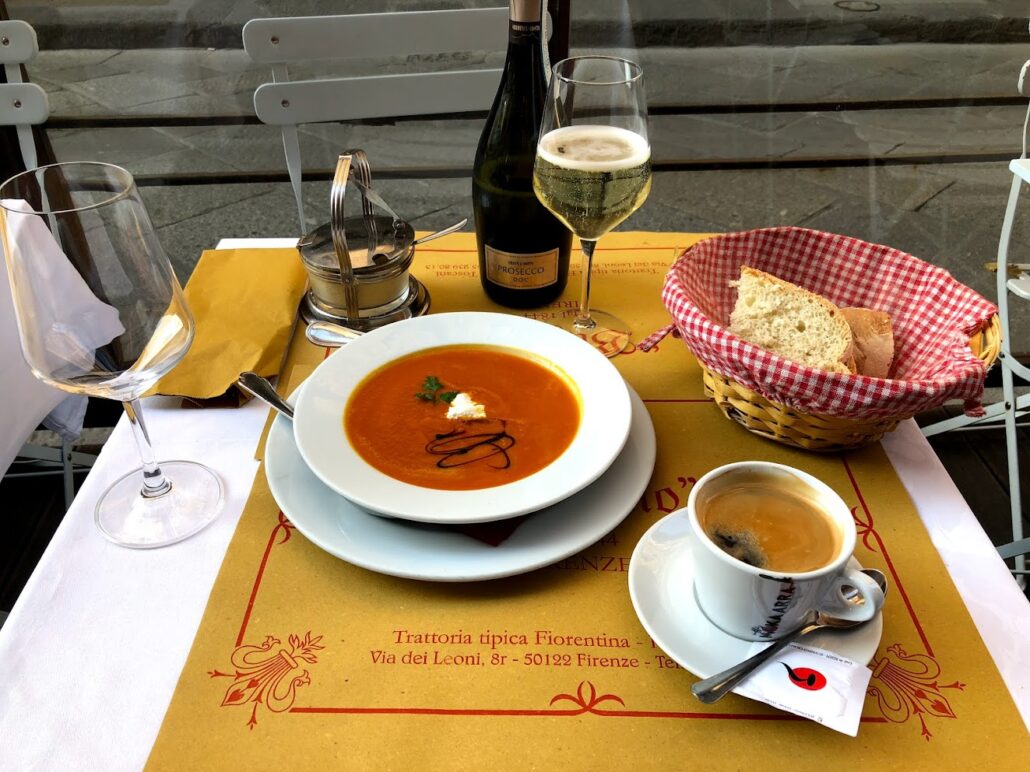
Another Tuscan bread soup — simpler than ribollita and more focused on the tomato. Stale Tuscan bread, ripe tomatoes, garlic, basil, olive oil, vegetable broth. The bread absorbs the tomato and broth and swells into a thick porridge-like consistency. Served warm or at room temperature, finished with excellent olive oil. One of the most direct expressions of Tuscan olive oil quality — if the oil is good, pappa al pomodoro is extraordinary. If it isn’t, it’s just mush.
The importance of Tuscan bread in both ribollita and pappa al pomodoro is worth noting: Tuscan bread is made without salt (a tradition dating to medieval salt taxes), which gives it a neutral flavor that absorbs other ingredients without competing with them. This is why both dishes evolved specifically in Tuscany — the bread behaves differently here than anywhere else in Italy.
Lampredotto
Florence’s defining street food — a sandwich made with the fourth stomach of a cow (lampredotto), slow-braised in broth with tomato, onion, parsley, and celery, then sliced and served on a semelle roll that is dipped in the braising broth. Finished with salsa verde (parsley, capers, anchovies, garlic, olive oil) or a spicy red sauce.
Lampredotto is eaten standing up at the city’s trippaio carts — traditional street vendors operating from market stalls and fixed spots around the city. This is genuinely beloved local food that has been eaten in Florence for centuries. It costs €4–6 and is one of the most authentic food experiences in the city, entirely invisible to visitors who don’t know to look for it.
The Mercato Centrale and the Mercato di Sant’Ambrogio both have lampredotto vendors. The trippaio at the Loggia del Porcellino near the Mercato Nuovo is also a well-known option. If you have even moderate adventurousness with food, this is a non-negotiable Florence experience.
Schiacciata
Florentine flatbread — similar to focaccia but thinner, crispier, and typically finished with olive oil and coarse salt. Schiacciata is sold at bakeries and markets throughout the city and eaten as a snack, a sandwich base, or alongside a meal. In autumn, schiacciata con l’uva — the same bread topped with wine grapes and sometimes rosemary — is a seasonal Florentine specialty worth seeking out if you’re visiting in September or October.
Crostini Toscani
A Florentine antipasto staple — toasted Tuscan bread topped with a spreadable paste of chicken livers, anchovies, capers, butter, and vin santo (Tuscan dessert wine). The combination produces something rich, slightly funky, and deeply savory that is quite different from more generic bruschetta preparations. Crostini toscani appear on the antipasto menu at virtually every traditional Florentine trattoria and are a reliable way to gauge the kitchen’s commitment to the local tradition.
Florentine Markets: Where to Eat Like a Local
Mercato Centrale
Florence’s main covered market operates across two floors in a 19th-century iron-and-glass building near San Lorenzo. The ground floor is a traditional market — butchers, fishmongers, vegetable vendors, cheese and charcuterie stalls, fresh pasta makers — and is one of the best places in the city to see Florentine produce at its best. The upper floor is a modern food hall that opened in 2014 with numerous vendors serving prepared food. The upper floor is convenient and accessible but skews touristy — the ground floor is where the real market is.
If you are buying ingredients or simply want to see what a functioning Florentine market looks like, the Mercato Centrale ground floor is the place. If you want to eat quickly and conveniently in a pleasant space, the upper floor works. Just know the difference.
More information and hours at mercatocentrale.it.
Mercato di Sant’Ambrogio
Florence’s other major covered market, located in the Sant’Ambrogio neighborhood east of the historic center. Less famous than the Mercato Centrale and significantly less touristy — this is where Florentines actually shop. The market has fresh produce, meat, fish, cheese, and a small number of prepared food vendors including a lampredotto cart. The neighborhood around the market has several excellent trattorias and wine bars that serve a local clientele.
Mercato delle Cascine
A large outdoor market held every Tuesday morning along the Arno in the Cascine park. Primarily a general goods market with clothing, household items, and local products alongside food vendors. Worth visiting if your Tuesday schedule allows — the atmosphere is genuinely local and the food vendors sell Tuscan specialties at lower prices than the tourist center.
Wine: Florentine and Tuscan Context
Florence is surrounded by some of Italy’s most important wine regions, and understanding the basics makes ordering in Florentine restaurants significantly more rewarding.
Chianti Classico — The wine region directly south of Florence, producing Sangiovese-based reds under strict DOCG regulations. The Gallo Nero (black rooster) symbol on the neck capsule indicates Chianti Classico as opposed to the broader Chianti appellation. The best Chianti Classico Riserva and Gran Selezione wines are among Italy’s most age-worthy reds. This is the natural pairing for bistecca alla Fiorentina — the acidity and tannin structure of Sangiovese cuts through the richness of Chianina beef in a way that feels designed.
Brunello di Montalcino — From the town of Montalcino south of Siena, made from Sangiovese Grosso (locally called Brunello). Among Italy’s most prestigious wines and most expensive. A Rosso di Montalcino — the younger, lighter version from the same area — is more accessible in price and pairs beautifully with Florentine food.
Vernaccia di San Gimignano — Tuscany’s most important white wine, from the hilltop town of San Gimignano west of Florence. A dry, minerally white with good acidity that pairs well with the lighter Florentine preparations — pappa al pomodoro, schiacciata, crostini, seafood.
Vin Santo — Tuscany’s traditional dessert wine, made from dried Trebbiano and Malvasia grapes and aged in small barrels. Traditionally served with cantucci (hard almond biscuits) for dipping. Every traditional Florentine restaurant offers this combination at the end of the meal. The quality range is wide — a serious Vin Santo from a small producer is a genuinely extraordinary wine, complex, oxidative, and nutty in a way that resembles fine Madeira.
For guidance on Tuscan wine producers and vintages, Gambero Rosso and Jancis Robinson’s wine site are both authoritative references.
Florentine Sweets and Pastries
Cantucci
Hard, twice-baked almond biscuits from Prato (technically Cantucci di Prato or biscotti di Prato) — the most famous Tuscan sweet and one of Italy’s most widely imitated. The correct version has whole toasted almonds, a dry, crunchy texture, and a clean almond flavor. They are served with Vin Santo for dipping and are sold at bakeries throughout Florence. Most supermarkets and souvenir shops also sell them — quality varies considerably.
Ricciarelli
Soft, chewy almond paste cookies from Siena, covered in powdered sugar. Similar in concept to a marzipan but lighter in texture. A traditional Tuscan Christmas sweet that is now available year-round. A good ricciarelli should be moist inside and not too sweet.
Gelato
Florence has an extraordinary gelato culture and some of Italy’s most respected gelaterias. The same quality indicators apply here as in Rome: covered metal containers, natural colors, a focused flavor list. Florence is particularly known for its fior di latte (pure milk gelato — a test of technique), pistachio, and fruit sorbets. Gelateria dei Neri in the Sant’Ambrogio area is consistently regarded as one of the city’s best.
Schiacciata alla Fiorentina
Not to be confused with schiacciata flatbread — this is a soft, flat orange-scented cake made during Carnival season (February). Dusted with powdered sugar with a lily (the symbol of Florence) stenciled on top. Available from late January through Shrove Tuesday at Florentine bakeries. A seasonal specialty worth knowing about if your trip falls in that window.
Where to Eat in Florence by Neighborhood
Oltrarno
The neighborhood south of the Arno is Florence’s best for eating. More local-feeling than the tourist center, with a concentration of trattorias, wine bars, and osterie that serve a mixed clientele of residents, students, and visitors who know where to look. The streets around Piazza Santo Spirito and Piazza della Passera are particularly good. This is the right neighborhood for lampredotto, ribollita, and a glass of Chianti without paying tourist center prices.
Sant’Ambrogio
The neighborhood around the Mercato di Sant’Ambrogio is Florence’s most authentically local food district. Several long-standing trattorias and casual restaurants serve the market’s customers and neighborhood residents at prices well below the historic center. Cibrèo — one of Florence’s most celebrated restaurants — is located here, along with its more casual spinoff Cibrino, which serves a similar menu at lower prices without reservations.
Historic Center
The area between the Duomo and the Uffizi has many tourist-facing restaurants of variable quality and a smaller number of genuinely good ones. The rule of thumb: avoid restaurants on the main tourist squares and the streets immediately adjacent to the Uffizi and Piazza della Repubblica. The better restaurants are typically one or two streets removed from the main foot traffic.
San Lorenzo
The market neighborhood around the Mercato Centrale has been cleaned up for tourists over the past decade — the leather market stalls around San Lorenzo church are heavily tourist-oriented and so are many nearby restaurants. The Mercato Centrale ground floor remains excellent; the streets immediately around it are mixed. Worth navigating for the market itself rather than as a dining destination.
Practical Eating Notes for Florence
Olive oil — Tuscany produces some of Italy’s finest extra-virgin olive oil, and good Florentine restaurants will have excellent oil on the table. It is used on everything — ribollita, pappa al pomodoro, grilled vegetables, bistecca — and the quality of the oil is often what separates a good version of a dish from a great one.
Tuscan bread — Saltless, as noted. Don’t season it expecting salt flavor. It is designed to be a vehicle for other flavors, not a standalone snack.
Reservations — Florence’s best restaurants are booked ahead. Book online through TheFork or directly through restaurant websites. Weekend dinners particularly fill up fast. The most popular spots — Buca Mario, Trattoria Sostanza for bistecca — book out days or weeks ahead during peak season.
Meal timing — Same as Rome. Lunch 1–3pm, dinner from 7:30pm or later at serious restaurants. The tourist center has more restaurants accommodating early diners; the Oltrarno operates on a more Italian schedule.
👉 For full Florence logistics including where to stay, what to see, and how to structure your days around eating well, see our Florence city guide. If you’re coming from Rome, our Rome to Florence transport guide covers all your options.