Barcelona to Madrid is Spain’s most traveled intercity route and one of the best-connected city pairs in Europe. The high-speed AVE train covers the 620 kilometers between the two cities in 2 hours 30 minutes, with departures roughly every 30 to 60 minutes throughout the day. Flying is faster in the air but slower door-to-door. The bus takes 7–8 hours. The train wins for nearly every traveler — this guide explains why and covers everything else you need to make the journey.
Spain’s high-speed rail network (Alta Velocidad Española, or AVE) is one of the most developed in the world — Spain has more high-speed track than any other country in Europe. The Barcelona–Madrid corridor was inaugurated in 2008 and transformed a journey that previously took nine hours overnight into a routine 2.5-hour connection. It is one of the routes that genuinely demonstrates what high-speed rail does to the relationship between cities.
👉 Planning your Spain trip? See our Spain travel guide and our guides to Barcelona and Madrid for full destination coverage at both ends.
Quick Answer
Take the AVE high-speed train. Renfe’s AVE and Iryo (a private competitor) both run direct services from Barcelona Sants to Madrid Puerta de Atocha or Madrid Chamartín-Clara Campoamor in approximately 2 hours 30 minutes. Book in advance through renfe.com or iryo.eu. Fares from approximately €25–40 booked several weeks ahead.
Option 1: High-Speed Train (Recommended)
Spain’s AVE network on the Barcelona–Madrid corridor is served by two operators: Renfe (the national rail operator) and Iryo (a private competitor that launched in 2022). Both run direct services, both are comfortable, and their competition has driven prices down significantly from the monopoly Renfe era. This is good news for travelers — comparing both operators before booking consistently returns better fares than defaulting to one.
Journey Time and Frequency
Direct AVE services cover the route in 2 hours 30 minutes to 2 hours 40 minutes. A small number of services are slightly longer with intermediate stops. Trains run roughly every 30 minutes during peak travel periods (morning and early evening) and every 60 minutes at quieter times. Total daily departures across both operators typically exceed 20 in each direction.
The frequency makes this one of the most forgiving high-speed rail connections in Europe from a scheduling perspective — there is almost always another train within an hour if your plans change.
Stations
Barcelona departure: Barcelona Sants — The main intercity rail station in Barcelona, located in the Eixample district. Served by Metro Lines 3 and 5, multiple bus routes, and taxis. Not in the absolute center but easily accessible from all parts of the city. Some AVE services also stop at the newer Sagrera station in the northeast of the city — less useful for most visitors, but worth checking your ticket if you are staying in that area.
Madrid arrival: Madrid Puerta de Atocha or Madrid Chamartín — Most Barcelona–Madrid AVE services arrive at Puerta de Atocha, Madrid’s main southern terminus, which is served by Metro Lines 1 and 10 and is walking distance from the Prado Museum and the Retiro Park. Some services continue to or terminate at Chamartín in the north of the city. Check your specific booking — both stations are well-connected to central Madrid by Metro, but knowing which one you’re arriving at matters for planning your onward journey.
Ticket Classes and Pricing
Renfe AVE classes:
- Turista — Standard class. Comfortable seats, good legroom by train standards, Wi-Fi available.
- Turista Plus — Extra legroom, more recline, at-seat meal service on some trains.
- Preferente — Business class equivalent. Wider seats, meal included.
- Club — Premium cabin with suite-style seating.
Iryo classes:
- Inicial — Standard class, comparable to Renfe Turista.
- Singular — Mid-tier with extra comfort.
- Infinit — Business equivalent, with premium seating and meal service.
For a 2.5-hour journey, Turista/Inicial is entirely adequate. The seat pitch on Spanish AVE trains is generous compared to many European high-speed services. Meals on standard class are not included but a café car is available.
Advance Turista/Inicial fares typically start around €25–45 per person when booked 3–6 weeks ahead. Standard flexible fares run €55–85. Last-minute fares can reach €100–130 for standard class. As with Italian high-speed rail, the yield management is aggressive — booking early makes a meaningful difference.
Booking
Book directly through renfe.com (Renfe) or iryo.eu (Iryo). Both sites operate in English. Both issue e-tickets downloadable to your phone. The Renfe site can be somewhat slow and occasionally temperamental with international credit cards — have patience, or try the Renfe app as an alternative. Iryo’s site is newer and somewhat more user-friendly.
Third-party platforms including Rail Europe and Omio sell Spanish rail tickets with a booking fee. For this specific route, booking direct is straightforward enough that the third-party fee is hard to justify — but if the official sites give you trouble with payment, these platforms are legitimate fallbacks.
Option 2: Flying
Barcelona–Madrid is one of the busiest air routes in the world by passenger volume — historically one of the top five globally. Multiple airlines operate the route, including Iberia, Vueling, Air Europa, and Ryanair, with dozens of daily departures from both Barcelona El Prat (BCN) and Madrid Barajas (MAD).
The Door-to-Door Reality
The flight itself is approximately 1 hour 15 minutes. But the door-to-door calculation — travel to the airport, check-in and security, boarding, flight, deplaning, baggage claim, travel from the airport to the city center — typically adds 3 to 4 hours on each end. A total door-to-door journey of 5–6 hours versus the train’s 3–4 hours (including station transit at both ends) means flying is almost never faster on this specific route.
Flying makes sense only in two scenarios: if you find a flight significantly cheaper than an advance train fare (this occasionally happens with Ryanair on specific dates), or if you are connecting onward from Madrid airport to an international flight and flying into Barajas directly from Barcelona saves a separate airport trip.
Airport Transit
Barcelona El Prat (BCN) — Metro Line 9 Sud connects the airport to central Barcelona in approximately 35 minutes (€5.15). A taxi to the city center costs approximately €35–45.
Madrid Barajas (MAD) — Metro Line 8 connects the airport to central Madrid (Nuevos Ministerios) in approximately 25 minutes (€4.50–6 depending on zone). A taxi to the city center costs approximately €30–40.
Option 3: Bus
ALSA, FlixBus, and other coach operators run Barcelona–Madrid services. Journey time is typically 7 to 8 hours under normal traffic conditions, occasionally longer. Fares start around €10–20 booked in advance.
Departures from Barcelona are typically from the Estació d’Autobusos Barcelona Nord (Metro Arc de Triomf, Line 1) or from Sants bus station adjacent to the train station. Arrivals in Madrid are at Estación Sur de Autobuses (Metro Méndez Álvaro, Line 6).
The bus makes sense in one specific scenario: an overnight journey where you sleep through the travel time, save a night’s accommodation cost, and arrive in the morning ready to start the day. Some operators run overnight services timed exactly for this purpose. For a daytime journey where you’re conscious of every hour, 7–8 hours is a significant time cost relative to the 2.5-hour train — the price difference rarely justifies it on a short Spain trip.
Option 4: Rental Car
Driving from Barcelona to Madrid takes approximately 6 hours on the AP-7 and AP-2 motorways. Toll costs run approximately €35–50 for the full route depending on your vehicle class and which toll booths you use. Fuel costs are additional.
There is essentially no scenario in which driving from Barcelona to Madrid is preferable to the train for a simple point-to-point transfer. The journey takes more than twice as long, costs more when fuel and tolls are included, and produces a car that then needs to be managed in central Madrid.
The car makes sense if your Spain itinerary involves driving through the interior — the wine regions of Ribera del Duero or La Rioja between Barcelona and Madrid, or the historic cities of Zaragoza, Cuenca, or Segovia en route. In that case, a Barcelona → wine country → Madrid road trip structure is genuinely excellent. But for point-to-point transit, take the train.
Stopping Between Barcelona and Madrid
The high-speed line between Barcelona and Madrid passes through Zaragoza, which makes for an easy and rewarding intermediate stop.
Zaragoza — Spain’s fifth-largest city and one of its most undervisited. The Basílica del Pilar on the Ebro riverbank is one of the most dramatically sited churches in Spain — a baroque complex with multiple domes and towers reflected in the river. The Aljafería Palace, a Moorish palace from the 11th century, is one of the best-preserved Islamic-era palaces outside Andalusia. Zaragoza has excellent tapas culture, particularly in the El Tubo neighborhood, and very few tourists relative to its quality. The city makes an excellent overnight stop between Barcelona and Madrid, or a half-day stop on the AVE with checked luggage storage at the station.
Tarragona — Not on the Madrid high-speed line but accessible as a stop before Barcelona if you’re traveling south from France. An ancient Roman provincial capital with an extraordinary archaeological complex — the amphitheater directly on the sea, the circus, the forum, and the city walls are all UNESCO-listed. Worth knowing about for itineraries that include the Mediterranean coast.
Arriving in Madrid
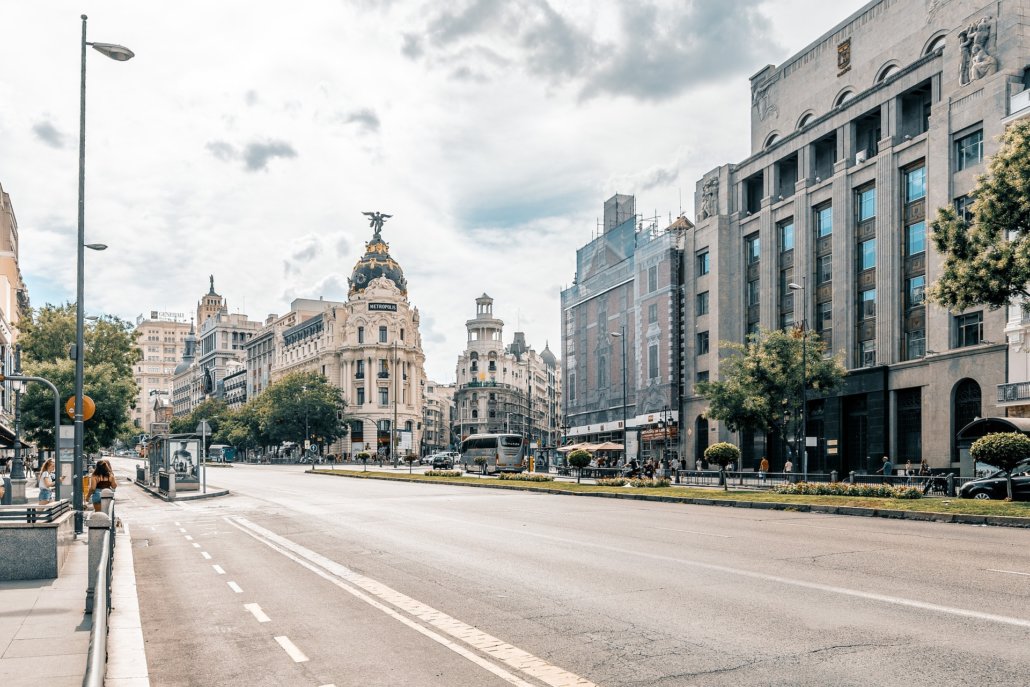
Most Barcelona AVE services arrive at Madrid Puerta de Atocha. The station is in the southern part of central Madrid, adjacent to the Retiro Park and within walking distance of the Prado Museum, the Thyssen-Bornemisza, and the Reina Sofía — three of the world’s great art museums within a 15-minute walk of each other.
From Atocha, Metro Line 1 connects to Sol (Madrid’s central square) in two stops. Line 10 connects to Chamberí and the north of the city. Taxis are available outside the station. The central Puerta del Sol area is about a 20-minute walk from Atocha through the Paseo del Prado boulevard.
Madrid’s Metro is efficient, affordable (single fares €1.50–2 depending on zones), and covers all central areas well. A 10-trip Metrobús card at €12.20 is good value for a stay of several days. Buy at any Metro station or tobacco shop (estanco).
Comparison Table
| Option | Journey Time | Price (per person) | Best For |
|---|---|---|---|
| AVE High-Speed Train | 2h 30m | €25–85+ | Almost everyone |
| Flight | 1h 15m (air) / 5–6h door-to-door | €30–100+ | Airport connections only |
| Bus | 7–8h | €10–25 | Overnight travel, very tight budgets |
| Rental Car | 6h | €60–120+ (car + tolls + fuel) | Interior Spain road trips only |
Prices approximate and vary by season, booking lead time, and operator.
Booking Tips
Book 4–8 weeks ahead for the best fares. Spanish AVE pricing is yield-managed like airline pricing — early booking secures the lowest fares. The gap between a fare booked six weeks out and one booked the week before can be €50 or more per person.
Compare Renfe and Iryo every time. Since Iryo launched in 2022, competition on the Barcelona–Madrid route has driven prices down and increased frequency. The cheaper operator on any given day can switch — always check both before committing.
Mid-week is cheaper than weekends. Monday mornings and Friday evenings see the highest domestic demand. Tuesday through Thursday departures consistently have better availability and lower prices.
The Renfe website can be frustrating. If you encounter payment issues on renfe.com, try the Renfe app or use Omio as a fallback. Iryo’s website is generally smoother for international credit card transactions.
Check which Madrid station you’re arriving at. Most services arrive at Atocha, but some continue to Chamartín. If your Madrid hotel is in the north of the city, a Chamartín arrival is more convenient. If it’s in the center or south, Atocha is the better option.
👉 For full coverage of both cities, see our Barcelona city guide and Madrid city guide. For food at both ends, our what to eat in Barcelona guide covers the Catalan food scene in detail.