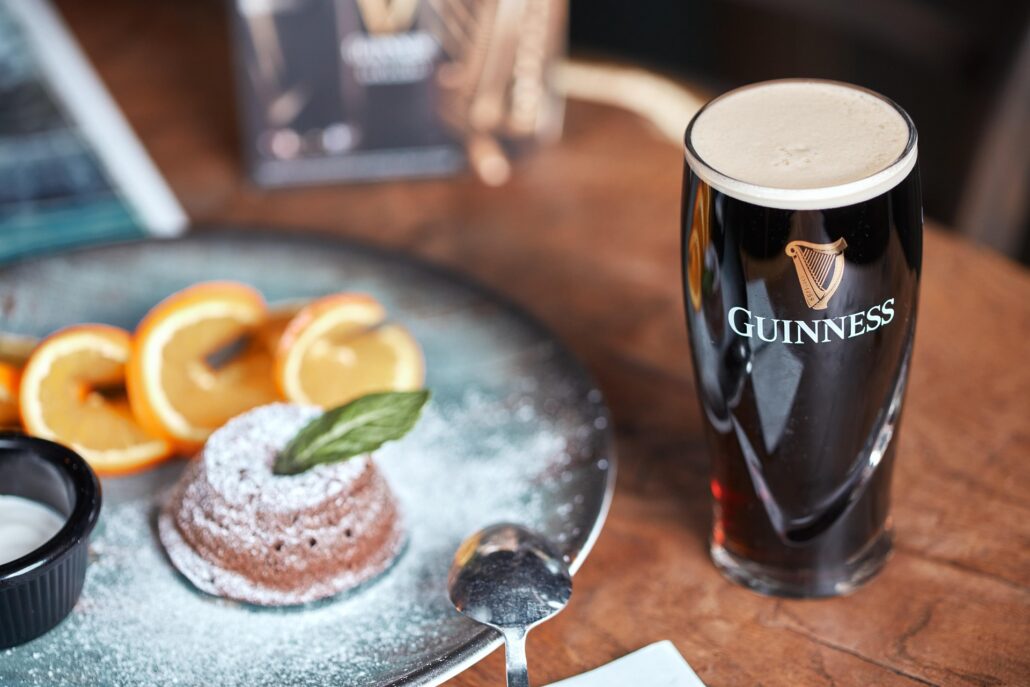
There is a moment that happens to almost every visitor who orders their first Guinness in Dublin, and it is the moment they realize they have been drinking it wrong their entire life. The bartender pulls the pint, fills it roughly three-quarters of the way, and then sets it on the bar to rest. You wait. You watch the cascade of nitrogen bubbles surge down through the dark liquid and settle into the creamy head that forms at the top. You wait some more. The bartender comes back, tops it off with a final pour that creates a perfect domed head above the rim of the glass, and slides it across the counter. The whole process takes 119.5 seconds — a number that Guinness has been specific about for decades.
We have drunk Guinness in a lot of places. In pubs in New York, in bars in London, in airports and hotel lobbies and sports venues across several continents. None of it prepares you for the first properly poured pint in an Irish pub. The difference is real and it is not nostalgia or the romance of being in Ireland making it taste better. It is nitrogen, it is temperature, it is the freshness of kegs that turn over daily in a country where Guinness is not an imported specialty but the default order at virtually every pub in the country. It is also, genuinely, the pour. The 119.5 second ritual is not theater. It changes the texture and the temperature and the way the head integrates with the body of the drink in ways that matter.
Guinness is not just a beer in Ireland. It is a cultural artifact, a social institution, a piece of national identity that survived colonialism, famine, emigration, and the transformation of Irish society into one of Europe’s most dynamic economies. Understanding Guinness in Ireland means understanding something about the country that no amount of castle-visiting and cliff-walking can fully deliver.
The History: From St. James’s Gate to the World
Arthur Guinness signed a 9,000-year lease on the St. James’s Gate Brewery in Dublin in 1759 at an annual rent of £45. The lease still exists. The brewery still operates on the same site, now expanded to cover 64 acres in the heart of Dublin and producing approximately 2.5 million pints per day for export to 150 countries.
The original Guinness was not the stout we know today. Arthur Guinness initially brewed ales, as was standard for the period. The shift to porter — a dark, roasted malt beer that had become popular in London — came in the 1770s, and the development of the extra stout porter that eventually became simply Guinness Stout followed over subsequent decades. By the early 19th century Guinness was already the largest brewery in Ireland. By the late 19th century it was the largest brewery in the world.
The growth of Guinness as a global brand tracks closely with the Irish diaspora. Wherever Irish emigrants went — to America, to Australia, to Britain, to South America — they took the demand for Guinness with them. The brand became, for millions of people with Irish heritage around the world, a physical connection to a place they or their ancestors had left. That emotional weight is part of what Guinness carries today and part of why ordering one in Dublin feels like more than ordering a beer.
The nitrogen innovation that defines the modern Guinness pint came in 1959 — the same year as the company’s 200th anniversary — when Guinness engineers developed the mixed gas system combining nitrogen and carbon dioxide that replaced the traditional CO2-only carbonation. Nitrogen produces smaller bubbles than CO2, which creates the characteristic creamy, dense head and the cascade effect visible during the pour. It also produces a smoother, less acidic mouthfeel that distinguishes Guinness draught from every other stout on the market. The widget in the Guinness can — the small plastic ball that releases nitrogen when the can is opened — is a direct descendant of this innovation and won the Queen’s Award for Technological Achievement in 1991.
How Guinness Is Made
Guinness Stout is brewed from four ingredients: water, barley, hops, and yeast. The distinctive dark color and roasted flavor come from a proportion of the barley being roasted at high temperature before brewing — the same basic process that produces coffee’s dark color and bitter notes from green coffee beans. The roasted barley is not malted before roasting, which produces a drier, more coffee-like bitterness than malted roasted barley would.
The water used in Guinness production comes from the Wicklow Mountains via the River Liffey — Dublin’s water source — with a mineral profile that has historically been considered important to the character of the finished beer. Modern Guinness production adjusts water chemistry to produce consistent results across different brewing locations, but the Dublin water profile remains the reference standard.
The hops used in Guinness are primarily for bittering rather than aromatic contribution — Guinness is not a hop-forward beer in the way that IPAs or pale ales are. The bitterness comes primarily from the roasted barley and from a modest hopping rate that adds structure without dominating the flavor profile.
The Guinness yeast strain is proprietary and has been maintained continuously since the early days of the brewery. Yeast contributes significantly to a beer’s flavor profile and the Guinness strain produces the characteristic dry, slightly fruity notes that complement the roasted barley bitterness. The same yeast strain is used at all Guinness production facilities worldwide, which is one of the mechanisms by which consistency across markets is maintained.
The nitrogen-CO2 mixed gas system used for draught Guinness means that the beer is served at a lower carbonation level than most beers — approximately 1.2 volumes of CO2 compared to 2.5 to 3.0 volumes for typical lagers. The nitrogen compensates for the low carbonation by providing the physical texture and head formation that CO2 alone could not produce at these levels. The result is a pint that is physically different from anything else on the bar — denser, creamier, and with a head that sits above the rim of the glass rather than collapsing into it.
The Perfect Pour: What Actually Happens in 119.5 Seconds
The two-part pour that produces a proper Guinness pint is not a marketing invention. It is a technical process that produces a measurably different result from a single pour.
The glass — a tulip-shaped pint glass specifically designed for Guinness — is held at a 45-degree angle under the tap. The tap is pulled fully open and the glass is filled to approximately three-quarters full. The glass is then placed on the bar and left to rest while the cascade — the visible surge of nitrogen bubbles moving downward through the liquid — completes and the liquid settles from opaque brown to the characteristic near-black with the creamy head forming at the top.
The rest period allows the nitrogen bubbles to fully separate and collect in the head rather than remaining dispersed through the body of the beer. A pint that is topped off immediately after the initial pour will have nitrogen bubbles distributed through the liquid, producing a less clean, less satisfying texture.
After the rest — approximately 90 seconds — the glass is returned to the tap and topped off with a final pour that fills the glass completely and creates the domed head that sits fractionally above the rim. The tap is pushed forward rather than pulled back for this final pour, reducing flow rate and allowing precise control of the head formation.
The finished pint should have a head of approximately 10mm, perfectly white and dense enough to hold the impression of a shamrock drawn in it with a cocktail stick — a trick performed in tourist-facing pubs that is somewhat theatrical but not entirely without basis in the actual head density of a well-poured pint.
Why It Tastes Different in Ireland
This is not a myth or a placebo effect. Guinness genuinely tastes different — better — in Ireland than almost anywhere else in the world, and the reasons are specific and quantifiable.
Keg turnover. In Ireland, Guinness kegs in a busy pub turn over every day or two. In an Irish-themed pub in New York or London or Sydney, the same keg might sit on the line for a week or more. Beer in contact with dispensing line equipment degrades over time — the flavor compounds break down, off-flavors develop, and the nitrogen balance shifts. Fresh Guinness tastes like Guinness is supposed to taste. Old Guinness tastes like something else.
Line cleaning. Irish pub owners take beer line cleaning seriously in a way that correlates directly with the quality of the pint. Clean lines produce clean-tasting beer. Dirty lines produce beer with off-flavors that most drinkers attribute to the beer itself rather than the infrastructure delivering it.
Temperature. Guinness is served at 6 degrees Celsius in Ireland — cooler than many international markets serve it. Temperature affects carbonation, head formation, and the perception of bitterness and sweetness. A Guinness served too warm tastes flatter and sweeter. A Guinness served at the correct temperature tastes the way it was designed to taste.
The psychological dimension. We will be honest about this one — drinking a Guinness in a 19th-century pub on a rainy Dublin afternoon with a fire going and a conversation happening at the bar does something to the perception of the drink that the same drink in a different context cannot replicate. The environment is part of the experience and the experience is part of the flavor. That is not a dismissal of the other reasons — it is an acknowledgment that drinking is a context-dependent activity and Ireland provides an extraordinary context for drinking Guinness.
What to Eat with Guinness
Guinness is one of the most food-versatile drinks in the world — the combination of roasted bitterness, creamy texture, and moderate alcohol makes it work with a surprising range of food.
Irish stew. The classic pairing and the most historically authentic. Irish stew — lamb or mutton with potatoes, carrots, and onions in a simple broth — has the rich, fatty, savory character that the bitterness of Guinness cuts through perfectly. The two have been eaten and drunk together in Ireland for centuries and the pairing is as good as it is because it has been refined by generations of people who had nothing else. In virtually every traditional Irish pub that serves food, the stew and the pint remain the most honest meal available.
Oysters. This is the pairing that surprises people until they try it. The briny, mineral quality of fresh Atlantic oysters and the roasted, slightly sweet character of Guinness create a combination that food scientists call a “flavor bridge” — each brings out qualities in the other that neither fully reveals alone. The Galway Oyster Festival, held annually in September, has been serving Guinness and Galway Bay oysters together since 1954. It is not a gimmick. It is one of the great food and drink pairings in the world.
Beef and Guinness pie. Guinness in cooking reduces to a deeply savory, slightly sweet glaze that transforms braised beef into something extraordinary. Beef and Guinness pie — shortcrust or puff pastry over slowly braised beef shin or chuck in a Guinness-based gravy — is found on pub menus across Ireland and is one of the dishes that most rewards drinking the same thing you cooked with.
Soda bread and butter. Simple and perfect. The slight bitterness of good Irish soda bread and the creaminess of Irish butter — Kerry Gold or similar — with a cold Guinness alongside is the kind of combination that does not require explanation if you have experienced it and cannot be adequately explained if you have not.
Smoked salmon. Irish smoked salmon — cold-smoked over oak, served with brown bread and crème fraîche — has the fat and smoke character that Guinness handles with ease. The combination is standard on the menus of better Dublin restaurants and is one of the best expressions of Irish food culture available.
Guinness Cocktails and Mixed Drinks
Black and Tan. Half Guinness, half pale ale — typically Bass — layered in a pint glass using the back of a spoon to float the Guinness on top of the lighter beer. The name has politically charged connotations in Ireland — the Black and Tans were a paramilitary force deployed by the British government during the Irish War of Independence — and ordering one by that name in Ireland is likely to produce a reaction. In Ireland it is called a Half and Half. Outside Ireland the history is less fraught. The drink itself is pleasant — the contrast between the roasted stout and the hoppy pale ale creates a more complex pint than either alone.
Black Velvet. Half Guinness, half Champagne. Created at Brooks’s Club in London in 1861 to mourn the death of Prince Albert, it is a drink that sounds absurd until you taste it. The sweetness and effervescence of the Champagne lifts the roasted heaviness of the Guinness and the combination is genuinely elegant. Use a decent Champagne or Cava rather than cheap sparkling wine — the quality of the sparkling component matters more than the quality of the Guinness in this cocktail.
Irish Car Bomb. A shot glass of Irish whiskey and Bailey’s dropped into a half pint of Guinness and consumed immediately before the Bailey’s curdles. The name is deeply offensive in Ireland and the drink is not ordered there. Outside Ireland it is a standard bar order in Irish-American establishments. The drink itself is effective — the combination is sweet and strong and the urgency of consuming it before curdling occurs adds a social dimension that accounts for much of its popularity.
Guinness Float. A scoop of vanilla ice cream in a pint of Guinness. It sounds wrong and tastes right — the roasted bitterness of the stout and the sweetness of the vanilla ice cream create a combination that is essentially an adult Guinness milkshake. Common in Dublin dessert bars and increasingly found on menus internationally.
Where to Drink Guinness in Ireland
The honest answer is almost anywhere outside the tourist trap pubs in central Dublin. The Guinness is the same — it is the environment and the company that varies.
Mulligan’s on Poolbeg Street in Dublin is frequently cited as serving the best Guinness in the city. It is an old pub without music or food, focused entirely on the quality of the drink. The pints are extraordinary and the atmosphere is as close to 19th-century Dublin as anything still operating.
The Long Hall on South Great George’s Street is one of the most beautiful Victorian pub interiors in Dublin — original wood paneling, antique mirrors, and a bar that has barely changed in a century. The Guinness is excellent and the atmosphere is genuinely that of a Dublin pub rather than a tourist simulation of one.
Outside Dublin, the pubs of Galway, Cork, and the smaller towns of the west coast serve Guinness that is consistently excellent. In a small pub in Doolin or Dingle or Westport, where the keg turnover is high and the barman has been pulling pints for thirty years, you will drink Guinness that makes everything you have ever drunk elsewhere feel like a pale approximation.
The Guinness Storehouse at St. James’s Gate is a tourist attraction rather than a pub experience but worth visiting for the context it provides — the history of the brewery, the Arthur Guinness story, and the Gravity Bar at the top with its 360-degree view of Dublin and a complimentary pint that, in fairness, is very well poured.
For everything else you need to plan a trip to Ireland, see our complete Ireland itinerary and our Ireland city and destination guides.
The Honest Assessment
Guinness is not the best beer in the world by any objective technical measure — there are more complex, more nuanced, more carefully crafted beers available in virtually every country that takes brewing seriously. But Guinness in Ireland is not primarily a beer-quality argument. It is a cultural experience that happens to involve a beer — the 9,000-year lease, the 119.5-second pour, the cascade in the glass, the oysters in Galway, the Victorian pub interior, the rain outside. The sum of those parts is something that transcends the technical quality of the liquid in the glass.
Drink it in Ireland. Drink it slowly. Wait for the pour.