Bordeaux is the most argued-about wine region on earth. More words have been written about it, more money has been spent on it, more dinner party conversations have been derailed by it than any other wine-producing area in the world. It is a region that attracts both obsessive devotion and reflexive dismissal — the wine world’s equivalent of a city that everyone has an opinion about before they have been there. We have been to Bordeaux, we have drunk the wine in the places where it is made, and our honest assessment is that the devotion is more justified than the dismissal.
Understanding Bordeaux does not require becoming a wine expert. It requires understanding one geographical fact, one historical decision, and one ongoing argument — and then applying that framework to what is in your glass.
The Geography That Explains Everything
Bordeaux sits in southwestern France where the Garonne and Dordogne rivers meet to form the Gironde estuary before emptying into the Atlantic. The wine region — the largest fine wine appellation in the world by production volume — straddles this water system in a way that creates two distinct growing environments with fundamentally different soils, drainage conditions, and therefore fundamentally different wines.
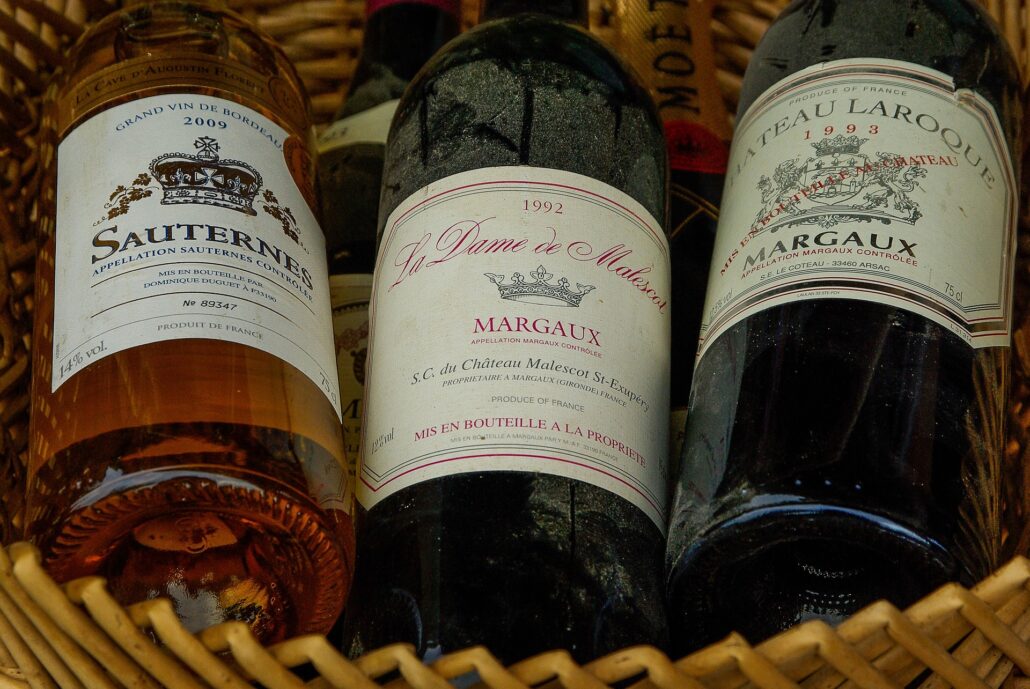
The Left Bank — the Médoc and Graves appellations on the western side of the Gironde — sits on deep gravel beds deposited by the rivers over millennia. Gravel drains quickly and warms rapidly in the sun, producing stress conditions that force vines to send roots deep into the subsoil in search of water and nutrients. The result is the wine produced from Cabernet Sauvignon, which thrives in these well-drained, slightly austere conditions. Left Bank Bordeaux — the wines of Pauillac, Saint-Estèphe, Margaux, and Saint-Julien — are Cabernet-dominant blends with firm tannins, cassis and cedar flavors, and the structure to age for decades. These are the wines that built Bordeaux’s international reputation.
The Right Bank — Saint-Émilion and Pomerol on the eastern side — sits on clay and limestone soils that retain moisture and warmth differently from the gravel of the Left Bank. These conditions favor Merlot, which ripens earlier and produces a rounder, more immediately approachable wine with plum and chocolate character and softer tannins. Right Bank wines — including the legendary and extraordinarily expensive Pétrus, which comes entirely from a small clay plateau in Pomerol — are Merlot-dominant blends that age well but are often more approachable young than their Left Bank counterparts.
The distinction matters not as wine snobbery but as a practical guide to what you are drinking and what you want from it. If you want power, structure, and a wine that rewards a decade of patience, the Left Bank is your direction. If you want richness, accessibility, and something that drinks beautifully now, the Right Bank is your answer.
The 1855 Classification: One Decision That Still Shapes Everything
In 1855, Napoleon III ordered a classification of Bordeaux wines for the Paris World Exhibition. The Bordeaux Chamber of Commerce produced a ranking of the region’s top red wines into five tiers — Premier Cru through Cinquième Cru — based primarily on the prices the wines had historically commanded. Sixty-one châteaux were classified. The classification has been revised exactly once in 170 years, in 1973, when Mouton Rothschild was elevated from second to first growth after a decades-long campaign by its owner Philippe de Rothschild.
The 1855 classification is simultaneously a historical artifact and a living force in the wine market. Châteaux classified as Premier Crus — Lafite, Latour, Margaux, Mouton Rothschild, and Haut-Brion — command prices that bear almost no relationship to the cost of production and every relationship to the prestige that 170 years of classification has accumulated. A bottle of 2015 Lafite Rothschild retails for $1,000 or more. A bottle from a Fifth Growth château on the same appellation might retail for $40 to $80 and offer a genuinely comparable drinking experience from a similar vintage.
The practical lesson for visitors and wine drinkers: the classified growths are extraordinary but the value proposition in Bordeaux is not at the top of the classification. The crus bourgeois — châteaux that are not classified in 1855 but produce wine of high quality — and the Cotes de Bordeaux appellations offer some of the best value in French wine. Drinking at this level in Bordeaux is discovering the region as its residents experience it rather than as its global reputation commands.
How Bordeaux Wine Is Made
Bordeaux wine is almost always a blend rather than a single varietal — this is one of the defining characteristics of the region and one of the reasons Bordeaux winemaking is considered among the most technically complex in the world. The decision of which grape varieties to use, in what proportions, from which vineyard parcels, in which vintage conditions — this is the art of Bordeaux winemaking.
The primary grape varieties are Cabernet Sauvignon, Merlot, Cabernet Franc, Petit Verdot, and Malbec for reds, and Sauvignon Blanc and Sémillon for the whites. In any given vintage, the winemaker harvests each variety and each parcel separately, vinifies them separately, tastes through the results, and then assembles the blend that best represents the estate’s style and the character of that year’s conditions.
The harvest in Bordeaux typically runs from late September through October, with earlier-ripening Merlot picked before later-ripening Cabernet Sauvignon. Vintage variation — the year-to-year difference in weather conditions and therefore grape quality — is more pronounced in Bordeaux than in many other regions because of the Atlantic climate’s unpredictability. A cool, wet September can undermine a promising vintage. A warm, dry autumn can rescue a difficult summer. Understanding vintage variation is essential to understanding Bordeaux pricing — a 2010 or 2015 from a mid-tier château can be a significantly better wine than a 2013 or 2011 from a classified growth at the same price.
Red Bordeaux is aged in oak barrels — typically French oak — for 12 to 24 months before bottling. The oak contributes vanilla, spice, and toast notes alongside the fruit character of the wine and provides controlled oxidation that softens tannins and allows complex flavors to develop. The proportion of new oak used is a stylistic decision — more new oak produces a more toasted, international style; older oak allows the fruit and terroir character to express themselves more directly.
Bordeaux Blanc: The Underappreciated Half of the Region
Most people who think of Bordeaux think of red wine. The white wines of the region — produced primarily in the Graves and Entre-Deux-Mers appellations from Sauvignon Blanc and Sémillon — are genuinely extraordinary and represent some of the best value in French white wine.
Dry white Bordeaux ranges from crisp, aromatic Sauvignon Blanc-dominant wines with grapefruit and grass character to the more complex, oak-aged Sauvignon-Sémillon blends of the Pessac-Léognan appellation — wines that age as gracefully as many white Burgundies at a fraction of the price.
Sauternes — the sweet wine produced from grapes affected by botrytis cinerea, or noble rot, in the southern Graves — is in a category of its own and represents one of the world’s great wine styles. The concentration of sugars, acids, and flavor compounds produced by the botrytis mold creates a wine of extraordinary complexity — honeyed, apricot, and saffron notes with an acidity that prevents the sweetness from becoming cloying. Château d’Yquem, the only Premier Cru Supérieur classified in 1855, produces arguably the greatest dessert wine in the world. But the broader Sauternes and Barsac appellations produce wines at a fraction of Yquem’s price that are well worth seeking out.
What to Eat with Bordeaux Wine
The food of the Bordeaux region and the wines of the region have evolved together over centuries in ways that make the local pairings consistently the best.
Duck confit with Left Bank Cabernet. The classic pairing and the most honest expression of what Bordeaux food culture actually looks like. Duck confit — duck legs slowly cooked and preserved in their own fat — has the richness and gamey depth that the firm tannins and black fruit of a young Médoc cut through perfectly. The fat in the duck softens the perception of tannin; the wine’s structure cuts through the fat. This is a pairing that works because of chemistry as much as tradition.
Entrecôte bordelaise. The region’s signature beef dish — grilled rib steak with a red wine, bone marrow, and shallot sauce — is the most direct expression of the meat-and-wine culture that drives Bordeaux’s identity. The sauce is made with wine from the region, served with wine from the region, and the combination is as complete as food and drink pairings get. In the restaurants of Bordeaux city, entrecôte bordelaise with a glass of Médoc is a meal that justifies the entire trip.
Aged cheese with Right Bank Merlot. The softer tannins and rounder fruit of Right Bank wines make them natural partners for cheese — particularly aged hard cheeses like Comté and Cantal, whose nutty, crystalline character complements the plum and chocolate notes of Saint-Émilion. The pairing also works beautifully with Roquefort, whose salt and fat balance the wine’s richness in a way that makes both better than they are alone.
Foie gras with Sauternes. The pairing that people describe as transformative the first time they experience it. The rich, fatty, slightly livery character of foie gras and the honeyed sweetness and acidity of Sauternes interact to create something greater than either component. The sweetness of the wine mirrors the richness of the foie gras while the acidity provides the counterpoint that prevents both from becoming overwhelming. This pairing is served throughout the region and represents one of the great French culinary traditions — simple in concept, extraordinary in execution.
Oysters with dry white Bordeaux. The oysters of the Arcachon Bay — a tidal lagoon south of Bordeaux — are among the best in France, and the dry white wines of the Entre-Deux-Mers appellation are their natural partner. The crisp acidity and minerality of Sauvignon Blanc-dominant white Bordeaux mirrors the salinity and freshness of Atlantic oysters in a combination that has been practiced in this region for centuries.
Lampreys à la bordelaise. This is the most genuinely local dish — lamprey eel cooked in red wine with leeks in a preparation that dates to the medieval period. It is not for everyone and it is increasingly difficult to find on restaurant menus, but it represents the honest, unglamorous food culture that predates Bordeaux’s international wine prestige. If you see it on a menu in a traditional restaurant, order it. It tastes like the region’s history.
Bordeaux Cocktails and Mixed Drinks
Bordeaux is wine country rather than cocktail country — the local drinking culture is built around the table and the meal rather than the bar and the aperitif. That said, a few mixed drinks are genuinely Bordelais.
Kir Bordelais. The standard French kir — white wine with blackcurrant liqueur — is made in Bordeaux with dry white Bordeaux rather than the Burgundian Aligoté that the original recipe calls for. The result is slightly different in character — more structured, slightly drier — but the combination of the wine’s acidity and the liqueur’s sweetness works well as an aperitif.
Lillet. Lillet is a Bordeaux-produced aromatized wine — a blend of Bordeaux wines infused with fruit liqueurs and quinine — that is served as an aperitif over ice with an orange slice. It is produced in the village of Podensac south of Bordeaux and has been made there since 1872. Lillet Blanc is the most commonly seen version; Lillet Rouge and Lillet Rosé are also produced. As an aperitif before a Bordeaux meal, Lillet is the most local and most appropriate choice.
Wine spritzer with Bordeaux blanc. In the summer heat of southwestern France, mixing dry white Bordeaux with sparkling water over ice is the local approach to refreshment — not a compromise but a genuine local drinking habit that makes sense in context. The acidity of Sauvignon Blanc holds up well to dilution in a way that heavier, oaked whites do not.
Where to Experience Bordeaux Wine in Context
Bordeaux city itself — which underwent a dramatic urban transformation in the 2000s and is now one of the most beautiful cities in France — has a wine bar culture that is the best entry point for visitors who want to explore the region without committing to specific château visits.
La Cité du Vin is Bordeaux’s wine museum — an extraordinary piece of contemporary architecture on the waterfront that opened in 2016 and provides the most comprehensive, immersive wine education experience in the world. The permanent exhibition covers wine culture across every major wine region globally, not just Bordeaux. The included tasting in the Belvedere at the top of the building, with its 360-degree view of the city, is a genuine experience worth planning around. laciteduvin.com
The Médoc châteaux north of Bordeaux city along the D2 — the route des châteaux — are visitable by appointment for most of the classified growths. Visiting Château Margaux, Château Lynch-Bages, or any of the grand crus classés in the context of their vineyards, cellars, and winemaking teams makes the wine infinitely more meaningful than encountering the same bottle in a restaurant.
Saint-Émilion — the medieval village at the heart of the Right Bank — is one of the most beautiful wine destinations in France. The village itself is UNESCO World Heritage listed, the limestone plateau on which it sits contains some of the most famous vineyards in the world, and the combination of architectural beauty, underground cellar visits, and wine tasting makes it the most accessible and rewarding day trip from Bordeaux city. Go in the morning before the tour buses arrive and spend the afternoon tasting.
For more on visiting France and building a trip around the Bordeaux region, see our complete France itinerary and our guide to the best time to visit France.
The Honest Assessment
Bordeaux wine rewards engagement and punishes casual dismissal in equal measure. The finest wines are extraordinary and priced accordingly — spending $200 on a bottle of classified growth Bordeaux is not irrational if the context is right. But the deeper value of the region is in the wines that do not carry the weight of the classification — the Crus Bourgeois, the Côtes appellations, the dry whites, the Sauternes from producers other than Yquem — where quality is high and prices are honest.
Drink it in the region if you can. Drink it with duck confit and entrecôte bordelaise. Drink the whites with oysters from Arcachon. Drink the Sauternes with foie gras. The pairings exist because they work and they work because centuries of people eating and drinking in the same landscape refined them into something approaching perfection.
The Left Bank and the Right Bank argument is ultimately unresolvable because it is a question of preference rather than quality. We lean Right Bank — the Merlot richness and the accessibility of Saint-Émilion in its youth suits the way we drink. But we have had Left Bank bottles that changed our minds for an evening and we expect to have more of them.