Lasagne al forno is not a weeknight dinner in Bologna. It is an event — something made on Sunday morning, assembled in stages over several hours, baked until the top layer of béchamel is bronzed and the edges are crackling and the whole thing needs to rest for twenty minutes before you cut it or it will collapse into something delicious but structurally undignified. The Bolognese take their lasagne seriously in the way they take all food seriously, which is to say with an intensity that visitors from other countries sometimes find alarming and locals find completely normal.
Gordon Ramsay’s version of lasagne al forno is one of the more faithful renditions of the Bolognese original that has made it into English-language cooking. It respects the fundamentals — a proper slow-cooked ragù, a real béchamel, fresh pasta rather than dried, patience — while making the process accessible to home cooks who did not grow up watching their grandmother make it every Sunday for forty years.
Bologna and the Birthplace of Lasagne
Bologna is the food capital of Italy. This is not a controversial opinion in Italy — it is simply acknowledged, the way you acknowledge that Bordeaux makes the best Cabernet or that Tokyo has the highest density of Michelin-starred restaurants in the world. The city’s nickname is La Grassa — the fat one — and it earned it. Mortadella, prosciutto di Parma (technically from the neighboring province but Bologna claims adjacency), tortellini, tagliatelle al ragù, and lasagne al forno all originate in Emilia-Romagna, the region of which Bologna is the capital.
The ragù bolognese that forms the heart of lasagne al forno is formally registered with the Bologna Chamber of Commerce. In 1982 the Italian Academy of Cuisine deposited the official recipe — beef, pancetta, onion, carrot, celery, tomato paste, white wine, milk, and patience — as a protected cultural document. The recipe does not include garlic. It does not include dried herbs. It does not include red wine, though many cooks now use it. The registered version uses white wine only. Bolognese purists will correct you on this.
We spent two days in Bologna on our Italy trip and ate ragù in some form at every meal — on tagliatelle at lunch at Trattoria Anna Maria, in lasagne at dinner at a place near the Piazza Maggiore that had been in the same family for three generations, in a small bowl of tortellini in brodo at a bar at eleven in the morning because the woman behind the counter offered and it seemed wrong to refuse. Every version was slightly different. Every version was excellent. The city understands something about meat sauce that the rest of the world is still working out.
Fresh Pasta vs Dried
Authentic lasagne al forno uses fresh pasta sheets — thin, egg-rich, slightly yielding — rather than the dried lasagne sheets available in boxes at every grocery store. The fresh pasta absorbs the ragù and béchamel differently, becoming part of the dish rather than a structural container for it. The layers meld together in a way that dried pasta cannot replicate regardless of how long you bake it.
Fresh lasagne sheets are increasingly available at Italian specialty shops and good grocery stores with fresh pasta sections. If you can find them, use them — the difference is significant. If you cannot, the dried no-boil lasagne sheets from good Italian pasta brands are a reasonable substitute. Do not use regular dried lasagne sheets that require pre-boiling — they become waterlogged and the texture is wrong.
If you want to make the pasta from scratch — two cups of 00 flour, three egg yolks, one whole egg, a tablespoon of olive oil, worked into a smooth dough and rested for thirty minutes before rolling thin — the result is worth the effort. It is also a Sunday morning project that requires more time than most weeknight cooks have available. Both approaches produce good lasagne. The fresh pasta produces better lasagne.
The Ragù
The ragù is the heart of the dish and it cannot be rushed. The Bolognese version cooks for a minimum of two hours and ideally three — long enough for the meat to become completely tender, for the wine to cook off and the milk to integrate and the whole thing to reduce into a sauce that is barely recognizable as the raw ingredients you started with.
Gordon Ramsay’s version uses a combination of beef and pork mince — a slight departure from the strictly beef registered recipe but a common variation that adds richness. The pancetta adds a salty, slightly fatty depth that straight mince lacks. The milk, added toward the end, is the detail that most non-Italian ragù recipes omit and that makes the biggest single difference in the finished sauce — it tenderizes the meat and rounds out the acidity of the tomatoes in a way that is hard to explain but immediately identifiable in the taste.
The Recipe
Ingredients (serves 6)
For the ragù bolognese:
- 2 tablespoons olive oil
- 1 medium onion, finely diced
- 2 medium carrots, finely diced
- 2 stalks celery, finely diced
- 4 oz pancetta or guanciale, finely diced
- 1 lb ground beef (80/20)
- ½ lb ground pork
- 2 tablespoons tomato paste
- 1 cup dry white wine
- 1 cup whole milk
- 1 cup beef stock
- Salt and black pepper
For the béchamel:
- 4 tablespoons unsalted butter
- 4 tablespoons all-purpose flour
- 2½ cups whole milk, warmed
- ½ teaspoon kosher salt
- ¼ teaspoon white pepper
- Pinch of freshly grated nutmeg
For assembly:
- Fresh lasagne sheets or no-boil dried lasagne sheets
- 4 oz Parmigiano-Reggiano, freshly grated
- 2 oz unsalted butter, cut into small pieces
Instructions
Make the ragù. Heat the olive oil in a heavy-bottomed Dutch oven over medium heat. Add the pancetta and cook until the fat has rendered and it is lightly golden, about 4 minutes. Add the onion, carrot, and celery — the soffritto — and cook over medium-low heat, stirring occasionally, until completely softened and lightly caramelized, about 12 to 15 minutes. Do not rush this step. Add the beef and pork mince, breaking it up thoroughly. Cook until no pink remains and the meat is beginning to brown, about 8 minutes. Add the tomato paste and stir to coat the meat, cooking for 2 minutes until it darkens slightly. Pour in the white wine and raise the heat to medium-high, scraping up any browned bits from the bottom of the pan. Cook until the wine has almost completely evaporated, about 5 minutes. Add the stock. Reduce heat to low, partially cover, and simmer for 2 to 3 hours, stirring occasionally, adding splashes of water if it becomes too dry. In the last 30 minutes, stir in the milk and allow it to fully absorb. Season generously with salt and pepper. The finished ragù should be thick, rich, and barely saucy — not a wet tomato sauce but a dense, unctuous meat preparation.
Make the béchamel. Melt the butter in a medium saucepan over medium heat. Add the flour and whisk constantly for 2 minutes. Add the warm milk in a slow stream, whisking constantly. Cook over medium heat, whisking frequently, until the sauce is thick enough to coat the back of a spoon heavily, about 8 minutes. Season with salt, white pepper, and nutmeg. The béchamel for lasagne should be thicker than a sauce béchamel — it needs to hold its layer during baking without running.
Assemble. Preheat the oven to 375°F. Lightly butter a 9×13 inch baking dish. Spread a thin layer of ragù on the bottom — just enough to prevent sticking. Add a layer of pasta sheets, overlapping slightly. Spread a layer of ragù over the pasta, then a layer of béchamel. Sprinkle with Parmigiano. Repeat the layers — pasta, ragù, béchamel, Parmigiano — until you have used all the components, finishing with a final layer of béchamel spread to cover completely. Top with the remaining Parmigiano and dot with the butter pieces.
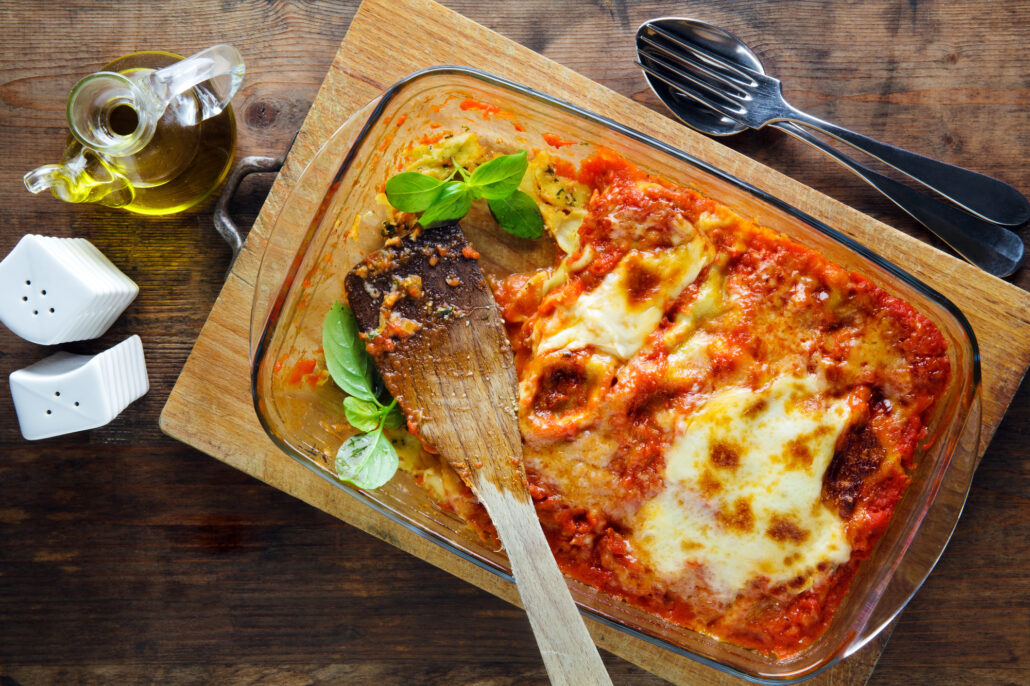
Bake. Cover loosely with foil and bake for 30 minutes. Remove the foil and bake for a further 20 to 25 minutes until the top is deep golden brown and bubbling at the edges. The top should have dark spots — this is correct and good. Remove from the oven and rest for 20 minutes before cutting. This rest is not optional. The lasagne needs time to set or it will fall apart when served.
What Bologna Taught Us About Patience
The thing that traveling in Emilia-Romagna teaches you about Italian food is that time is an ingredient. The ragù that cooks for three hours is not the same dish as the ragù that cooks for forty-five minutes with the same ingredients. The pasta that rests for thirty minutes before rolling is not the same pasta as the pasta that goes straight from the bowl to the pin. The lasagne that rests for twenty minutes before serving is not the same dish as the lasagne cut straight from the oven.
Italians in Bologna are not patient people in general — they drive aggressively, they talk over each other, they eat quickly by the standards of the rest of Italy. But they are patient with food in the specific way that people are patient with things they consider sacred. The ragù gets its three hours. The lasagne gets its rest. The result justifies the wait every time.
For everything you need to plan a trip to Bologna and Emilia-Romagna see our complete Italy itinerary. For more Italian recipes from our travels see our Authentic Italian Red Sauce and our Homemade Lasagna with Fresh Pasta.