Bacalhau — salt cod — is Portugal’s most important ingredient. Not its most popular, not its most celebrated, but its most important in the sense that no other single ingredient defines Portuguese cuisine as completely or as continuously. Portugal has been eating bacalhau since the 15th century, when Portuguese fishing fleets began making the journey to the Grand Banks off Newfoundland and preserving their catch in salt for the long voyage home. The preservation technique that made bacalhau practical for long-distance maritime trade also transformed it into a culinary obsession that has lasted six hundred years.
The Portuguese say there are 365 recipes for bacalhau — one for every day of the year. Food historians suggest the real number is closer to a thousand. Both figures make the same point: bacalhau is not a dish. It is a category of cooking, as fundamental to Portuguese cuisine as pasta is to Italian or rice is to Japanese.
The History of Salt Cod in Portugal
Portugal’s relationship with bacalhau begins with the Age of Discovery. Portuguese navigators in the 15th century were the first Europeans to fish the Grand Banks systematically, bringing back enormous quantities of Atlantic cod that needed to be preserved for the return journey. Salt cod — dried and salted until the moisture content drops below 50 percent — could survive months at sea without refrigeration and arrive in Lisbon still edible. It was this preservation method, as much as the navigation, that made long-distance maritime trade possible.
The salt cod that returned to Portugal was cheaper than fresh fish, available year-round, and could be stored indefinitely. It became the protein of the poor, the provision of the church for meatless Fridays, and eventually — through the particular alchemy that transforms peasant food into national cuisine — the most beloved ingredient in the Portuguese kitchen regardless of social class.
During the Salazar dictatorship of the 20th century, bacalhau was promoted as a symbol of Portuguese national identity — affordable, nourishing, and distinctly Portuguese in a way that connected the country to its maritime heritage. The political use of bacalhau as national symbol has faded but the culinary attachment has not. Portugal today imports most of its bacalhau from Norway — the Portuguese fishing fleets on the Grand Banks having largely disappeared — but the cultural significance is unchanged.
Understanding Bacalhau Before You Cook It
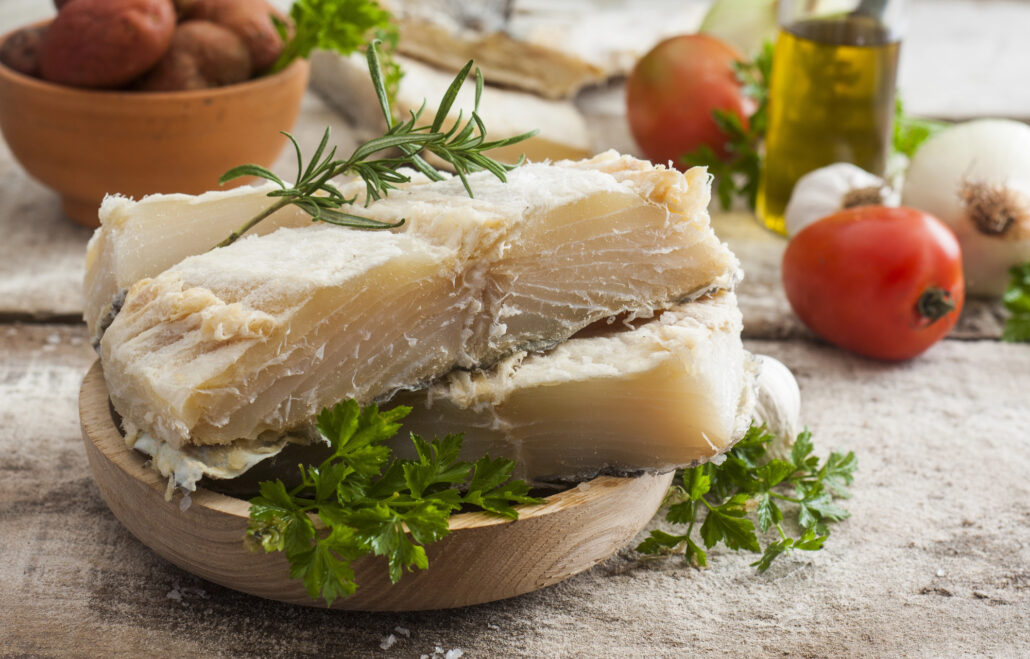
The bacalhau sold in Portuguese markets is not fresh cod. It is cod that has been salted and dried until rigid — pale yellow, rock-hard, intensely salty, and completely shelf-stable. Before cooking it must be desalted through a process of soaking in cold water, changed regularly, over 24 to 48 hours. The desalting time depends on the thickness of the fish. Thin pieces require 24 hours with water changed three times. Thick pieces require 48 hours with water changed four to five times. Under-desalted bacalhau is inedibly salty. Properly desalted bacalhau has a mild, pleasant salinity and a texture that no fresh cod dish can replicate.
In Portugal, bacalhau is sold in most grocery stores and fish markets in its dried salt-preserved form. Outside Portugal it can be found at Portuguese, Brazilian, Spanish, and West Indian specialty food stores, and increasingly at good fish counters and online. Do not substitute fresh or frozen cod — the texture, flavor, and cooking behavior of bacalhau are specific to the salt-drying process and cannot be replicated with fresh fish.
Bacalhau à Brás — The Most Popular Version
Among Portugal’s many bacalhau preparations, Bacalhau à Brás is the most widely eaten and most immediately accessible to first-time bacalhau cooks. It was created in Lisbon in the 19th century — named for the Alfama neighborhood tavern keeper who invented it — and has spread throughout Portugal and the Portuguese diaspora as the default bacalhau preparation for everyday cooking.
The dish combines shredded desalted bacalhau with thin fried potato matchsticks, eggs scrambled softly through the mixture, black olives, and fresh parsley. It is a one-pan preparation that takes about 30 minutes once the bacalhau has been desalted and shredded. It is the bacalhau recipe most likely to convert someone who claims not to like salt cod, because the potato and egg soften the bacalhau’s assertive flavor and the whole combination is more approachable than preparations that present the fish more directly.
The Recipe: Bacalhau à Brás
Ingredients (serves 4)
- 500g (about 1 lb) dried salt bacalhau, desalted (see below), shredded into flakes
- 500g (about 1 lb) potatoes, peeled and cut into very thin matchsticks
- 1 large onion, thinly sliced
- 4 cloves garlic, minced
- 6 eggs, lightly beaten
- 4 tablespoons good quality olive oil
- Vegetable oil for frying the potatoes
- Salt and white pepper
- Fresh flat-leaf parsley, roughly chopped
- Black olives (Azeitona preta or Kalamata), for serving
How to Desalt the Bacalhau
Place the bacalhau pieces in a large bowl. Cover completely with cold water. Refrigerate. Change the water every 8 hours. Thin pieces (under 2 cm) need 24 hours and 3 water changes. Thick pieces need 48 hours and 5 water changes. After desalting, taste a small piece — it should taste pleasantly mild and slightly salty, not aggressively so. If still too salty, continue soaking with more water changes. Once desalted, remove any skin and bones and shred the fish into irregular flakes with your fingers.
Instructions
Fry the potatoes. Heat vegetable oil to 350°F in a deep pan. Fry the potato matchsticks in batches until golden and crisp, about 3 to 4 minutes per batch. Drain on paper towels and salt lightly. Set aside. Do not make them too far in advance or they will soften.
Cook the aromatics. Heat the olive oil in a large wide pan over medium heat. Add the sliced onion and cook until softened and translucent, about 8 minutes. Add the garlic and cook for 2 minutes more. Add the shredded bacalhau and stir to combine, cooking for 3 to 4 minutes until warmed through and beginning to take on some color at the edges.
Add the potatoes. Add the fried potato matchsticks to the pan and toss gently to combine with the bacalhau and onion. The potatoes will begin to soften slightly in the pan — this is correct. You want them to retain some crunch but integrate with the other components.
Add the eggs. Season the beaten eggs with white pepper (do not add salt — the bacalhau provides sufficient salinity). Pour the eggs over the bacalhau and potato mixture. Reduce heat to medium-low. Stir gently and continuously until the eggs are just set but still slightly creamy — this takes about 2 minutes and the eggs should look softly scrambled throughout the mixture, not dry or rubbery. Remove from heat immediately when the eggs are just barely cooked through. The residual heat will finish them.
Serve. Transfer to a warm serving dish or serve directly from the pan. Scatter fresh parsley generously over the top. Arrange black olives around the dish. Serve immediately. Bacalhau à Brás does not improve with sitting — it should be eaten as soon as the eggs are set.
Other Essential Bacalhau Preparations
Bacalhau com Natas — bacalhau baked with cream, potato, and onion — is the richest and most indulgent of the classic preparations, served at special occasions and weekend lunches throughout Portugal. The cream is cooked down with the bacalhau until thick, layered with potato, and baked until golden.
Bacalhau à Lagareiro — bacalhau roasted in the oven with olive oil and garlic, served with roasted potatoes smashed and re-fried in olive oil — is the preparation most associated with the Beira Litoral region of central Portugal and produces the most direct and unadulterated bacalhau flavor of any preparation.
Bacalhau à Gomes de Sá — layered bacalhau, potato, onion, hard-boiled egg, olives, and olive oil, baked together — is Porto’s version and the one most often served in northern Portuguese restaurants. It is named for a 19th-century Porto merchant who supposedly created it.
Eating Bacalhau in Portugal
Traveling in Portugal without eating bacalhau is like traveling in Italy without eating pasta — technically possible and completely contrary to the point. In Lisbon the tascas and tascóis of the Alfama and Mouraria neighborhoods serve bacalhau preparations that have not changed in decades. In Porto the bacalhoeiros — specialty salt cod shops — sell every conceivable cut and curing style of bacalhau alongside cookbooks explaining what to do with each one. In the Alentejo region bacalhau appears in preparations influenced by the region’s olive oil and coriander traditions that differ from the Lisbon and Porto versions in instructive ways.
The best way to understand bacalhau’s central place in Portuguese culture is to eat it multiple times in multiple preparations during a single trip. The range across a thousand recipes is genuinely wide — from the rustic simplicity of bacalhau assado to the baroque richness of bacalhau com natas — and each preparation reveals a different facet of what salt cod can be when a cuisine has been working with it for six centuries.
For everything you need to plan a Portugal trip see our complete Portugal itinerary. For more Portuguese food culture see our Port wine guide and our guide to Lisbon vs Porto.

Ingredients
Method
- Preheat the oven to 400°F.
- In a large pot, bring water to a boil and add the soaked salt cod. Reduce the heat to a simmer and cook for 10-15 minutes, or until the cod is tender. Remove the cod from the pot and set aside to cool.
- In a separate pot, bring water to a boil and add the sliced potatoes. Cook for 5-7 minutes, or until tender. Drain the potatoes and set aside.
- Once the cod has cooled, remove the skin and bones and shred the meat into small pieces.
- In a large mixing bowl, combine the shredded cod, cooked potatoes, beaten eggs, chopped onion, bell pepper, minced garlic, and parsley. Mix well.
- Heat the olive oil in a large skillet over medium heat. Add the cod mixture to the skillet and press it down into an even layer. Cook for 5-7 minutes, or until the bottom is golden brown.
- Transfer the skillet to the preheated oven and bake for 15-20 minutes, or until the top is golden brown.
- Serve the bacalhau à Brás hot, with a sprinkle of parsley on top and a side of vegetables or a salad. Enjoy!