Three days in Rome is enough time to see its greatest landmarks, eat extraordinarily well, and begin to understand why this city has been pulling people in for two and a half millennia. It is not enough time to see everything — but nothing is.
The key to a good 3-day Rome itinerary isn’t cramming in as many stops as possible. It’s grouping attractions by geography, building in real meal time, and being honest about the fact that standing in front of the Pantheon for twenty minutes is worth more than rushing through six neighborhoods in a day to say you covered them.
This itinerary is built for first-time visitors to Rome. It covers the Colosseum and Roman Forum, Vatican City, the historic center (Pantheon, Piazza Navona, Campo de’ Fiori), Trastevere, and the best meals you can find in each area — all organized to minimize backtracking and maximize time on the ground.
👉 Planning to visit more of Italy? See our full Italy travel guide, our 7 days in Italy itinerary, and our guide to how many days to spend in Rome if you’re still figuring out your overall schedule.
Before You Go: Essential Logistics
Rome has some of the most visited attractions in the world, and several of them require advance booking. Do not arrive in Rome expecting to figure it out on the day — especially between April and October. The Colosseum, Vatican Museums, and Borghese Gallery all sell out or have hours-long queues without reservations.
Book these before you leave home:
- Colosseum + Roman Forum + Palatine Hill — Combined ticket available on the official coopculture.it website. Timed entry for the Colosseum is required. Book at minimum two weeks in advance; a month or more during peak season.
- Vatican Museums + Sistine Chapel — Book through the official Vatican Museums website (museivaticani.va). This is the highest-traffic museum complex in Europe. Book as far in advance as possible.
- Borghese Gallery — Strictly enforced two-hour timed entry slots with a hard capacity limit. This one often sells out weeks in advance. Book immediately if it’s on your list.
- St. Peter’s Basilica — Free entry but a dome climb ticket can be purchased on-site. No advance booking required for the main basilica, but expect a queue.
On the food side: Rome’s better restaurants fill up on weekends. If you have specific places in mind, book ahead. Neighborhoods near the Pantheon and Campo de’ Fiori can be surprisingly hit-or-miss quality-wise despite the foot traffic — more on that in the food section below.
Day 1: Ancient Rome — Colosseum, Roman Forum, and Palatine Hill
Spend your first day entirely in the ancient city. The Colosseum, Roman Forum, and Palatine Hill are covered by a single combined ticket and are all within walking distance of each other. Grouping them into one day is efficient and also gives the day a coherent theme — you’re spending it in a world that no longer exists above ground, which deserves full attention.
Morning: The Colosseum
Arrive for your timed-entry slot as early as the Colosseum allows — ideally 9am. The Colosseum is an amphitheater that seated roughly 50,000 to 80,000 spectators and hosted gladiatorial combat, public spectacles, and animal hunts for nearly five centuries. Despite centuries of stone quarrying and earthquake damage, what remains is still one of the most impressive structures in the ancient world.
The standard entry covers the arena floor and the first and second levels. Upper tiers and underground arena access (the hypogeum, where gladiators and animals were held before entering the arena) require separate, more expensive tickets. If those interest you, book them in advance — they’re worth it for history enthusiasts.
Budget 90 minutes to two hours inside the Colosseum. The audio guide (available via the official app or rental) fills in context that would otherwise be lost without a guide.
Late Morning: The Roman Forum and Palatine Hill
The Roman Forum sits immediately adjacent to the Colosseum — your combined ticket covers entry. The Forum was the civic, commercial, and political heart of ancient Rome for nearly a thousand years. What remains today is a field of columns, arches, and foundations that requires some imagination and context to appreciate fully.
Key landmarks within the Forum include the Temple of Saturn, the Arch of Septimius Severus, the Temple of Vesta, the Basilica of Maxentius, and the Arch of Titus (commemorating the Roman destruction of Jerusalem in 70 CE). Allow 60 to 90 minutes.
Palatine Hill rises directly above the Forum and is included in the same ticket. According to Roman tradition, this is where Romulus founded Rome. By the imperial period, the hill was covered in palaces. The views from the top over the Forum and toward the Circus Maximus are among the best vantage points in the city. Allow another 45 minutes to an hour here.
Afternoon: Circus Maximus and the Aventine
After lunch near the Colosseum (see food section below), walk the short distance to the Circus Maximus — the ancient chariot-racing track that once held up to 250,000 spectators. There’s not much to see structurally today, but the scale of the space is still striking.
From Circus Maximus, walk up the Aventine Hill. This quiet, residential neighborhood has two specific highlights: the Giardino degli Aranci (Orange Garden), which has panoramic views toward St. Peter’s; and the Knights of Malta Keyhole — a small brass keyhole in a green door on the Piazza dei Cavalieri di Malta through which you can see a perfectly framed view of St. Peter’s dome at the end of a garden corridor. It’s one of Rome’s best minor moments and costs nothing.
Evening: Trastevere
From the Aventine, it’s a short walk or taxi to Trastevere for dinner. This neighborhood — the name means “across the Tiber” — is Rome’s most charming at night. The streets are narrow, the lighting is warm, and the trattorias here tend to be more genuine than those near the tourist center. Dinner in Trastevere is one of the better experiences Rome offers a first-time visitor.
👉 For specific restaurant recommendations across Rome’s neighborhoods, see our what to eat in Rome guide.
Day 2: Vatican City and Castel Sant’Angelo
Dedicate Day 2 entirely to Vatican City. The Vatican Museums, Sistine Chapel, and St. Peter’s Basilica are collectively the most visited site in Rome and require both advance booking and significant time. Don’t try to combine Vatican day with other major attractions — you won’t do any of them justice.
Morning: Vatican Museums and the Sistine Chapel
Arrive at your reserved time slot — earlier is better. The Vatican Museums constitute one of the most extraordinary art collections in the world, assembled over five centuries by the Catholic Church. The complex contains multiple distinct museums, galleries, and courtyards; the total walking distance, if you visited everything, would be around seven kilometers.
For a first visit, the essential route moves through the Gallery of Maps, the Raphael Rooms (the Stanza della Segnatura, which contains the School of Athens, is the highlight), and ends in the Sistine Chapel. Michelangelo painted the Sistine Chapel ceiling between 1508 and 1512; The Last Judgment on the altar wall was completed nearly three decades later in 1541. Both are more complex and more detailed in person than any reproduction suggests.
Budget three to four hours for the Vatican Museums and Sistine Chapel. More if you have a deep interest in art history; less if you prefer to move quickly. Photography is technically not permitted in the Sistine Chapel, though enforcement is inconsistent.
Late Morning/Early Afternoon: St. Peter’s Basilica
From the Sistine Chapel, there’s a direct exit into St. Peter’s Basilica — use it, as going back through the main entrance involves rejoining the public queue. St. Peter’s is the largest church in the world by interior volume, and it is genuinely overwhelming in scale. Key works inside include Michelangelo’s Pietà (behind glass near the entrance), Bernini’s Baldachin over the papal altar, and the tomb of St. Peter beneath the high altar.
Climbing the dome is optional but worthwhile for the views over Rome and the Vatican gardens. There are two options: taking an elevator to the base of the drum and then walking approximately 320 steps to the top of the lantern, or walking the full 551 steps from ground level. The staircase inside the dome curves along the interior curve of the structure, which is a memorable experience. Allow 30 to 45 minutes for the dome climb.
Afternoon: Castel Sant’Angelo and the Prati Neighborhood
After lunch in the Prati neighborhood (the area immediately north of the Vatican is full of decent mid-range restaurants, better than anything near the Vatican gates themselves), walk along the Lungotevere to Castel Sant’Angelo.
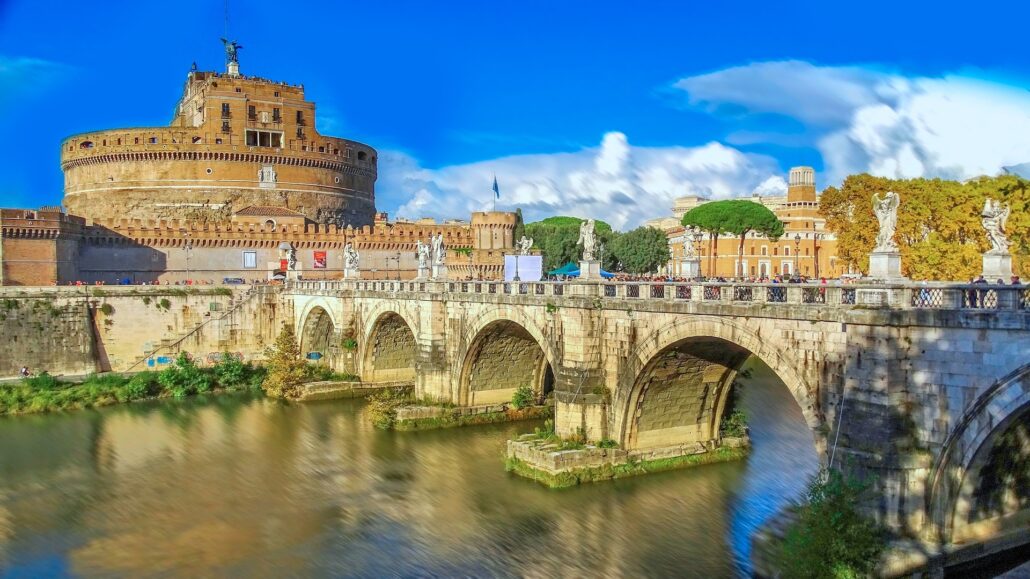
Originally built as a mausoleum for the Emperor Hadrian in the 2nd century CE, Castel Sant’Angelo was later converted into a medieval fortress and served as a papal refuge during sieges. The castle is connected to the Vatican by the Passetto di Borgo, an elevated corridor built into the city walls, which popes used to escape in times of danger. The views from the top ramparts over the Tiber and toward the city center are excellent. Allow 60 to 90 minutes.
Evening: Prati or Back to Trastevere
Prati is a comfortable evening neighborhood — upscale, residential, and notably less crowded than the tourist center. Alternatively, make your way back across the river toward the Campo de’ Fiori for evening aperitivo before dinner. The Piazza Farnese, just steps from Campo de’ Fiori, is one of Rome’s quieter great squares and worth lingering in after the Campo’s market crowd disperses.
Day 3: Historic Center, Trastevere, and the Borghese Gallery
Day 3 covers the historic center — the Pantheon, Piazza Navona, the Trevi Fountain, Campo de’ Fiori — and, time permitting, the Borghese Gallery in the Villa Borghese park. This is the most geographically concentrated day of the three, which makes it the easiest day logistically.
Morning: The Pantheon and Piazza della Rotonda
The Pantheon is the best-preserved ancient building in Rome. Built around 125 CE during the reign of Hadrian, it served first as a Roman temple and has functioned as a Christian church since 609 CE. The unreinforced concrete dome — still the largest of its kind in the world — has a 9-meter oculus at its apex that is the building’s only light source. On a clear day, a column of sunlight moves across the interior as the hours pass.
The Pantheon now requires an advance reservation (a change implemented in recent years). Tickets are inexpensive but must be purchased in advance through the official website. Arrive at your time slot, allow 30 to 45 minutes inside, and then spend time in the surrounding Piazza della Rotonda, which is one of the livelier squares in the city even in the morning hours.
Mid-Morning: Piazza Navona and Campo de’ Fiori
Walk west from the Pantheon to Piazza Navona, built over the ancient Stadium of Domitian. The piazza is elongated in the shape of the original track and contains three fountains, most importantly Bernini’s Fountain of the Four Rivers at its center. The piazza is perpetually busy but still beautiful — come in the morning for fewer crowds and better photographs.
Continue south to Campo de’ Fiori, a working market square in the mornings and a bar scene in the evenings. The market (held Monday through Saturday until roughly 2pm) sells produce, flowers, spices, and tourist goods. It’s a useful place to pick up supplies and to see a Rome that isn’t entirely organized around visitor experience.
Afternoon: Trevi Fountain and the Spanish Steps
After lunch, walk northeast to the Trevi Fountain. This is Rome’s most famous fountain — a Baroque theatrical composition by Nicola Salvi completed in 1762, built against the back wall of the Palazzo Poli as if it were a stage set emerging from the palace facade. The scale is impressive; the crowds are also significant. The best strategy is to go in the early morning or late evening for photographs. Midday is reliably packed.
From the Trevi, it’s a short walk north to the Spanish Steps — the 135-step staircase connecting the Piazza di Spagna below to the Trinità dei Monti church above. The area at the base of the steps (and the steps themselves) is very busy and quite touristy, but the views from the top are good and the surrounding streets contain some of Rome’s best high-end shopping.
Late Afternoon: Borghese Gallery (If Booked)
The Villa Borghese park is directly accessible from the top of the Spanish Steps. If you’ve booked a slot at the Borghese Gallery, the walk through the park to the museum takes about 20 minutes. The Borghese houses one of the finest private art collections in the world, assembled by Cardinal Scipione Borghese in the early 17th century. Its Bernini sculptures — Apollo and Daphne, The Rape of Proserpina, David — are widely considered the greatest Baroque sculpture in existence. Canova’s reclining portrait of Pauline Bonaparte Borghese and a significant Caravaggio collection round out a collection that would be extraordinary by any standard.
The two-hour slot moves quickly; the museum is small and the collection is concentrated. This is genuinely one of the best museums in the world and is worth the advance booking effort.
Evening: Dinner in the Center
End your three days in Rome with dinner in the historic center or Trastevere. The neighborhood around the Pantheon and Piazza Navona has many tourist-facing restaurants of variable quality — use the recommendations in our food guide rather than walking into whichever place looks busy. Some of Rome’s better osterie are in this area, they’re simply less visible from the street.
👉 For full neighborhood-by-neighborhood coverage of where to eat, see our Rome food guide. For accommodation across all budget levels, see our where to stay in Rome guide.
Where to Eat: Best Neighborhoods by Day
Rome’s culinary geography matters as much as its artistic geography. The neighborhoods immediately surrounding the major tourist attractions are, with exceptions, full of mediocre restaurants charging premium prices. The better eating is usually a few streets back from the main draws.
Near the Colosseum — The streets immediately adjacent to the Colosseum are notoriously bad for food. Walk north toward the Monti neighborhood, which is Rome’s most livable and food-forward district. Monti has excellent trattorias, wine bars, and delis within about ten minutes’ walk of the Forum.
Near the Vatican — Prati, as noted above, is your best option. It’s a proper Roman neighborhood with good mid-range restaurants and excellent pizza al taglio (by the slice). Avoid the restaurants directly on the streets leading to St. Peter’s Square.
Historic Center — The streets between Campo de’ Fiori and the Jewish Ghetto have some of the best cacio e pepe and carbonara in Rome. The Jewish Ghetto itself has Rome’s fried artichoke tradition (carciofi alla giudia) — this is not a dish to miss. Trastevere remains one of the most reliable dinner neighborhoods in the city.
Roman dishes to order: Cacio e pepe (pasta with pecorino and black pepper), carbonara (with guanciale, egg, and pecorino — never cream), amatriciana (tomato, guanciale, pecorino), supplì (fried rice balls with mozzarella), carciofi alla giudia (Jewish-style fried artichokes), and saltimbocca alla romana (veal with prosciutto and sage).
Where to Stay in Rome
Rome is a large city and neighborhood matters for a three-day itinerary. The historic center (around the Pantheon and Piazza Navona) and Trastevere put you in walking distance of most Day 3 and evening activities. The Monti neighborhood — between the Colosseum and Termini station — is excellent for Day 1 and is more local-feeling than the tourist center. Prati, across the river near the Vatican, is convenient for Day 2 but adds some walking or transit to Days 1 and 3.
👉 See our full where to stay in Rome guide for hotel recommendations across all budget levels by neighborhood.
Getting Around Rome
Rome is a walkable city in its historic core. The Colosseum, Forum, Circus Maximus, and Aventine are all on foot from each other. The historic center — Pantheon, Piazza Navona, Campo de’ Fiori, Trevi — is a tight cluster that requires no transit. Trastevere is a short walk or taxi from both the Colosseum and the historic center.
The Vatican is further from the main historic center — it’s across the Tiber, about 2.5 kilometers from the Pantheon. Walking is possible in good weather (about 30 minutes), but taxis and the 40/64 bus lines are faster and practical. The metro (Line A) connects Termini to the Ottaviano station near the Vatican, which is useful from the Monti or Termini areas.
Taxis in Rome are metered and regulated. Ride apps including FREE NOW and Uber (with regular Uber drivers, not UberX) operate in the city. Avoid unmarked or non-metered cabs.
What to Skip on 3 Days
A 3-day Rome itinerary requires prioritization. The following are worth knowing about but not worth displacing any of the core Day 1–3 activities on a first visit:
The Catacombs — Fascinating historically, but they’re located outside the city on the Appian Way. Getting there takes time, and the guided-only format limits how much you can explore. Better suited for a return trip or a longer Rome stay.
Piazza del Popolo and the Pincian Hill — Beautiful, but geographically separate from the rest of this itinerary. The views from the Pincian Hill terrace are very good; not essential on a three-day trip.
Palazzo Altemps and Palazzo Massimo — Two exceptional national museums of antiquities that most first-time visitors never visit. Genuinely worth it for Roman sculpture enthusiasts, but there’s no room in a three-day first-timer itinerary.
EUR — Mussolini’s planned district south of Rome with Fascist-era architecture is intellectually interesting but takes significant time to reach and offers nothing a first-time visitor can’t live without.
Extending to 4 or 5 Days
If you have a fourth day in Rome, the best use of it is either the Borghese Gallery (if you haven’t gone) plus the Villa Borghese park, a day trip to the ancient port city of Ostia Antica (one of the best-preserved Roman towns in Italy, less visited than Pompeii, and accessible by metro), or a slower revisit of the neighborhoods you liked most.
Five days allows for a day trip to Naples and Pompeii — about 70 minutes by high-speed train and one of the most dramatic archaeological sites in the world. It’s a long day but very doable from Rome.
👉 Thinking about how Rome fits into a bigger Italy trip? See our how many days in Rome guide for a fuller breakdown, and our Rome vs. Florence comparison if you’re deciding how to split your time between the two cities. For logistics between the two, see our guide on how to get from Rome to Florence.
Your 3-Day Rome Itinerary at a Glance
Day 1: Colosseum → Roman Forum → Palatine Hill → Circus Maximus → Aventine Hill → Trastevere dinner
Day 2: Vatican Museums + Sistine Chapel → St. Peter’s Basilica → Castel Sant’Angelo → Prati or Campo de’ Fiori evening
Day 3: Pantheon → Piazza Navona → Campo de’ Fiori market → Lunch → Trevi Fountain → Spanish Steps → Borghese Gallery (if booked) → Dinner in center or Trastevere
Book in advance: Colosseum, Vatican Museums, Pantheon, Borghese Gallery. All four require reservations. Rome rewards the organized visitor and taxes the spontaneous one heavily.