The honest answer: three days in Florence gives you a solid trip. Four days lets you breathe. Five days means you can actually slow down, eat well, and still catch what you missed.
Florence is compact by European standards, but it is extraordinarily dense with world-class museums, Renaissance architecture, and exceptional food. The challenge isn’t finding things to do — it’s making sensible choices about what to prioritize given how much time you have.
This guide breaks down exactly what’s possible in 2, 3, 4, and 5+ days in Florence, so you can build an itinerary that matches your pace and interests rather than sprinting through highlights on a schedule designed for someone else.
👉 Planning the broader trip? See our full Florence city guide and our 7 days in Italy itinerary for context on where Florence fits into a wider Italian trip.
Quick Answer: How Many Days Do You Need?
Three days is the most commonly recommended duration for Florence, and it holds up well in practice. In three days, you can visit the Uffizi Gallery, climb the Duomo, see the Accademia (home of Michelangelo’s David), cross the Ponte Vecchio, spend an afternoon in the Oltrarno neighborhood, and still have time to eat well at least twice.
That said, “three days” doesn’t mean three identical days for every traveler. A first-timer focused on the Renaissance masterpieces will use those days very differently than someone who wants to spend half a day in a leather workshop or take a wine tour in Chianti. Read the breakdowns below and decide based on how you actually travel, not on what sounds right in a general recommendation.
Here’s the short version by trip type:
- 2 days — Possible but tight. Best for those on a multi-city Italy trip who’ve already been to Florence or have no interest in museums.
- 3 days — The sweet spot for first-timers. Covers the highlights without feeling rushed.
- 4 days — Ideal for art lovers or anyone who wants to explore neighborhoods and eat their way through the city.
- 5+ days — For slow travelers, return visitors, or those using Florence as a Tuscany base.
2 Days in Florence: The Essential Edit
Two days in Florence is a real visit, not just a layover — but it requires discipline. You won’t be able to see everything, so the key is deciding in advance what matters most and building your days around those anchors rather than trying to cover ground in every direction.
Day 1: The Historic Core
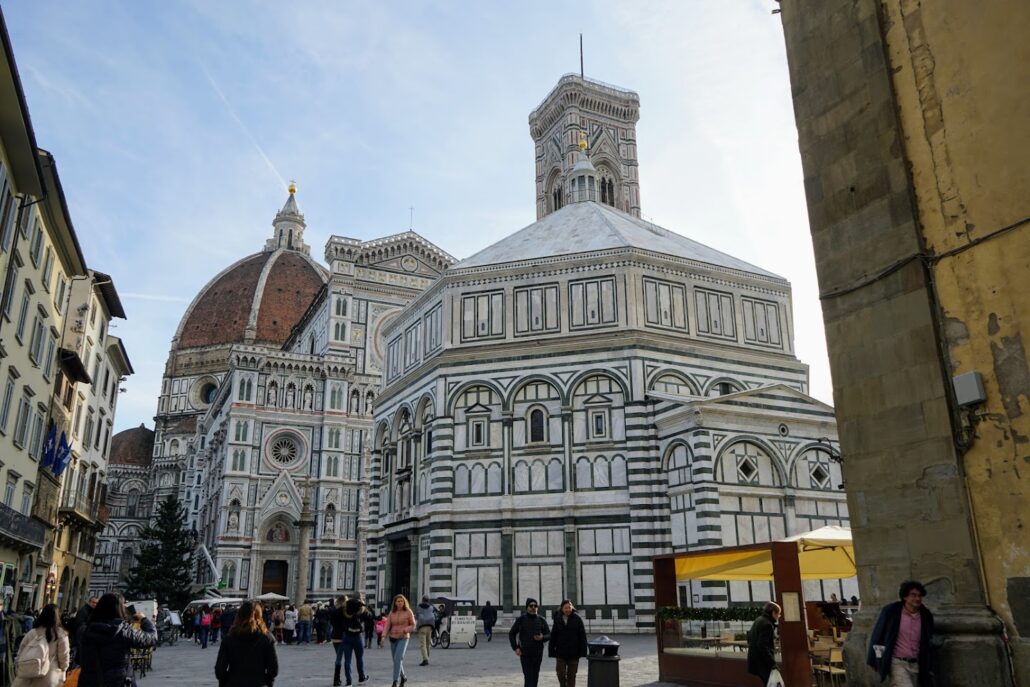
Start at the Piazza del Duomo first thing in the morning, ideally before 8:30am when tour groups begin arriving. The Cathedral of Santa Maria del Fiore — Brunelleschi’s dome, specifically — is one of the most extraordinary feats of Renaissance engineering in existence. You can visit the interior for free, but climbing the dome requires a ticket. On a two-day trip, skip the climb unless it’s a personal priority; save the time for the Uffizi.
From the Duomo, walk south through the medieval streets to the Piazza della Signoria, Florence’s civic center. The open-air sculpture gallery here — the Loggia dei Lanzi — contains original and reproduction works including Perseus with the Head of Medusa by Cellini. The Palazzo Vecchio on the square is worth a look even from outside.
Book your Uffizi Gallery tickets months in advance for an afternoon slot. This is not optional — walk-up availability at the Uffizi is essentially nonexistent during peak season, and even in shoulder season, same-day entry is unreliable. The Uffizi holds Botticelli’s Birth of Venus and Primavera, works by Leonardo, Raphael, Michelangelo, Caravaggio, and Titian. Give yourself at least two to three hours.
End Day 1 with dinner in the Oltrarno, the neighborhood across the Ponte Vecchio. It’s less touristy than the historic center and has some of the city’s better trattorias. Cross the bridge at dusk — it’s one of the better light moments in the city.
Day 2: David and Departure
The Accademia Gallery opens at 8:15am. Get there early or have pre-booked tickets. Michelangelo’s David is genuinely one of those works that exceeds its reputation in person — the scale and detail are impossible to fully appreciate in photographs. The museum is smaller than the Uffizi; budget ninety minutes to two hours.
Spend the late morning walking the San Lorenzo market area and the Mercato Centrale, Florence’s covered food market. It’s an excellent place to eat lunch (the upstairs food hall is touristy but convenient) and pick up provisions. The afternoon is best used for whatever you didn’t manage on Day 1 — wandering the Oltrarno, visiting the Boboli Gardens behind Palazzo Pitti, or simply sitting in a piazza with a coffee.
👉 See our what to eat in Florence guide for specific restaurant and market recommendations.
3 Days in Florence: The Sweet Spot
Three days is the right amount of time for most first-time visitors to Florence. It gives you access to everything essential, time for at least one longer meal or cooking experience, and a day with some genuine flexibility rather than a strict checklist.
Day 1: The Uffizi and the Duomo Quarter
Dedicate your first full day to the Uffizi and the Duomo complex. Book both in advance. Start at the Duomo at opening — if you want to climb the dome or the Campanile (Giotto’s bell tower), buy a combined cathedral complex ticket online, which covers multiple entry points. The views from the top of the dome over the terracotta rooftops of Florence are worth the 463 steps.
Lunch near the market area before heading to the Uffizi for an afternoon session. Two to three hours inside the gallery is realistic for someone seeing it properly. After, walk through the Piazza della Signoria and down to the Arno riverbank. The stretch between Ponte Vecchio and Ponte Santa Trinita at golden hour is excellent for photographs.
Day 2: Accademia, San Marco, and Oltrarno
Morning at the Accademia for David, then walk north to the Piazza San Marco. The Museo di San Marco — a former Dominican monastery filled with Fra Angelico frescoes — is one of Florence’s most underrated attractions. It’s rarely crowded, affordable, and genuinely beautiful in a way that’s quite different from the grand gallery experience of the Uffizi.
Afternoon should be spent entirely in the Oltrarno. This is the neighborhood where Florentines actually live, shop, and eat. The Piazza Santo Spirito has a relaxed, bohemian atmosphere. The Palazzo Pitti and Boboli Gardens are here as well — the Pitti houses several museums including the Palatine Gallery, which contains another exceptional collection of Renaissance paintings in a palace setting that feels more intimate than the Uffizi.
Day 3: Flexibility and Neighborhoods
Use Day 3 for whatever the first two days didn’t cover. Good options include the Bargello (Florence’s sculpture museum, housing Donatello’s David and works by Ghiberti), a walk up to Piazzale Michelangelo for panoramic views over the city, or a morning at the Santa Croce basilica — the burial site of Michelangelo, Galileo, Machiavelli, and Rossini.
A cooking class or market tour is a good way to spend a half-day on Day 3 without museum fatigue setting in. Florence has a strong culinary tradition — bistecca alla Fiorentina, ribollita, pappa al pomodoro, and lampredotto (tripe sandwich, a local street food staple) are all worth knowing about before you go.
👉 Our where to stay in Florence guide covers neighborhoods by traveler type — useful for deciding whether to base yourself in the historic center or the Oltrarno.
4 Days in Florence: The Comfortable Visit
Four days is the luxury version of a Florence trip — enough time to do everything in the three-day plan without the clock pressure, plus room for a day trip into Tuscany, a more leisurely approach to the neighborhoods, or a deeper focus on art and architecture.
What the Extra Day Gets You
The fourth day is best used for one of three things: a day trip to Siena or the Chianti wine region, a deep dive into a specific area of interest (the Bargello and its sculpture collection, the Vasari Corridor if it’s open during your visit, or the lesser-known Museo dell’Opera del Duomo which holds original sculptures from the cathedral complex), or a genuinely slow day with no agenda.
The Museo dell’Opera del Duomo is particularly recommended for visitors with any interest in Renaissance sculpture. It houses Ghiberti’s original Gates of Paradise (the famous gilded bronze doors from the Baptistery), Donatello’s Penitent Magdalene, and Michelangelo’s Bandini Pietà — a late, emotionally raw work that’s far less visited than the David. Admission is included in the combined Duomo complex ticket.
Adding a Cooking Class or Wine Experience
Florence has a strong infrastructure for food and wine experiences. A half-day market tour followed by a cooking class is a well-worn but genuinely enjoyable option — several schools operate near the Mercato Centrale and the Sant’Ambrogio market. For wine, the Chianti Classico zone begins less than 30 kilometers south of Florence, and day tours that include visits to two or three estates with lunch are easy to book.
With four days, you can do the cooking class on Day 2 or 3 without it displacing any of the major museum visits. That scheduling flexibility is the real value of the extra day.
5+ Days in Florence: For Slow Travelers
Five days or more in Florence is a specific kind of trip. It’s for people who want to spend three hours in a single room of the Uffizi. Who want to eat at the same trattoria twice. Who are interested in Florence as a place rather than Florence as an itinerary.
There’s plenty of material to fill five days — the city has over 50 museums, more Renaissance art than most countries, and an artisan culture (leatherwork, gold jewelry, bookbinding, marbled paper) that rewards slow exploration. But the honest truth is that the marginal return on days four and five is lower if you’re not a dedicated art traveler. Most of what makes Florence Florence is concentrated in a relatively small geographic area and can be covered thoroughly in three to four days.
Using Florence as a Tuscany Base
The most compelling reason to stay five or more days in Florence is if you’re treating it as a base for Tuscany. From Florence, you can reach Siena in 90 minutes by bus or train, Lucca in under 90 minutes, Pisa in an hour, the Cinque Terre in two to two and a half hours, and San Gimignano in about 90 minutes with a connection.
A five-day Florence stay that includes a full day trip to Siena and another to the Chianti region is a genuinely excellent structure for a Tuscany-focused trip. You get the city’s museums and architecture in the first three days and use the remaining two for regional exploration.
👉 Also considering Venice or Milan? See our best cities to visit in Italy guide and our full Italy destination overview for help building the bigger picture.
What to Skip on a Short Trip
Florence’s tourist infrastructure actively encourages you to do everything. Resist this. On a two- or three-day trip, the following are lower priority than the main draws:
Piazzale Michelangelo — The panoramic overlook is beautiful, but the walk up is long and the view, while undeniably good, is similar to what you get from the Duomo or the Campanile. Skip it on a short trip unless you’re going at sunset or sunrise specifically for the light.
The Vasari Corridor — This elevated passageway connecting the Palazzo Vecchio to the Palazzo Pitti is historically fascinating but has had inconsistent opening hours and restricted access for years. Worth checking current status, but don’t build a trip around it.
The Cascine Park — Florence’s large public park along the Arno is pleasant for locals but offers nothing particularly distinctive for visitors with limited time.
Every single church — Florence has a church on what feels like every corner, and many are genuinely beautiful. But on a short trip, prioritize Santa Croce and the Duomo interior. Santa Maria Novella and San Miniato al Monte are also worth knowing — but if you’re running short on time, don’t feel obligated to visit churches just because they’re there.
Booking Tips That Change Everything
Florence is one of the most visited cities in Europe, and its major attractions have limited timed-entry capacity. This is not a city where showing up and figuring it out on the day works well in spring or summer. A few non-negotiable booking practices:
Book the Uffizi at least 2–3 months in advance in high season. The museum’s official website (uffizi.it) sells timed-entry tickets directly. Third-party booking platforms also sell them with varying markup. Either way, book early. Walk-up availability disappears fast.
Book the Accademia as early as the Uffizi. The Accademia is smaller and has less physical capacity than the Uffizi. Lines without reservations are routinely over two hours in summer.
The Duomo complex requires advance booking for the dome climb. Entry to the cathedral interior is free, but climbing the dome, the Campanile, or visiting the Baptistery requires a combined ticket purchased in advance through the Opera di Santa Maria del Fiore website.
Restaurant reservations matter. Florence’s better restaurants fill up quickly, especially on weekends. If there’s a specific restaurant on your list, book it before you arrive.
Shoulder season is significantly better. April, early May, September, and October offer lower crowds, more comfortable temperatures, and shorter booking lead times than the summer peak. November through March is the quietest period and often has the best prices, though some days can be cold and wet.
Day Trips Worth Considering
Florence’s position in central Tuscany makes it an exceptional base for day trips. If you have four or more days, consider building at least one of the following into your itinerary:
Siena — Florence’s great historical rival and one of the best-preserved medieval cities in Europe. The Piazza del Campo and the Duomo di Siena are both extraordinary. Reachable by bus (SENA/FlixBus, around 90 minutes) or by car. Siena deserves a full day.
Chianti Classico — The wine region between Florence and Siena produces some of Italy’s most respected Sangiovese-based reds. Greve in Chianti is the main town; Panzano and Radda are quieter alternatives. Best done by car or organized tour, as public transport into the wine country is limited.
Lucca — A walled Renaissance city about 80 kilometers west of Florence, accessible by train in under 90 minutes. Lucca is walkable, relaxed, and notably less touristy than Florence. Renting a bicycle and cycling the top of the city walls is one of the better afternoon activities in Tuscany.
Cinque Terre — Doable as a day trip from Florence (about two hours by train to La Spezia, then local trains to the villages) but better as an overnight. On a five-day Florence trip, a day trip to Cinque Terre is worth it; on a three-day trip, the travel time is too significant a cost.
How Florence Fits Into an Italy Trip
Florence is almost always a middle stop on an Italy itinerary rather than a first or last. The classic Rome–Florence–Venice triangle remains the most popular structure for first-time visitors to Italy, and it works well logistically — the train connections between all three cities are fast and frequent.
A typical allocation on a ten-day Italy trip might look like three nights in Rome, two nights in Florence, and three nights in Venice, with travel days accounted for. That’s a pace most people find manageable without feeling like they’re living on trains.
On a two-week trip, four nights in Florence becomes feasible, which opens up the Siena day trip and more time in the Oltrarno and the lesser-visited museums. Two weeks also allows for a night or two in the Tuscan countryside between Florence and your next destination.
👉 See how to move between cities: how to get from Rome to Florence covers all transport options in detail. And if the Rome vs. Florence debate is on your mind, our Rome vs. Florence comparison breaks down how the two cities differ and which might suit you better.
For the full Florence experience — restaurants, neighborhoods, logistics, and what not to miss — the Florence city guide is the place to start.
Final Verdict
Three days in Florence is the minimum for a genuinely satisfying first visit. It gives you enough time to engage with the Uffizi, the Accademia, the Duomo complex, and the Oltrarno without feeling like you’re rushing through everything. Four days is better if you have the schedule flexibility — the extra time removes the clock pressure and opens up either a day trip or a more relaxed pace overall.
The most important thing you can do regardless of how many days you have: book your major tickets before you arrive. Florence’s top attractions operate on timed entry, and the difference between having a reservation and not having one can be two hours standing in line — two hours that could have been spent eating well or wandering a neighborhood that wasn’t on any list.