Yes — but with conditions. Climbing Brunelleschi’s dome is one of the most remarkable architectural experiences available to a visitor anywhere in Italy. The views from the top are extraordinary, the engineering is unlike anything else you will stand inside, and the physical experience of ascending through the dome’s double shell is genuinely unlike any other climb in Europe. The conditions: it requires advance booking, costs time and physical effort, and is not the right choice for every visitor on every schedule. This guide helps you decide whether it belongs on yours.
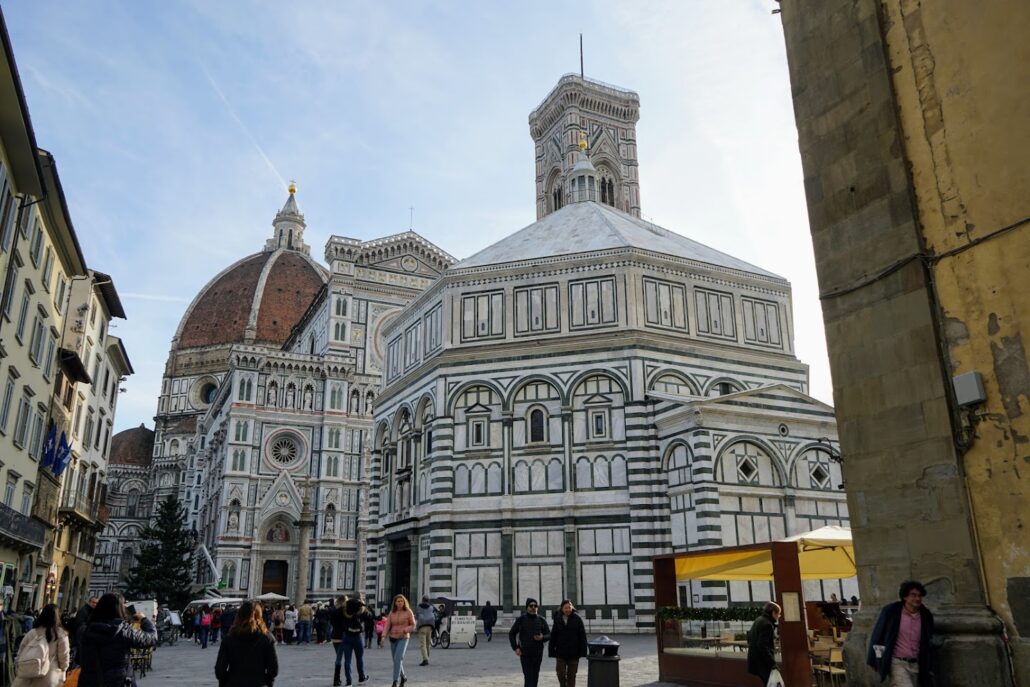
The Cathedral of Santa Maria del Fiore — the Duomo — is Florence’s defining landmark and the visual center of gravity for the entire city. Brunelleschi’s dome, completed in 1436, was the largest masonry dome ever built and remains one of the greatest engineering achievements in human history. Understanding what the climb involves, what you see from the top, and how it compares to the other viewpoints in Florence is the right framework for making the decision.
👉 Building your Florence itinerary? See our Florence city guide for full coverage, our how many days in Florence guide for planning, and our what to eat in Florence guide for the food side of the trip.
What the Climb Actually Involves
The dome climb covers 463 steps. There is no elevator, no shortcut, and no option to turn back easily once you are inside the narrow staircase between the dome’s inner and outer shells. The ascent takes approximately 30–45 minutes at a comfortable pace. The descent is faster but uses the same stairs, which become narrow enough in places that passing another person requires both parties to flatten against the wall.
The staircase is not for the severely claustrophobic. The passages through the dome’s double shell are tight, the ceiling is low in certain sections, and the sense of enclosure is pronounced. If you have moderate claustrophobia that responds to open-air environments — the top of the dome is fully open — you may find the ascent uncomfortable but manageable. If enclosed spaces trigger significant anxiety, this is a climb to skip in favor of the Campanile (see below).
There are two rest points during the ascent with small windows looking into the cathedral interior. The first gives you a view of the dome’s frescoes from below at close range — a perspective impossible to get from the cathedral floor. The second brings you to the base of the lantern, just before the final narrow staircase to the exterior viewing platform. Both rest points are worth taking. Don’t rush.
Physical fitness requirements are modest. The 463 steps are the main challenge — they are steep in sections but the pace is self-directed. Most reasonably healthy adults of any age can complete the climb. Allow more time than you think you need and stop at the viewing windows without pressure to keep moving.
What You See From the Top
The view from the dome’s exterior lantern is 360 degrees over Florence and its surrounding hills. The Arno curves through the city below. The terracotta rooftops extend in every direction. The Campanile (Giotto’s bell tower) stands adjacent and slightly below, giving a sense of the dome’s height relative to its surroundings. On a clear day, the Tuscan hills beyond the city are visible as far as Fiesole to the northeast and the beginning of the Chianti wine country to the south.
What makes the dome view specifically better than other Florence viewpoints is its position: you are standing at the highest point of the city’s historic fabric, looking down over a cityscape that has barely changed in 500 years. The Uffizi, the Palazzo Vecchio, the Baptistery, the medieval street pattern of the center — all of it visible and legible from above in a way that creates genuine spatial understanding of Florence’s layout.
The other element that makes the dome view irreplaceable: you have been inside the structure you’re now standing on. Walking through the double shell of the dome, seeing Brunelleschi’s brick herringbone pattern up close, understanding the structural logic of the ribs — these things make the exterior view significantly more meaningful than it would be if you had simply arrived at the top by escalator.
The Frescoes: What to Look For on the Way Up
The dome’s interior is covered with Giorgio Vasari’s Last Judgment fresco, completed between 1572 and 1579 after Vasari’s death by Federico Zuccari. It covers approximately 3,600 square meters — one of the largest fresco cycles in the world. From the cathedral floor, the scale is visible but the detail is not. From the first rest point on the climbing staircase, you pass at close range through sections of the fresco that reveal detail impossible to appreciate from below.
Vasari’s Last Judgment is not universally admired — Michelangelo reportedly criticized the commission and its execution, and some art historians find the fresco overwhelming rather than sublime. It is, regardless of aesthetic judgment, extraordinary in scale and the climbing route through the dome is the only way to see it properly. Bring a moment to look at the faces and figures at close range. This is a perspective most visitors to Florence never get.
Dome vs. Campanile: Which Should You Choose?
Florence’s Duomo complex offers two separate climbs: the dome (463 steps, no elevator) and the Campanile — Giotto’s bell tower adjacent to the cathedral (414 steps, no elevator). Both are included in the combined Duomo complex ticket. The question of which to prioritize, or whether to do both, is worth thinking through before you arrive.
The Case for the Dome
The dome climb is the more architecturally significant experience. You are ascending through Brunelleschi’s revolutionary double-shell structure — the engineering that made this dome possible and influenced architecture for centuries afterward. The passage through the inner shell, the close-range fresco views, and the final ascent through the lantern are all experiences specific to this structure and available nowhere else.
The view from the dome’s exterior platform is the higher of the two — at 91 meters above street level versus the Campanile’s 84 meters — and gives you the additional perspective of looking across at the Campanile from dome height, which is one of the better photographs available from the complex.
The Case for the Campanile
The Campanile’s staircase is wider and more open than the dome’s. There are viewing terraces at intermediate levels that allow you to stop, catch your breath, and look out over the city as you ascend. The climb feels less enclosed at every stage, making it significantly more comfortable for anyone with claustrophobic tendencies.
The Campanile also gives you a direct view of the dome from the outside — something you cannot get from the dome itself, which places you on top of the structure rather than across from it. Photographs of the dome’s exterior from the Campanile level are among the most distinctive Florence images available without a drone or a hilltop outside the city.
If You Only Have Time for One
Choose the dome. The architectural experience of ascending through Brunelleschi’s double shell is the more historically significant and the more unique. The Campanile is an excellent secondary climb if your schedule and energy allow, but the dome is the one to prioritize.
If You Have Time and Energy for Both
Do the dome first (when you have maximum energy), take a substantial break — coffee, lunch, a sit-down in a nearby café — and then do the Campanile in the afternoon. Both on the same day is a lot of steps; spread across a day with proper rest it is manageable for most visitors.
How to Book Duomo Climb Tickets
Climbing the dome requires an advance booking. Walk-up tickets at the Duomo are not available for the dome climb in peak season — the combined Duomo complex ticket, which includes the dome, must be purchased online in advance through the Opera di Santa Maria del Fiore official ticketing page.
The combined ticket covers: the dome climb, the Campanile, the Baptistery (exterior and interior), the Museo dell’Opera del Duomo, and the cathedral crypt (Santa Reparata). It is valid for 72 hours from first use, allowing you to spread the complex’s attractions across multiple days. The price is approximately €30 per adult. Individual attractions cannot be purchased separately — it is a combined ticket only.
Timed entry applies specifically to the dome climb and the Baptistery. When you book online, you select a specific time slot for the dome. Arrive at your booked time — late arrivals may not be accommodated, as the dome operates with a timed flow of visitors to manage the narrow staircase capacity.
How far in advance to book:
- July and August — Book 4–6 weeks in advance. Morning slots, especially on weekends, fill first.
- April, May, June, September, October — Book 2–4 weeks in advance.
- November through March — 1–2 weeks is generally sufficient.
The dome opens at 8:15am and closes at 7pm (last entry 6:20pm) on most days. The first slots of the day are the least crowded. Monday through Friday mornings are consistently better than weekends for crowd management at the top.
What Else the Combined Ticket Covers
The combined Duomo complex ticket is one of the better value museum passes in Florence, covering several distinct attractions that are each worth visiting independently.
Museo dell’Opera del Duomo
The museum behind the Duomo is one of Florence’s most underrated attractions and holds some of its finest sculpture. Ghiberti’s original Gates of Paradise — the gilded bronze doors from the Baptistery that Michelangelo reportedly said were worthy of the gates of heaven — are housed here, along with Donatello’s Penitent Magdalene (one of the most emotionally raw sculptures in Florence), the original cantorie (choir lofts) by Donatello and Luca della Robbia, and Michelangelo’s Bandini Pietà, a late work of anguished complexity that he reportedly wanted destroyed.
The museum is consistently less crowded than the Uffizi or Accademia and contains works of comparable quality. If you’re doing the dome climb, build at least 90 minutes for the Museo dell’Opera on the same visit.
The Baptistery
The Baptistery of San Giovanni — the octagonal building immediately west of the Duomo, one of the oldest in Florence — requires a timed-entry slot included in the combined ticket. The interior mosaics covering the ceiling are among the finest Byzantine-influenced works in Tuscany, covering the full dome with a Last Judgment and scenes from Genesis executed with an intensity of color and gold that the photographs don’t fully convey. The marble pavement and the interior architecture are also extraordinary. Allow 30–45 minutes.
Santa Reparata Crypt
Beneath the cathedral floor, excavations have revealed the remains of the early Christian church (Santa Reparata) that preceded the current Duomo. Brunelleschi’s tomb is here — a simple slab marking the man who built the dome that stands above. A short visit, 20–30 minutes, but meaningful if you’ve spent time thinking about the dome’s construction.
Practical Considerations
Weather — The viewing platform at the top of the dome is fully exposed. In summer, it can be very hot at midday — an early morning slot avoids both the heat and the crowds. In winter, it can be cold and windy. Dress appropriately for the conditions on the day of your visit.
Photography — Permitted throughout, including at the top. The dome’s external viewing platform has protective barriers that make photography straightforward, though wide-angle shots are limited by the barrier height. A camera with some zoom capability gets better results from the top than a standard smartphone wide-angle lens.
Children — Children over the age of around 8 can typically manage the climb without significant difficulty. Younger children should be assessed honestly — the staircase is enclosed, the steps are steep, and there is no way to bring a stroller or carry a very young child safely through the tightest sections. The Campanile is a better option for families with young children.
Dress code — The cathedral interior requires covered shoulders and knees. This applies to entry into the cathedral itself rather than the dome climb specifically, but as the combined ticket covers both, dress accordingly.
Accessibility — The dome climb is not accessible for wheelchair users or people with significant mobility limitations. The Museo dell’Opera del Duomo is accessible. Full accessibility information is available on the Opera di Santa Maria del Fiore website.
Comparing Florence’s Viewpoints
Florence has several elevated viewpoints, and placing the dome climb in context of the alternatives helps clarify its specific value.
Piazzale Michelangelo — The most popular panoramic viewpoint in Florence, located on the south side of the Arno with a wide terrace overlooking the entire city. The view is broad and includes the dome prominently. Accessible by foot (steep walk), bus, or taxi. Free. The limitation: you are looking at Florence from outside the city fabric rather than from within it. The dome view puts you above the city you’ve been walking through; Piazzale Michelangelo puts you at a scenic remove. Both are worth having; they are not the same experience.
San Miniato al Monte — The Romanesque church above Piazzale Michelangelo offers similar views from a slightly more elevated and significantly less crowded position. Worth combining with a Piazzale Michelangelo visit. Free.
The Campanile — As discussed above: a view of the dome from outside, wider stairs, more manageable for anyone with claustrophobia. Included in the combined ticket.
Palazzo Vecchio Tower — The civic tower of the Palazzo Vecchio in the Piazza della Signoria can also be climbed for views over the historic center. The perspective is different from the dome — you are in the center of the medieval city rather than above it — and the views up toward the dome from tower height are excellent. A different experience rather than a better or worse one.
The Verdict
Climbing the Duomo is worth it for almost every visitor to Florence who is physically able to do it and not significantly claustrophobic. The architectural experience of ascending through Brunelleschi’s double shell, the close-range views of Vasari’s frescoes, and the panoramic view from the top are all things that have no substitute elsewhere in the city and no equivalent elsewhere in Italy.
It is not worth it if: your Florence schedule is so compressed that three to four hours at the Duomo complex displaces a museum visit you’ve prioritized; if enclosed spaces trigger significant anxiety; or if you are traveling with very young children for whom the narrow staircase presents practical difficulties.
For everyone else — book the first morning slot available, arrive early, take your time on the staircase, and build the rest of the morning around the Museo dell’Opera del Duomo after you descend. It is one of the better half-days available to a visitor in Florence.
👉 For help fitting the Duomo climb into a broader Florence itinerary, see our how many days in Florence guide. For the full picture on Florence’s museum landscape, our Florence city guide covers everything.